Question
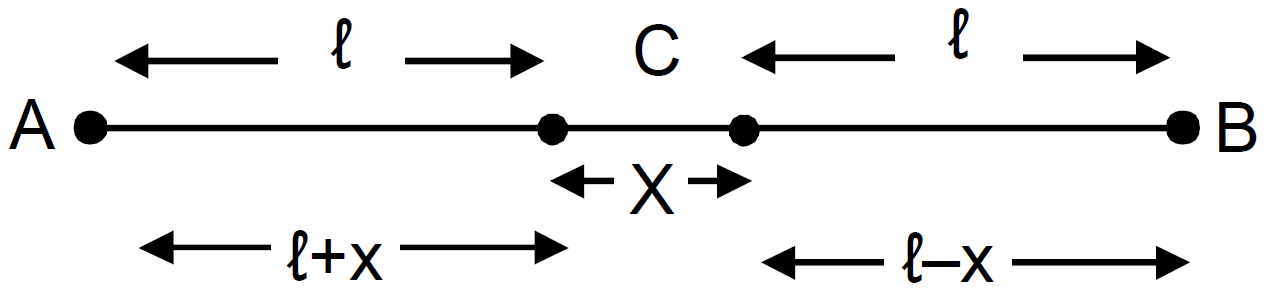
Repeat the previous problem if the particle C is displaced through a distance x along the line AB.

Answer


$\text{F}_\text{AC}=\frac{\text{KQq}}{(\ell+\text{x})^2}$
$\text{F}_\text{CA}=\frac{\text{KQq}}{(\ell-\text{x})^2}$
Net force $=\text{KQq}\Big[\frac{1}{(\ell-\text{x})^2}-\frac{1}{(\ell-\text{x})^2}\Big]$
$=\text{KQq}\bigg[\frac{(\ell+\text{x})^2-(\ell-\text{x})^2}{(\ell+\text{x})^2(\ell-\text{x})^2}\bigg]$
$=\text{KQq}\bigg[\frac{4\ell\text{x}}{(\ell^2-\text{x}^2)^2}\bigg]$
$\text{x}<<<\text{l}=\frac{\text{d}}{2}$ neglecting x w.r.t. $\ell$ We get
net $\text{F}=\frac{\text{KQq}4\ell\text{x}}{\ell^4}=\frac{\text{KQq}4\text{x}}{\ell^3}$ acceleration $=\frac{4\text{KQqx}}{\text{m}\ell^3}$
Time period $=2\pi\sqrt{\frac{\text{displacement}}{\text{acceleration}}}$
$=2\pi\sqrt{\frac{\text{xm}\ell^3}{4\text{KQqx}}}$
$=2\pi\sqrt{\frac{\text{m}\ell^3}{4\text{KQq}}}$
$=\sqrt{\frac{4\pi^2\text{m}\ell^34\pi\in_0}{4\text{Qq}}}$
$=\sqrt{\frac{4\pi^3\text{m}\ell^3\in_0}{\text{Qq}}}$
$=\sqrt{4\pi^3\text{md}^3\in_08\text{Qq}}$
$=\bigg[\frac{\pi^3\text{md}^3\in_0}{2\text{Qq}}\bigg]^{\frac{1}{2}}$

Need a full question paper?

Generate a complete, print-ready paper with questions like this in minutes — across 16+ boards, with answer keys.

Start Generating Free

Similar questions

Explain what is quantization of charge and conservation of charge?
Find the mass, the kinetic energy and the momentum of an electron moving at O.8c.
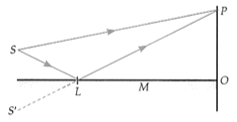
Figure shows an outline of Lloyd's mirror experiment. $M$ is a plane mirror; $S$ is a narrow slit illuminated by some source of light $($not shown$)$ and $S$' is the image of S in $M. M, S$ and $S\ '$ are in a plane perpendicular to the paper. $O$ is the line of intersection of the mirror and the screen.
$a$. What is the origin of fringes observed on the screen?
Image

$b$. Why is the slit $S$ placed so as to have very oblique angle of incidence of light striking the mirror?
$c.$ The two path lengths $PS$ and $PS\ '$ are equal when $P$ coincides with $O$. Yet the fringe at $O$ is found in the experiment to be dark not bright. What does this observation imply?
A gun of mass M fires a bullet of mass m with a horizontal speed V. The gun is fitted with a concave mirror of focal length f facing tpwards the receding bullet. Find the speed of separation of the bullet and the image just after the gun was fired.
(a) Define conduction current. Explain the necessity of displacement current and derive to formula for it.
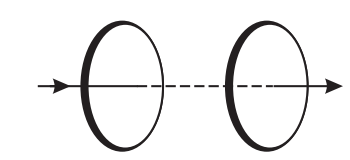
(b) In adjoining figure a capacitor is shown which is made by placing two circular plates (each of 12 cm radius) at a distance 5.0 cm apart.
Image
The capacitor is being charged by an external source which is not shown in the figure. The charging current is 0.15 A. Calculate:
(i) capacitance of the capacitor and rate of change of potential difference between its plates.
(ii) the displacement current between the plates.
(iii) Is the Kirchhoff's first law related to electric current obeyed on each plate.
$a$ . Derive an expression for the potential energy of an electric dipole in a uniform electric field. Explain conditions for stable and unstable equilibrium.
$b$ . Is the electrostatic potential necessarily zero at a point where the electric field is zero? Give an example to support your answer.
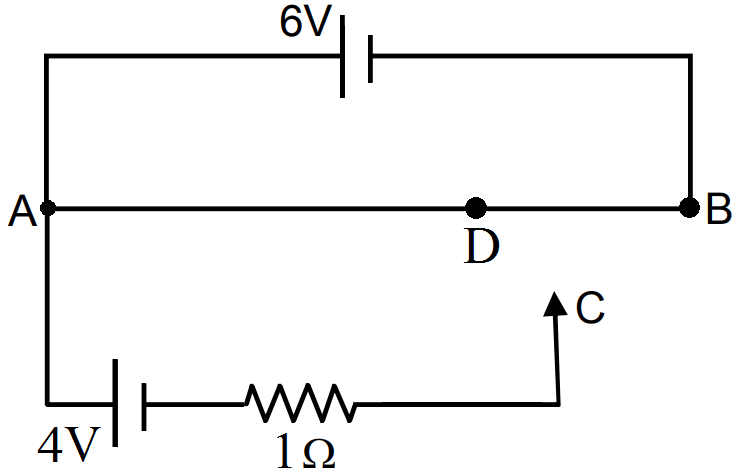
A $6$ volt battery of negligible internal resistance is connected across a uniform wire $AB$ of length $100\ cm.$ The positive terminal of another battery of emf $4V$ and internal resistance $1\Omega$ is joined to the point $A,$ as shown in the figure. Take the potential at $B$ to be zero.$ (a)$ What are the potentials at the points $A$ and $C$ ? $(b) $ At which point $D$ of the wire $AB,$ the potential is equal to the potential at $C$ ? $ (c)$ If the points $C$ and $D$ are connected by a wire, what will be the current through it? $(d)$ If the $4V$ battery is replaced by a $7.5V $ battery, what would be the answers of parts $(a)$ and $(b)$?
Find the charge required to flow through an electrolyte to liberate one atom of.
  1. A monovalent material.
  2. A divalent material.
A uniform electric field $\vec{\text{E}}=\text{E}_\text{x}\hat{\text{i}} N/ C$ for $x > 0$ and $\vec{\text{E}}=-\text{E}_\text{x}\hat{\text{i}} N/ C$ for $x < 0$ are given. $A$ right circular cylinder of length $l \ cm$ and radius $r \ cm$ has its centre at the origin and its axis along the $X-$axis. Find out the net outward flux. Using Gauss’s law, write the expression for the net charge within the cylinder.
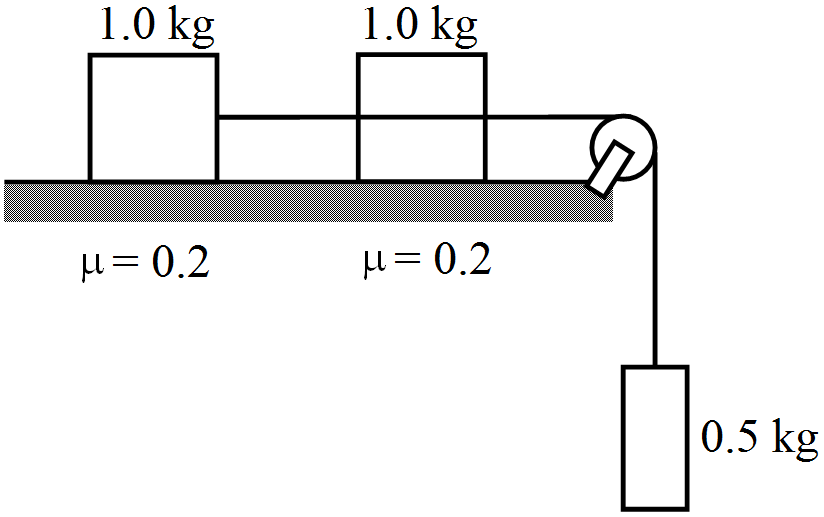
Consider the situation shown in figure. Calculate:
  1. The acceleration of the $1.0\ kg$ blocks.
  2. The tension in the string connecting the $1.0\ kg$ blocks.
  3. The tension in the string attached to $0.50\ kg.$