Question
Define root pressure. How would you demonstrate it experimentally?

Answer

Root Pressure is the pressure exerted on the liquid contents of the cortical cells of the root, under fully turgid condition, forcing a quantity of water into the xylem vessels and through them upwards into the stem up to a certain height.
Demonstration of Root pressure:
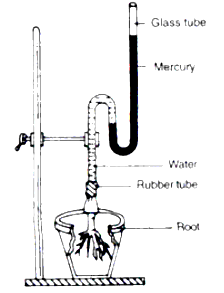
(a) Take a well matured healthy herbaceous plant.
(b) The stem of the plant is cut a few centimeters above the base with a sharp knife and attached to a manometer through a rubber tube.
(c) After a few hours, the level of mercury rises in the manometer.
(d) This is due to the pressure created by water exuded from the cut end of the plant on account of root pressure generated due to entry of water in the root cells.
Need a full question paper?

Generate a complete, print-ready paper with questions like this in minutes — across 16+ boards, with answer keys.

Start Generating Free

Similar questions

What causes acidic deposition?
Name and describe very briefly the stages in the development of human embryo.
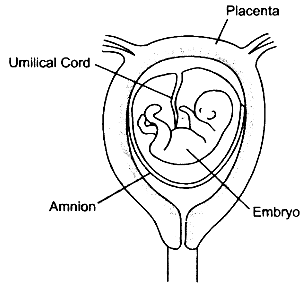
The below diagram is of a developing embryo is a mother’s womb:

(i) Write the functions of the placenta, amnion, and umbilical cord.
(ii) How are the waste products of a fetus removed?
(iii) What is the gestation period?
Differentiate between:
Red blood cells and White blood cells
List the events taking place in the photo-chemical phase of Photosynthesis.
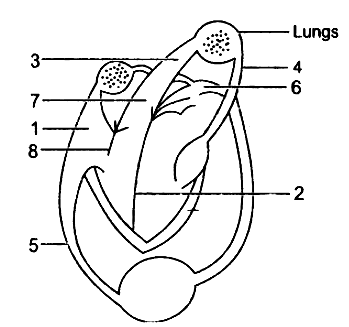
The figure below represents the internal structure of a mammalian heart and the associated blood vessels.

(i) (a) Name each of the structures labeled 1, 2, 3, 4, 5, 6, 7 and 8.
(b) State the function of each of the structures 5, 6, 7, and 8.
(ii) (a) State the function of the heart as an entire organ.
(b) Why are the walls of the left ventricle more muscular than the right?
List five plant growth hormones and briefly describe their roles.
Explain the mechanism of closing and opening of the stomata.
What is a photometer?
Complete the following by filling in the blanks numbered 1 to 10 with the appropriate word/term:
Photosynthesis involves light reaction and dark reaction. During light reaction, the chlorophyll present in the (1) ______ gets activated by absorbing light energy. This energy splits (2) ______ molecules to (3) ______ and oxygen and releases two electrons. This process is called (4) ______. The (5) ______ ions are picked up by NADP to form (6) ______. The ADP is converted to (7) ______. This process is called (8) ______. During the dark phase, the compound produced at the end of the light reaction reacts with carbon dioxide to form (9) ______. This product is converted to starch. The process is called (10) ______.