Question
  1. Define self-inductance. Write its SI units.
  2. A long solenoid with 15 turns per cm has a small loop of area 2.0 cm2 placed inside the solenoid normal to its axis. If the current carried by the solenoid changes steadily from 2.0 A to 4.0 A in 0.1 s, what is the induced emf in the loop while the current is changing?
Answer

  1. Self-inductance is the amount of magnetic flux linked with a coil when a unit current flows through it.

(Alternatively, It is the amount of emf induced in a coil when current through it changes at the rate of 1 A per second.)

S.I. Unit: henry (H)

  1. Magnetic field inside the solenoid, $B=\mu_0\text{n I}$

Induced emf in the loop, $\in=\frac{d\phi_B}{dt}$

$=A\frac{dB}{Dt}$

$=\mu_0nA\frac{dI}{dt}$

$=4\pi\times10^{-7}\times1500\times2\times10^{-4}\times\frac{(4-2)}{0.1}\text{V}$

$=7.5\times10^{-6}\text{V}$

Need a full question paper?

Generate a complete, print-ready paper with questions like this in minutes — across 16+ boards, with answer keys.

Start Generating Free

Similar questions

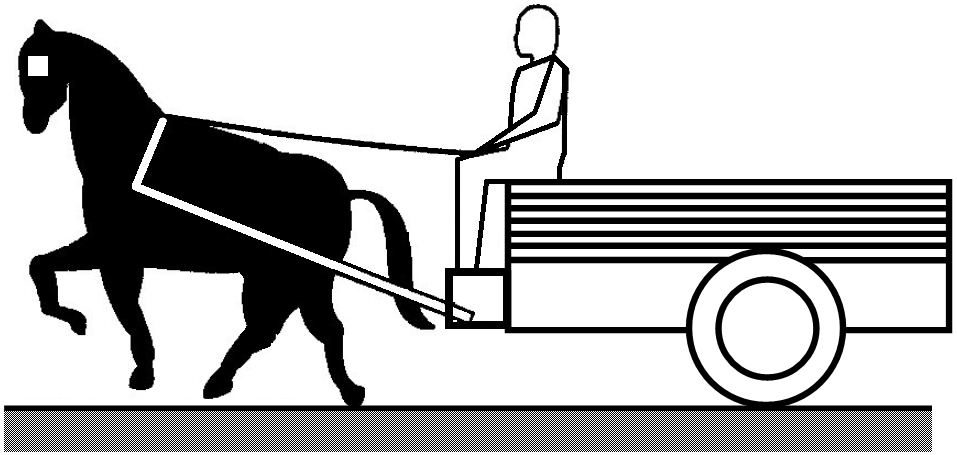
Figure shows a cart. Complete the table shown.
Define the terms (i) drift velocity, (ii) relaxation time.
A conductor of length L is connected to a dc source of emf ε. If this conductor is replaced by another conductor of same material and same area of cross-section but of length 3L, how will the drift velocity change?
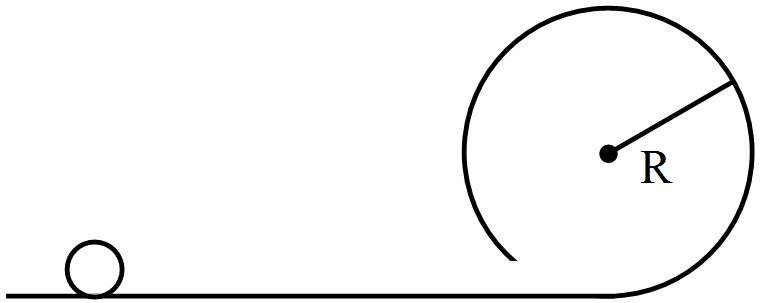
Figure shows a rough track, a portion of which is in the form of a cylinder of radius R. With what minimum linear speed should a sphere of radius r be set rolling on the horizontal part so that it completely goes round the circle on the cylindrical part.

A thin spherical shell lying on a rough horizontal surface is hit by a cue in such a way that the line of action passes through the centre of the shell. As a result, the shell starts moving with a linear speed v without any initial angular velocity. Find the linear speed of the shell after it starts pure rolling on the surface.
(a) Calculate the potential at a point P due to a charge of $4 \times 10^{-7} C$ located 9 cm away.
(b) Hence obtain the work done in bringing a charge of $2 \times 10^{-9} C$ from infinity to the point $P$. Does the answer depend on the path along which the charge is brought?
A solenoid of length 1.0m, radius 1cm and total turns 1000 wound on it, carries a current of 5A. Calculate the magnitude of the axial magnetic field inside the solenoid. If an electron was to move with a speed of 104ms–1 along the axis of this current carrying solenoid, what would be the force experienced by this electron?
Half life of $^{238}\text{U}_{92}$against$\alpha$ decay is $4.5 \times 10^{9}$years. Calculate the activity of Ig sample of$^{238}\text{U}_{92}$? Given Avogadro's number $= 6 \times 10^{26}$atoms/kmol.
How is a galvanometer converted into a voltmeter and an ammeter? Draw the relevant diagrams and find the resistance of the arrangement in each case. Take resistance of galvanometer as G.
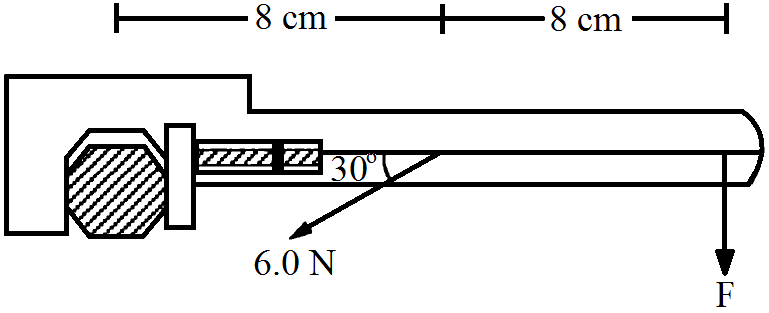
When a force of 6.0N is exerted at 30° to a wrench at a distance of 8cm from the nut, it is just able to loosen the nut. What force F would be sufficient to loosen it if it acts perpendicularly to the wrench at 16cm from the nut?

In Young’s double slit experiment, the two slits are separated by a distance of 1·5 mm and the screen is placed 1 m away from the plane of the slits. A beam of light consisting of two wavelengths 650 nm and 520 nm is used to obtain interference fringes. Find.
  1. The distance of the third bright fringe for$\lambda = 520$ nm on the screen from the central maximum.
  2. The least distance from the central maximum where the bright fringes due to both the wavelengths coincide.