Question
  1. Define solubility product. Write solubility product expression for $Zr_3(PO_4)_4$.
  2. Calculate the pH of $0.01 M CH_3COOH$ solution. $[K_a(CH_2COOH) = 1.74 \times 10^{-51}$
  3. Explain why NaCl is precipitated when HCl(g) is passed through the saturated solution of NaCl.
Answer

  1. Solubility Product: It is defined as the product of molar concentrations of the ions (formed in the saturated solution at a given temperature) raised to the power equal to the number of times each ion occurs in the equation for solubility equilibrium,
  1. $=-\log\text{C}\alpha$
    $=-\log\sqrt{\text{K}_\text{a}\times\text{C}}$
    $=-\log\sqrt{1.74\times10^{-5}\times0.01}$
    $=-\log\sqrt{1.74\times10^{-7}}$
    $=-\log\sqrt{17.4\times10^{-8}}$
    $=-\log4.17\times10^{-4}$
    $=-\log4.17-\log10^{-4}$
    $=-0.6217+4.000$
    $=3.3783$
  2. It is due to common ion, $CI^-$ increase, therefore rate of backward reaction increases, solubility of NaCl decreases.
  3. $\text{Zr}_3(\text{PO}_4)_4\rightleftharpoons3\text{Zr}^{4+}+4\text{PO}^{3-}_4$
    $\text{K}_{\text{sp}}=[\text{Zr}^{4+}][\text{PO}^{3-}_4]^4$
  4. $\text{pH}=-\log[\text{H}_3\text{O}^+]$

Need a full question paper?

Generate a complete, print-ready paper with questions like this in minutes — across 16+ boards, with answer keys.

Start Generating Free

Similar questions

What is common ion effect? Explain with examples.
The s-block elements are characterised by their larger atomic sizes, lower ionisation enthalpies, invariable $+1$ oxidation state and solubilities of their oxosalts.In the light of these features describe the nature of their oxides, halides and oxosalts.
1. Will $CCl _4$ give a white precipitate of AgCl on heating it with $AgNO _3$ ?
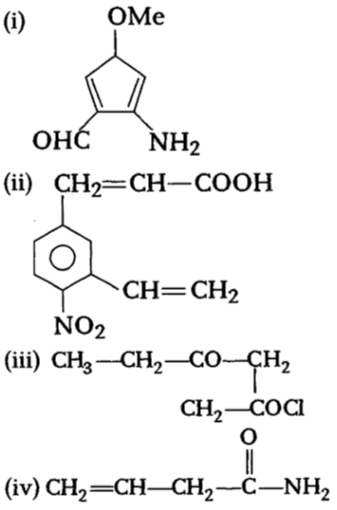
2. Identify the functional groups present in the following compounds.
Image
In any organic compound how will you analyse phosphorus and oxygen? Explain briefly.
What is the significance of the terms — ‘isolated gaseous atom’ and ‘ground state’
while defining the ionization enthalpy and electron gain enthalpy?
Hint : Requirements for comparison purposes.
On the basis of molecular orbital theory, prove that O2 molecule has two unpaired electrons, hence it is paramagnetic.
The energy of $\sigma 2 \mathrm{p}_{\mathrm{z}}$ molecular orbital is greater than $2 \mathrm{p}_{\mathrm{x}}$ and $2 \mathrm{p}_{\mathrm{y}}$ molecular orbitals in nitrogen molecule. Write the complete sequence of energy levels in the increasing order of energy in the molecule. Compare the relative stability and the magnetic behaviour of the following species:
$\mathrm{N}_2, \mathrm{~N}^{+}{ }_2, \mathrm{~N}_2^{-}, \mathrm{N}^{2+}{ }_2$
Explain the non linear shape of $H_2S$ and non planar shape of $PCl_3$ using valence shell electron pair repulsion theory.
What transition in the hydrogen spectrum would have the same wavelength as the Balmer transition $n = 4$ to $n = 2$ of $He^+$ spectrum?
Briefly describe the valence bond theory of covalent bond formation by taking an example of hydrogen. How can you interpret energy changes taking place in the formation of dihydrogen?