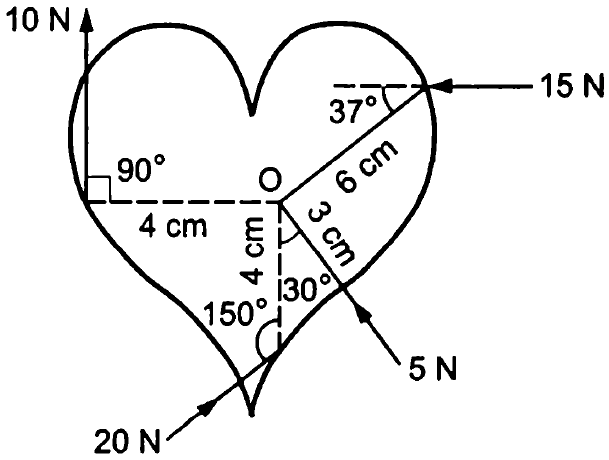
Calculate the total torque acting on the body shown in figure about the point O.
Download our app for free and get started
Torque about a point = Total force \times perpendicular distance from the point to that force.
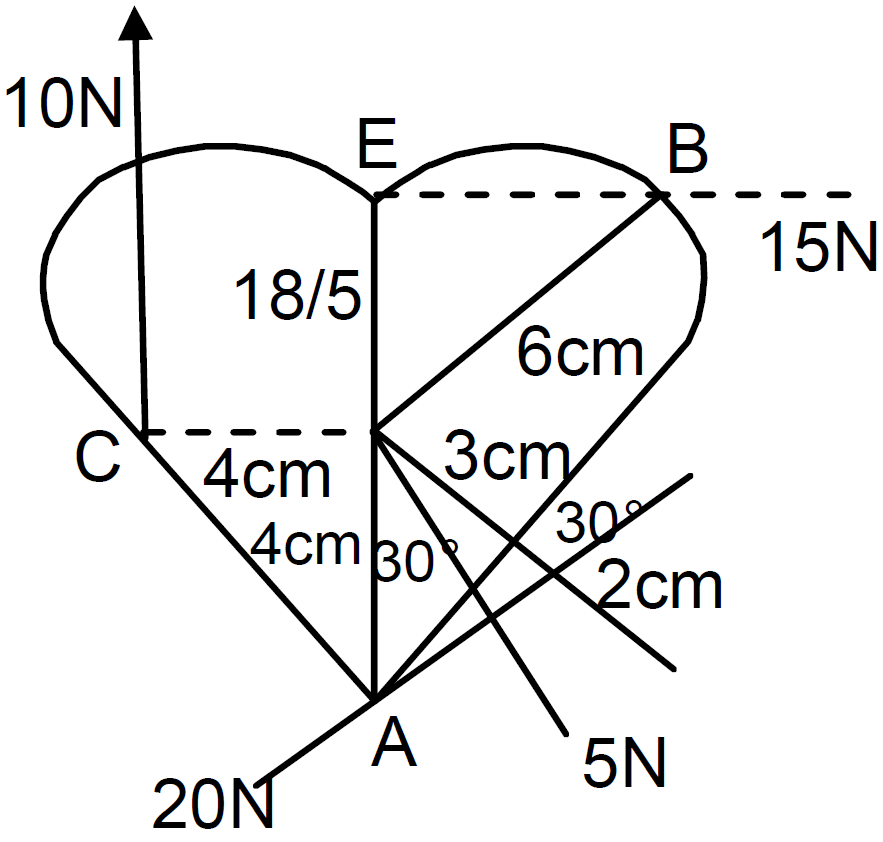
Let anticlockwise torque = +ve And clockwise acting torque = -ve Force acting at the point B is 15N Therefore torque at O due to this force $=15\times6\times10^{-2}\times\sin37^\circ$
$=15\times6\times10^{-2}\times\frac{3}{5}=0.54\text{N-m}$ (anticlock wise) Force acting at the point C is 10N Therefore, torque at O due to this force = $10 \times 4 \times 10^{-2} = 0.4N-m$ (clockwise) Force acting at the point A is 20N Therefore, Torque at O due to this force $=20\times4\times10^{-2}\times\sin30^{\circ}$
$=20\times4\times10^{-2}\times\frac{1}{2}=0.4\text{N-m}$ (anticlockwise) Therefore resultant torque acting at ‘O’ = 0.54 - 0.4 + 0.4 = 0.54N-m.
Let anticlockwise torque = +ve And clockwise acting torque = -ve Force acting at the point B is 15N Therefore torque at O due to this force $=15\times6\times10^{-2}\times\sin37^\circ$
$=15\times6\times10^{-2}\times\frac{3}{5}=0.54\text{N-m}$ (anticlock wise) Force acting at the point C is 10N Therefore, torque at O due to this force = $10 \times 4 \times 10^{-2} = 0.4N-m$ (clockwise) Force acting at the point A is 20N Therefore, Torque at O due to this force $=20\times4\times10^{-2}\times\sin30^{\circ}$
$=20\times4\times10^{-2}\times\frac{1}{2}=0.4\text{N-m}$ (anticlockwise) Therefore resultant torque acting at ‘O’ = 0.54 - 0.4 + 0.4 = 0.54N-m.

Download our appand get started for free
Experience the future of education. Simply download our apps or reach out to us for more information. Let's shape the future of learning together!No signup needed.*
Similar Questions
- 1View SolutionA metre stick is balanced on a knife edge at its centre. When two coins, each of mass 5g are put one on top of the other at the 12.0cm mark, the stick is found to be balanced at 45.0cm. What is the mass of the metre stick?
- 2Separation of Motion of a system of particles into motion of the centre of mass and motion about the centre of mass: Show $\text{L}=\text{L}'+\text{R}\times\text{MV}$ where $\text{L}'=\sum\text{r}'_\text{i}\times\text{p}'_\text{i}$ is the angular momentum of the system about the centre of mass with velocities taken relative to the centre of mass. Remember $\text{r}'_\text{i}=\text{r}_\text{i}-\text{R},$ rest of the notation is the standard notation used in the chapter.View Solution
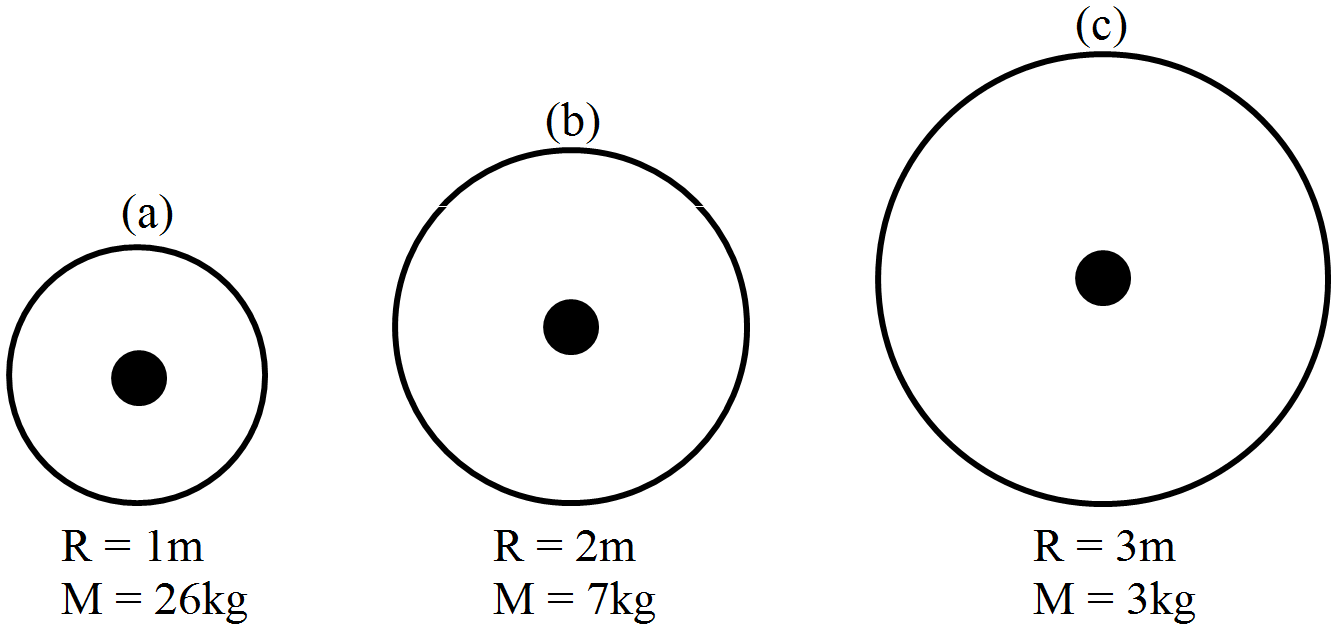
Note: $\text{L}'$ and $\text{MR}\times\text{V}$ can be said to be angular momenta, respectively, about and of the centre of mass of the system of particles. - 3View SolutionFigure shows three uniform discs, along with their radii R and masses M. Rank the discs according to their rotational inertia about their central axes, greatest first.
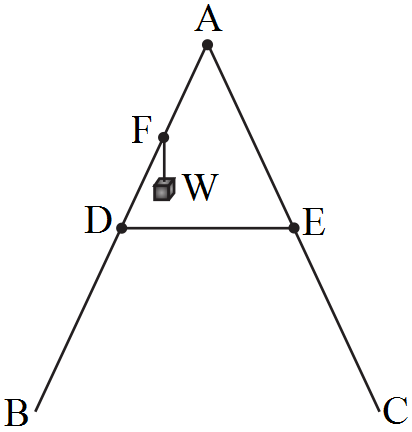
- 4As shown in the two sides of a step ladder BA and CA are 1.6m long and hinged at A. A rope DE, 0.5m is tied half way up. A weight 40kg is suspended from a point F, 1.2m from B along the ladder BA. Assuming the floor to be frictionless and neglecting the weight of the ladder, find the tension in the rope and forces exerted by the floor on the ladder. (Take $g = 9.8m/s^2$) (Hint: Consider the equilibrium of each side of the ladder separately).View Solution
- 5Prove the result that the velocity v of translation of a rolling body (like a ring, disc, cylinder or sphere) at the bottom of an inclined plane of height h given by $\text{v}^2=\frac{2\text{gh}}{\big(1+\frac{\text{K}^2}{\text{R}^2}\big)}$ using dynamical consideration. Note K is the radius of gyration of the body about its symmetry axis, and R is the radius of the body. The body starts from rest at the top of the plane.View Solution
- 6Three point masses m,, m, and m, are located at the vertices of an equilateral triangle of side length a. What is the moment of inertia about an axis along the altitude of the triangle passing through $m_1$?View Solution
- 7A comet revolves around the sun in a highly elliptical orbit having a minimum distance of $7 \times 10^{10}m$ and a maximum distance of $1.4 \times 10^{13}m$. If its speed while nearest to the Sun is $60km s^{-1}$, find its linear speed when situated farthest from the Sun.View Solution
- 8View SolutionFind the components along the x, y, z axes of the angular momentum l of a particle, whose position vector is r with components x, y, z and momentum is p with components px, py and pz. Show that if the particle moves only in the x-y plane the angular momentum has only a z-component.
- 9View SolutionDefine radius of gyration and give the physical significance of moment of inertia.
- 10Two discs of moments of inertia $I_1$ and $I_2$ about their respective axes (normal to the disc and passing through the centre), and rotating with angular speeds $\omega_1$ and $\omega_2$ are brought into contact face to face with their axes of rotation coincident.View Solution
- What is the angular speed of the two-disc system?
- Show that the kinetic energy of the combined system is less than the sum of the initial kinetic energies of the two discs. How do you account for this loss in energy? Take $\omega_1\neq\omega_2$