Question
Define surface tension.
State its formula and CGS and SI units.

Answer

Get the step-by-step solution for this question inside the Vidyadip app.

Get the answer in the app

Need a full question paper?

Generate a complete, print-ready paper with questions like this in minutes — across 16+ boards, with answer keys.
Start Generating Free

Similar questions

Obtain an expression for the half-lifetime of radioactive material. Hence state the relation between an average life and half lifetime of radioactive material.
The molar specific heat of nitrogen at constant volume is $4.952 \mathrm{cal} / \mathrm{mol} . \mathrm{K}$ and that at constant pressure is $6.933 \mathrm{cal} / \mathrm{mol} . \mathrm{K}$. Find the mechanical equivalent of heat. Take $R=8.31$ $\mathrm{J} / \mathrm{mol} . \mathrm{K}$.
Explain the construction of plane wavefront using Huygens' principle
Calculate the kinetic energy
(i) per mole
(ii) per unit mass
(iii) per molecule of nitrogen at STP. [Molar mass of nitrogen $=28 \times 10^{-3} \mathrm{~kg} / \mathrm{mol}, \mathrm{R}=8.314$
$
\left.\mathrm{J} / \mathrm{mol} . \mathrm{K}, \mathrm{K}_{\mathrm{B}}=1.38 \times 10^{-23} \mathrm{~J} / \mathrm{K}\right]
$
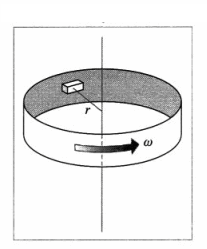
A thin cylindrical shell of inner radius 1.5 m rotates horizontally, about a vertical axis, at an angular speed ω. A wooden block rests against the inner surface and rotates with it. If the coefficient of static friction between block and surface is 0.3, how fast must the shell be rotating if the block is not to slip and fall ?

Image

Compare the rates of emission of heat by a blackbody maintained at 627°C and at 127°C, if the black bodies are surrounded by an enclosure at 27°C. What would be the ratio of their rates of loss of heat?
State the difference between a reversible process and an irreversible process.
OR
Distinguish between a reversible process and an irreversible process.
A raindrop of diameter $4 \mathrm{~mm}$ is about to fall on the ground. Calculate the pressure inside the rain drop. [Surface tension of water $\mathrm{T}=0.072 \mathrm{~N} / \mathrm{m}$, atmospheric pressure $=1.013 \times 10^5$ $\mathrm{N} / \mathrm{m}^2$ )
A toroid of narrow radius of $10\ cm$ has $1000$ turns of wire. For a magnetic field of $5 \times 10^{-2} T$ along its axis, how much current is required to be passed through the wire?
State Bernoulli's principle.