Question
Explain the construction of plane wavefront using Huygens' principle

Answer

Image
a. A plane wavefront is formed when point of observation is very far away from the primary source.
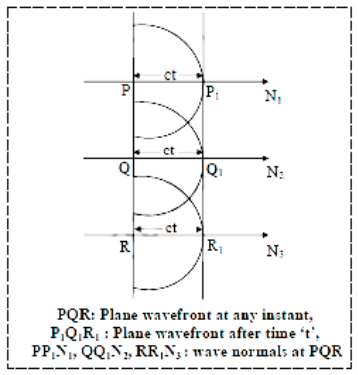
b. Let PQR represent a plane wavefront at any instant. According to Huygens' principle,all the points on this wavefront will act as secondary sources of light sending out secondary wavelets in the forward direction.
c. Draw hemispheres with P, Q R.... as centres and 'ct' as radius. The surface tangential
to all such hemispheres is $P_1 Q_1 R_1 \ldots$. at instant ' $t$ '. It is a new wavefront at time ' $t$ '.
d. The plane wavefronts is propagated as plane waves in homogeneous isotropic medium. They are parallel to each other.
e. PP1N1, $Q Q_1 N_2, R R_1 N_3$ are the wave normals at $P, Q R$ respectively. These wave normals show the direction of propagation of plane wavefront.
$f$. The new wavefront $P_1 Q_1 R_1$ is parallel to primary wavefront PQR.

Need a full question paper?

Generate a complete, print-ready paper with questions like this in minutes — across 16+ boards, with answer keys.
Start Generating Free

Similar questions

For proton acceleration, a cyclotron is used in which a magnetic field of $1.4 Wb / m ^2$ is applied. Find the time period for reversing the electric field between the two Ds.
Define the SI unit of magnetic induction from Lorentz force.
The tube of a mercury barometer is $1 \mathrm{~cm}$ in diameter. What correction due to capillarity is to be applied to the barometric reading if the surface tension of mercury is $435.5 \mathrm{dyn} / \mathrm{cm}$ and the angle of contact of mercury with glass is $140^{\circ}$ ? [Density of mercury $=13600 \mathrm{~kg} / \mathrm{m}^3$ ]
Give any two applications of resonance.
An electric dipole consists of two opposite charges each of magnitude \(1 \mu C\), separated by \(2 cm\).
The dipole is placed in an external field of \(10^5 N / C\). Calculate:
(a) maximum torque experienced by the dipole and
(b) work done by the external field to turn the dipole through \(180^{\circ}\).
Explain one application of electromagnet.
The diameters of two pistons in a hydraulic press are $5 \mathrm{~cm}$ and $25 \mathrm{~cm}$ respectively. A force of $20 \mathrm{~N}$ is applied to the smaller piston. Find the force exerted on the larger piston.
Explain the term free expansion of a gas.
In a conical pendulum, a string of length \(120 cm\) is fixed at rigid support and carries a mass of \(150 g\) at its free end. If the mass is revolved in a horizontal circle of radius \(0.2 m\) around a vertical axis, calculate tension in the string \(\left(g=9.8 m / s ^2\right)\)
What will happen to the mean square speed of the molecules of a gas if the temperature of the gas increases?