Question
Define the different terms used for the composition of a nucleus.

Answer

• The Composition of nucleus :
(i) Atomic number $( Z )$ :
The number of electrons in the neutral atom is called the atomic number.
OR
The number of protons in the neutral atom is called the atomic number.
(ii) Mass number (A) :
The sum of the number of protons and neutrons in the nucleus of the atom is called the atomic mass number A .
Both protons and neutrons are present in the nucleus hence it is known by the common name of nucleon.
The total number of nucleons in the nucleus of an atom is called atomic mass number A .
$\therefore A = Z + N$
(iii) Neutron number ( N $)$ :
The number of neutrons present in the nucleus of an atom is called the neutron number N .
(iv) Nuclide :
The type of nucleus is called nuclide and is represented by symbol ${ }_Z X^A$.
Where X is the chemical symbol of element, $Z =$ atomic number and A is atomic mass number.
For example :
Nuclide of gold ${ }_{79} A u^{197}$
in which 197 nucleons, 79 protons and 118 neutrons are there.

Need a full question paper?

Generate a complete, print-ready paper with questions like this in minutes — across 16+ boards, with answer keys.
Start Generating Free

Similar questions

The speed of light in glass is 2.0 × 101m/s. Does it violate the second postulate of special relativity?
Explain the principle, construction, working and application of moving coil galvanometer.
State Lenz’s law. Illustrate, by giving an example, how this law helps in predicting the direction of the current in a loop in the presence of a changing magnetic flux.
In a given coil of self-inductance of 5 mH, current changes from 4 A to 1 A in 30 ms. Calculate the emf induced in the coil.
Find the radius and energy of a He+ ion in the states (a) n = 1, (b) n = 4 and (c) n = 10.
Consider the situation of the previous problem. Define displacement resistance $\text{R}_\text{d}=\frac{\text{V}}{\text{i}_\text{d}}$ of the space between the plates, where V is the potential difference between the plates and id is the displacement current. Show that Rd varies with time as $\text{R}_\text{d}=\text{R}\big(\text{e}^{\text{t}/\tau}-1\big)$ 
The speed of sound in air is 332m/s. Is it advisable to define the length 1m as the distance travelled by sound in $\frac{1}{332}\text{s}$?
Light of wavelength 488 nm is produced by an argon laser which is used in the photoelectric effect. When light from this spectral line is incident on the emitter, the stopping (cut-off) potential of photoelectrons is 0.38 V. Find the work function of the material from which the emitter is made.
A spherical shell made of plastic, contains a charge Q distributed uniformly over its surface. What is the electric field inside the shell? If the shell is hammered to deshape it without altering the charge, will the field inside be changed? What happens if the shell is made of a metal?
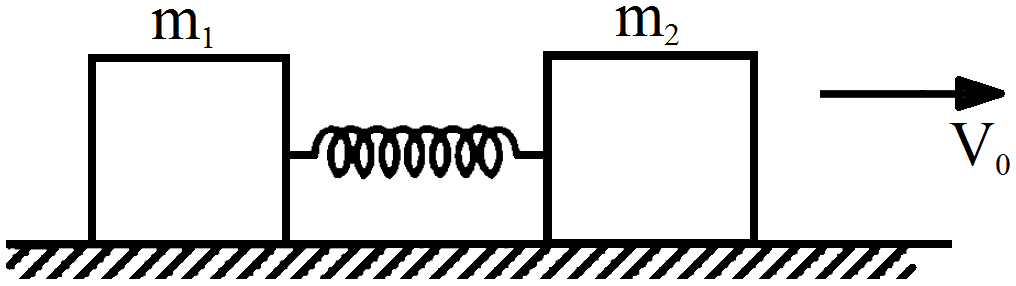
Two blocks of masses m1 and m2 are connected by a spring of spring constant k. The block of mass m2 is given a sharp impulse so that it acquires a velocity v0 towards right. Find
  1. The velocity of the centre of mass.
  2. The maximum elongation that the spring will suffer.
​​​​​​​
  1. Identify the part of the electromagnetic spectrum which is:
  1. Suitable for radar system used in aircraft navigation,
  2. Produced by bombarding a metal target by high-speed electrons.
  1. Why does a galvanometer show a momentary deflection at the time of charging or discharging a capacitor? Write the necessary expression to explain this observation.