Question
Define the following with a suitable example in each:
  1. Oligosaccharides
  2. Denaturation of protein
  3. Vitamins

Answer

  1. Carbohydrates that yield two to ten monosaccharide units, on hydrolysis, are called oligosaccharides.
Example: Sucrose or any other.
  1. When a protein in its native form, is subjected to physical change like change in temperature or chemical change like change in pH, the hydrogen bonds are disturbed. Due to this, globules unfold and helix get uncoiled and protein loses its biological activity.
Example: Boiling of egg.
  1. Organic compounds required in the diet in small amounts to perform specific biological functions for normal maintenance of optimum growth and health of the organism.
Example: Vitamin A.

Need a full question paper?

Generate a complete, print-ready paper with questions like this in minutes — across 16+ boards, with answer keys.
Start Generating Free

Similar questions

Discuss in details the oxidation of methyl ketones by haloform reaction. And also mention that for detection of which type of group this reaction is useful?
State Raoult's Law for solution containing volatile solutes. Write two Characteristics of the solutions which obeys Raoult's law at all concentrations.
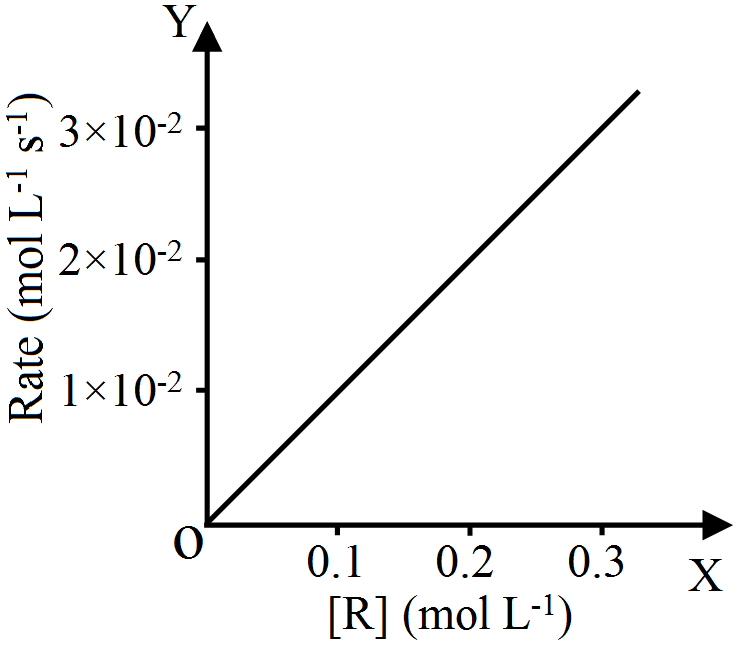
The rate for the reaction $R\rightarrow P$ is rate $= k[R].$ It has been shown graphically below. What is rate constant for the reaction?
What are ambident nucleophilies? Explain with an example.
Explain the bromination of Aniline. State what is done if Mono substituted derivative of aniline is to be formed by this process.
  1. The cell in which the following reaction occurs:
$2 Fe^{3+} (aq) + 2 I^- (aq) \longrightarrow 2 Fe^{2+}(aq) + I_2 (s)$
has $\text{E}^0_{\text{cell}} = 0·236 V$ at $298 K.$ Calculate the standard Gibbs energy of the cell reaction. $($Given : $1 F = 96,500\ C\ mol^{-1})$
  1. How many electrons flow through a metallic wire if a current of $0·5\ A$ is passed for $2$ hours? $($Given : $1 F = 96,500\ C\ mol^{-1})$
Calculate the molarity of 250 mL solution made by dissolving 5 g NaOH in water.
i. Write the mechanism of the following reaction:
$2 CH _3 CH _2 OH \xrightarrow[413 K]{\stackrel{H^{+}}{\longrightarrow}} CH _3 CH _2 OCH _2 CH _3+ H _2 O$
ii. Write the preparation of phenol from cumene.
The rate of a particular reaction triples when temperature changes from $50^\circ C$ to $100^\circ C$. Calculate the activation energy of the reaction.$[\log 3 = 0.4771; R = 8.314 \ JK^{-1} \ mol^{-1}].$
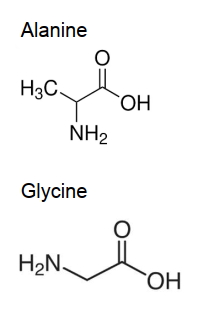
a. Give the structure of all the possible dipeptides formed when the following two amino acids form a peptide bond.
Image
b. Keratin, insulin, and myosin are a few examples of proteins present in the human body. Identify which type of protein is keratin and insulin and differentiate between them based on their physical properties.