Question
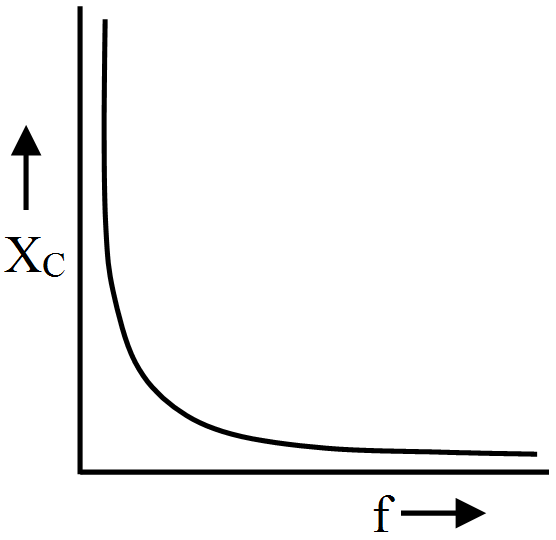
Define the term capacitive reactance. Show graphically the variation of capacitive reactance with frequency of applied alternating voltage. An ac voltage $\text{V = V}_0\sin\omega\text{t}$ is applied across a pure capacitor of capacitance $C.$ Find an expression for current flowing through it. Show mathematically the current flowing through it leads the applied voltage by angle $\frac{\pi}{2}.$
Answer

Capacitive Reactance: The opposition offered by a capacitor alone to the flow of alternating current through it is called the capacitive reactance.
It is denoted by $X_C$ Its value is $\text{X}_{\text{C}}=\frac{1}{\omega\text{C}}=\frac{1}{2\pi\text{fC}}$
The graph of variation of capacitive reactance with frequency is shown in figure.
Phase Difference between Current and Applied voltage in Purely Capacitive Circuit:

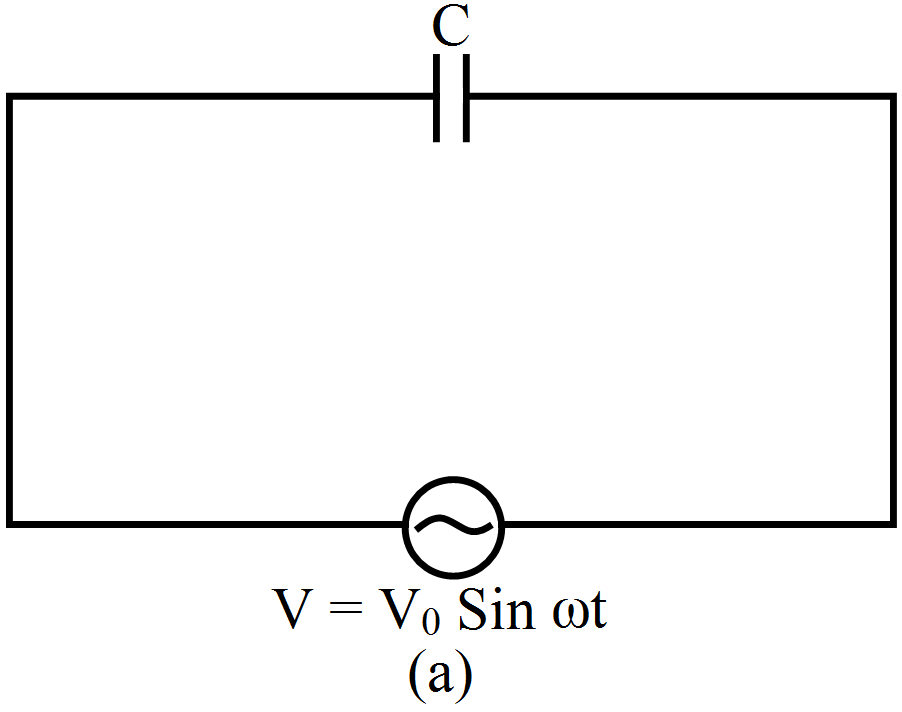
Circuit Containing Pure Capacitance: Consider a capacitor of capacitance $C;$ connected to an alternating voltage source as shown.
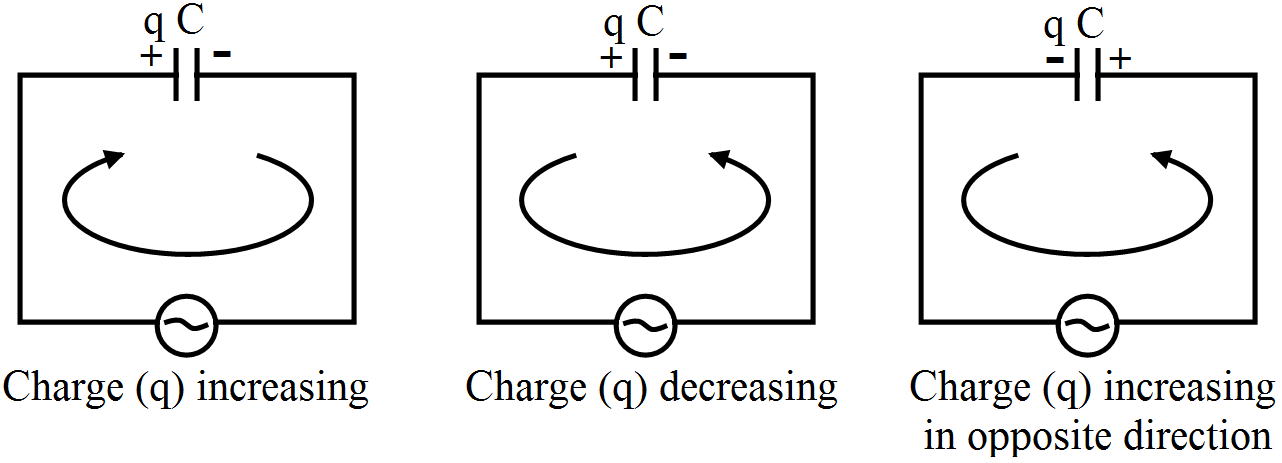
As ac voltage changes in magnitude and direction periodically with a definite frequency; therefore the plates of capacitor get charged, discharged and charged in opposite direction, discharged continuously $($Fig. $b). $ Therefore the flow of alternating current in the circuit is maintained. The instantaneous voltage,
$\text{V = V}_0\sin\omega\text{t} \ ...(\text{i})$
Let $q$ be the charge on capacitor and $i,$ the current in the circuit at any instant, then instantaneous potential difference,
$\text{V}=\frac{\text{q}}{\text{c}} \ ...(\text{ii})$
$\text{q}=\text{CV}_0\sin\omega\text{t}$

The instantaneous current,
$\text{i}=\frac{\text{dq}}{\text{dt}}=\frac{\text{d}}{\text{dt}}(\text{CV}_{\text{0}}\sin\omega\text{t})=\text{CV}_{0}\frac{\text{d}}{\text{dt}}(\sin\omega\text{t})$
$=\text{CV}_{0}\omega\cos\omega\text{t}$
$\text{i}=\frac{\text{V}_0}{\Big(\frac{1}{\omega\text{C}}\Big)}\cos\omega\text{t}=\frac{\text{V}_0}{\frac{1}{\omega\text{C}}}\sin\Big(\omega\text{t}+\frac{\pi}{2}\Big)$
$\text{i}=\text{I}_0\sin\Big(\omega\text{t}+\frac{\pi}{2}\Big) \ ...(\text{iii})$
where $\text{i}_0=\frac{\text{V}_0}{\Big(\frac{1}{\omega\text{C}}\Big)}$ = Peak value of $A.C. ...(iv)$
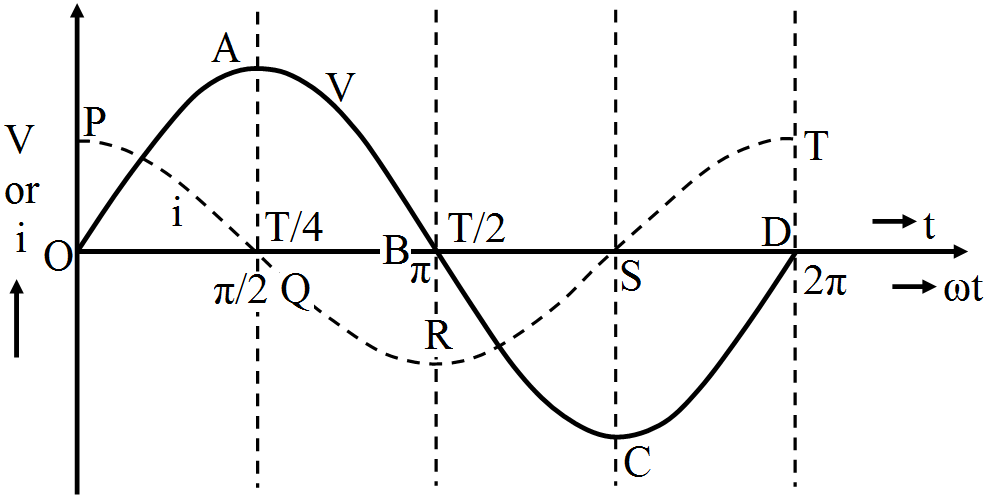
Also comparing $(i)$ and $(iii),$ we note that the current leads the applied emf by an angle $\frac{\pi}{2}$ This is shown graphically in fig. $(c).$

Need a full question paper?

Generate a complete, print-ready paper with questions like this in minutes — across 16+ boards, with answer keys.

Start Generating Free

Similar questions

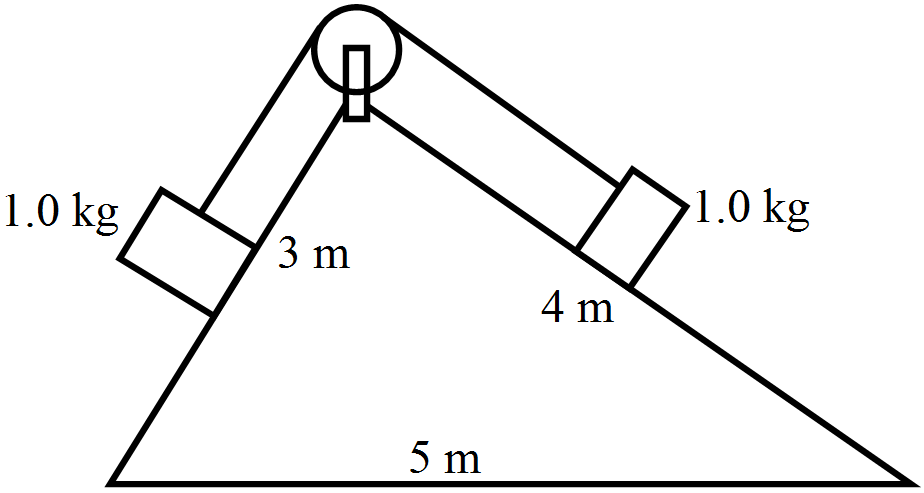
Consider the situation shown in figure. All the surfaces are frictionless and the string and the pulley are light. Find the magnitude of the acceleration of the two blocks.
A heater coil is to be constructed with a nichrome wire $(\rho=1.0\times10^{-6}\Omega-\text{m})$ which can operate at $500W$ when connected to a $250V$ supply.
  1. What would be the resistance of the coil?
  2. If the cross$-$sectional area of the wire $0.5\ mm^2,$ what length of the wire will be needed?
  3. If the radius of each turn is $4.0\ mm,$ how many turns will be there in the coil?
A small object is placed at the centre of the bottom of a cylindrical vessel of radius 3cm and height 4cm filled completely with water. Consider the ray leaving the vessel through a corner. Suppose this ray and the ray along the axis of the vessel are used to trace the image. Find the apparent depth of the image and the ratio of real depth to the apparent depth under the assumptions taken. Refractive index of water = 1.33
Two identical pith balls are charged by rubbing against each other. They are suspended from a horizontal rod through two strings of length $20\ cm$ each, the separation between the suspension points being $5\ cm.$ In equilibrium, the separation between the balls is $3\ cm.$ Find the mass of each ball and the tension in the strings. The charge on each ball has a magnitude $2.0 \times 10^{-8}C.$
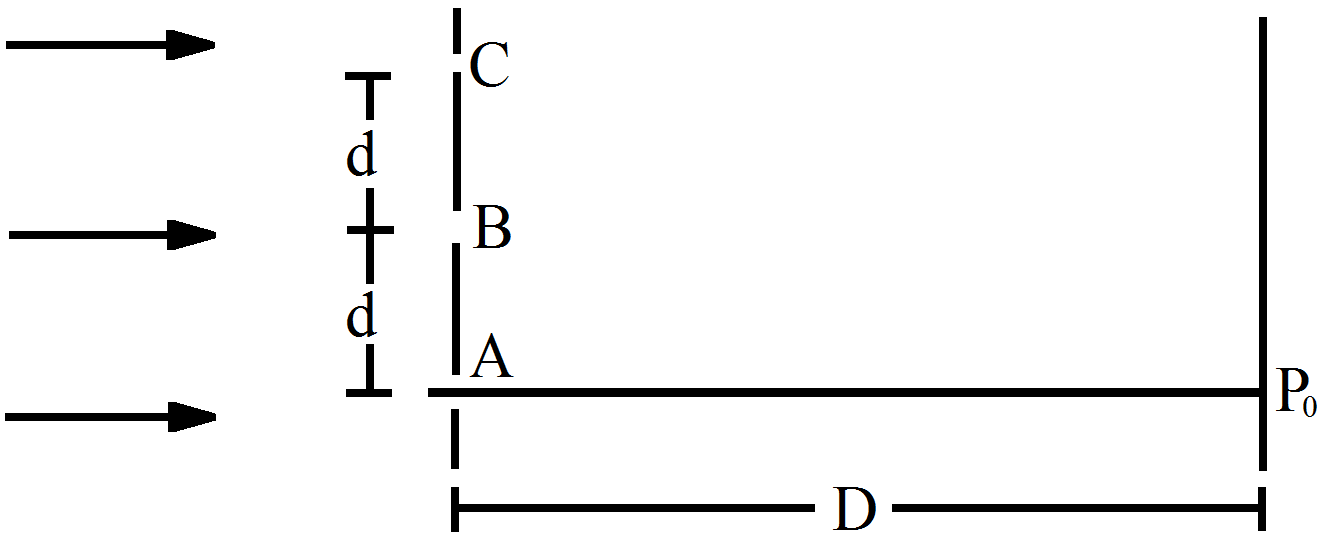
Figure shows three equidistant slits being illuminated by a monochromatic parallel beam of light.
Let $\text{BP}_0-\text{AP}=\frac{\lambda}{3}$ and $\text{D}>\lambda.$
  1. Show that in this case $\text{d}=\sqrt{\frac{2\lambda\text{D}}{3}}.$
  2. Show that the intensity at $P,$ is three times the intensity due to any of the three slits individually.
A train running at 108km/h towards east whistles at a dominant frequency of 500Hz. Speed of sound in air is 340m/s.
  1. What frequency will a passenger sitting near the open window hear?
  2. What frequency will a person standing near the track hear whom the train has just passed?
  3. A wind starts blowing towards east at a speed f 36km/h. Calculate the frequencies heard by the passenger in the train and by the person standing near the track.
A capacitor has some dielectric between its plates, and the capacitor is connected to a DC source. The battery is now disconnected and then the dielectric is removed. State whether the capacitance, the energy stored in it, electric field, charge stored and the voltage will increase, decrease or remain constant.
A short object of length $L$ is placed along the principal axis of a concave mirror away from focus. The object distance is u. If the mirror has a focal length $f,$ what will be the length of the image? You may take $L < < |v - f|.$
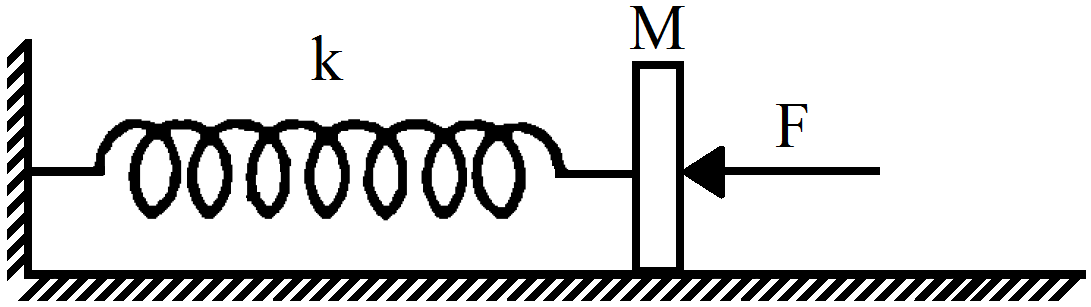
In figure k = 100N/m, M = 1kg and F = 10N,
  1. Find the compression of the spring in the equilibrium position.
  2. A sharp blow by some external agent imparts a speed of 2m/s to the block towards left. Find the sum of the potential energy of the spring and the kinetic energy of the block at this instant.
  3. Find the time period of the resulting simple harmonic motion.
  4. Find the amplitude.
  5. Write the potential energy of the spring when the block is at the left extreme.
  6. Write the potential energy of the spring when the block is at the right extreme.
The answers of (b), (e) and (f) are different. Explain why this does not violate the principle of conservation of energy.
Draw a phasor diagram for series LCR circuit joined with ac voltage source and obtain an expression for impedance of the circuit.