Question
  1. Define the term drift velocity.
  2. On the basis of electron drift, derive an expression for resistivity of a conductor in terms of number density of free electrons and relaxation time. On what factors does resistivity of a conductor depend?
  3. Why alloys like constantan and manganin are used for making standard resistors?
Answer

  1. Average velocity acquired by the electrons in the conductor in the presence of external electric field.
Alternate Answer
$[\text{V}_{d} =\frac{-eE\tau}{\text{m}}$ where $\tau$is the relaxation time.$]$
  1. $\text{V}_{d} =\frac{-eE\tau}{\text{m}}$ 
We have $\text{E} = - \frac{\text{V}}{\ell'}$
where $V$ is potential difference across the length $\ell$
of the conductor
$\text{V}_{d} = \frac{\text{eV}\tau}{\text{m}\ell}$ Current flowing $I = neAv_d​​​​​​​$
I = neA$\text{V}_{d}\frac{\text{eV}\tau}{\text{ml}} = \frac{ne^{2}\text{AV}\tau}{\text{ml}}$
$\frac{\text{I}}{\text{V}} = \frac{\text{ne}^{2}A\tau}{ml} = \frac{1}{\text{R}} . . . . . (i)$
Also,  $\text{R} = \rho\frac{\ell}{\text{A}} . . . . (ii) $
Comparing $(i)$ and $(ii)$
$\rho = \frac{m}{ne^{2}\tau}$
Resistivity of the material of a conductor depends on the relaxation time, i.e., temperature and the number density of electrons.
  1. Because constantan and manganin show very weak dependence of resistivity on temperature.

Need a full question paper?

Generate a complete, print-ready paper with questions like this in minutes — across 16+ boards, with answer keys.

Start Generating Free

Similar questions

Electrons give up energy at the rate of $RI^2$ per second to the thermal energy. What time scale would one associate with energy in problem $(a)$? $n =$ no of electron/volume $= 10^{29}/m^3,$ length of circuit $= 10\ cm,$ cross$-$section $= A = (1\ mm)^2.$
What do you understand by a solenoid? Obtain an expression for magnetic field of a solenoid of infinite length.###Establish a formula for magnetic field on the axis inside of a straight and long solenoid. Show the direction of magnetic field inside it and what is the magnitude of magnetic field outside the solenoid.###Establish a formula for magnetic field inside a long solenoid. Represent produced force lines by diagram.###Write Ampere's circuital law. Obtain an expression for magnetic field on the axis of a very long current carrying solenoid. Draw necessary diagram also.
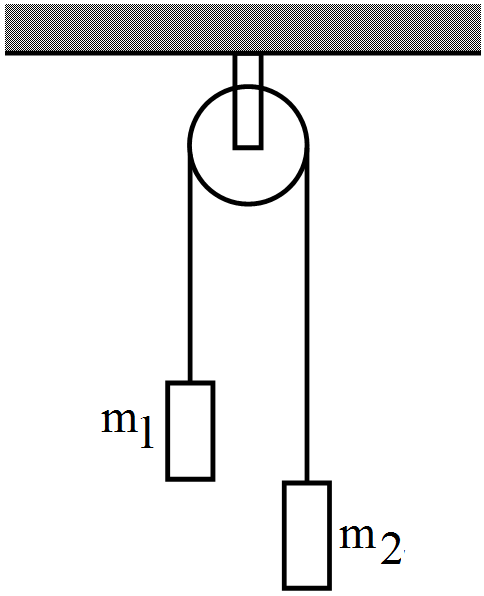
In a simple Atwood machine, two unequal masses $m_1$ and $m_2$ are connected by a string going over a clamped light smooth pulley. In a typical arrangement $m_1 = 300g$ and $m_2 = 600g$. The system is released from rest.
  1. Find the distance travelled by the first block in the first two seconds.
  2. Find the tension in the string.
  3. Find the force exerted by the clamp on the pulley.
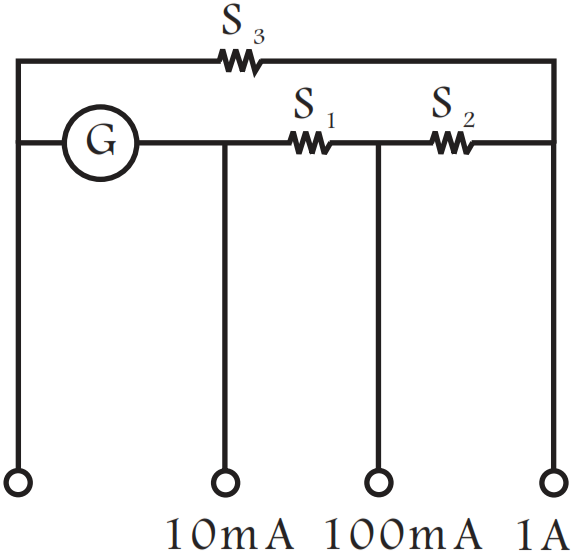
A multirange current meter can be constructed by using a galvanometer circuit as shown in Fig. We want a current meter that can measure $10mA,$ $100mA$ and $1A$ using a galvanometer of resistance $10\Omega$ and that prduces maximum deflection for current of $1mA.$ Find $S_1, S_2$ and $S_3$ that have to be used.
A person stands on a spring balance at the equator.
  1. By what fraction is the balance reading less than his true weight?
  2. If the speed of earth's rotation is increased by such an amount that the balance reading is half the true weight, what will be the length of the day in this case?
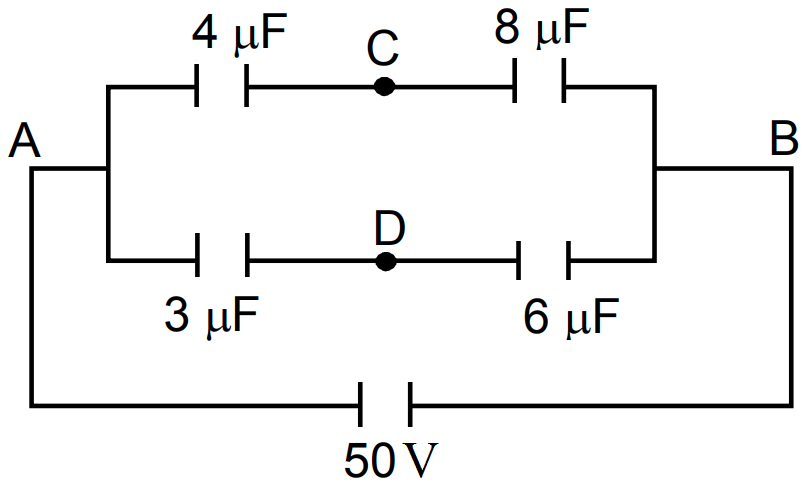
Take the potential of the point B in figure to be zero:
  1. Find the potentials at the points C and D.
  2. If a capacitor is connected between C and D, what charge will appear on this capacitor?
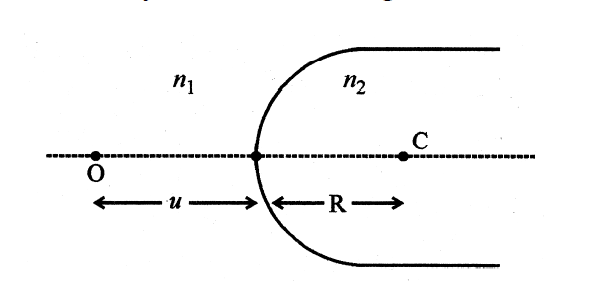
A point object $'O\ '$ is kept in a medium of refractive index $n_1$ in front of a convex spherical surface of radius of curvature $R$ which separates the second medium of refractive index $n_2$ from the first one, as shown in the figure. Draw the ray diagram showing the image formation and deduce the relationship between the object distance and the image distance in terms of $n_1, n_2$ and $R.$​​​​​​​
  1.  
  1. hen the image formed above acts as a virtual object for concave spherical, surface separating the medium $n_2$ from $n_1 (n_2> n_1),$ draw this ray diagram and write the similar $($similar to $(a)$ relation. Hence obtain the expression for the lens maker's formula.
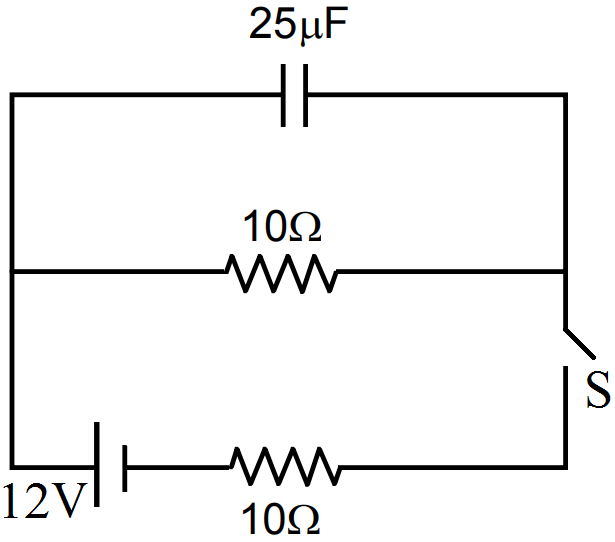
The switch S shown in figure. is kept closed for a long time and is then opened at t = 0. Find the current in the middle $1.0\Omega$ resistor at t = 1ms.
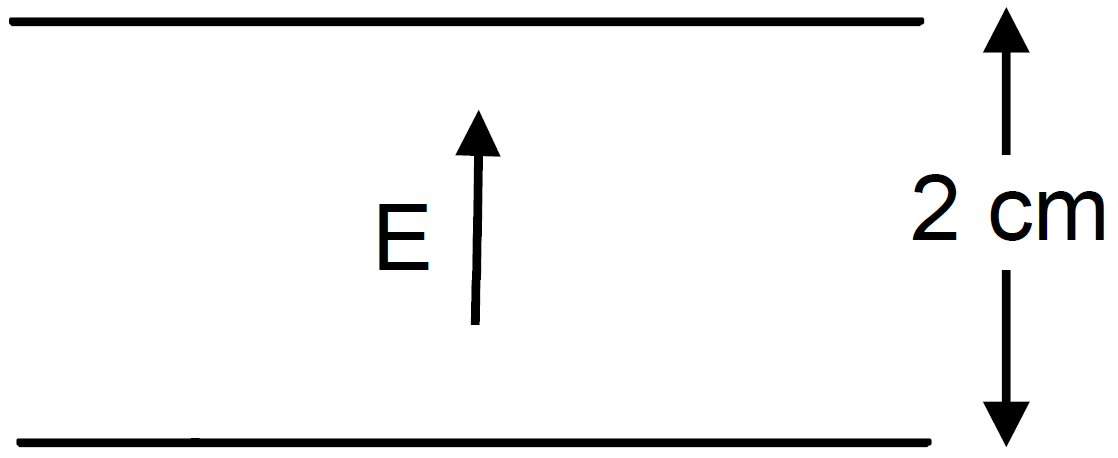
An electric field of magnitude $1000NC^{-1}$ is produced between two parallel plates having a separation of $2.0\ cm$ as shown in figure.
  1. What is the potential difference between the plates?
  2. With what minimum speed should an electron be projected from the lower plate in the direction of the field so that it may reach the upper plate?
  3. Suppose the electron is projected from the lower plate with the speed calculated in part $(b).$ The direction of projection makes an angle of $60^\circ$ with the field. Find the maximum height reached by the electron.
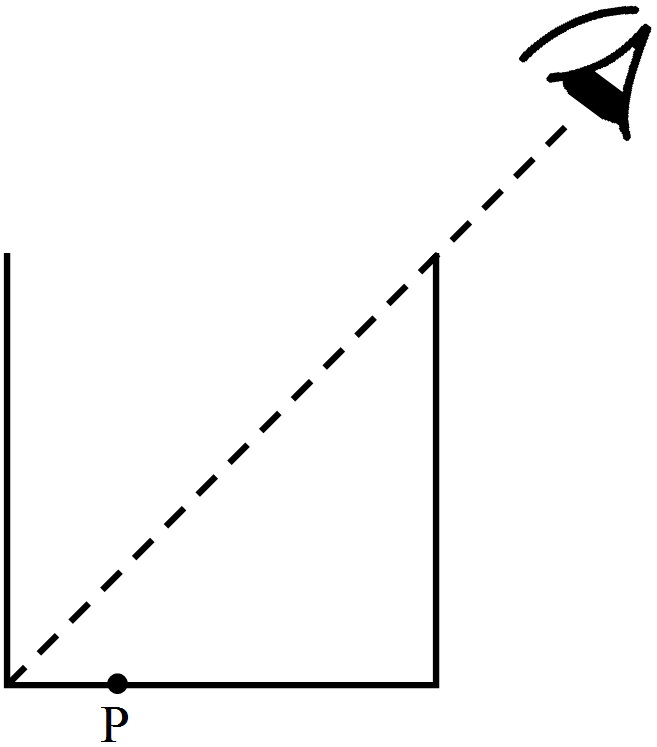
A cylindrical vessel, whose diameter and height both are equal to 30cm, is placed on a horizontal surface and a small particle P is placed in it at a distance of 5.0cm from the centre. An eye is placed at a position such that the edge of the bottom is just visible. The particle P is in the plane of drawing. Up to what minimum height should water be poured in the vessel to make the particle P visible?