Question
Define the term 'focus' of a lens.

Answer

Principal focus: Rays of light can pass through the lens in any direction and hence there will be two principal foci on either side of the lens and they are referred to as the first principal focus and the second principal focus of a lens.
First Principal Focus (F1)
It is a point on the principal axis of the lens such that the rays of light starting from it (convex lens) or appearing to meet at the point (concave lens) after refraction from the two surfaces of the lens become parallel to the principal axis of the lens.
Second Principal Focus (F2)
It is a point on the principal axis of the lens such that the rays of light parallel to the principal axis of the lens after refraction from both the surfaces of the lens pass through this point (convex lens) or appear to be coming from this point.

Need a full question paper?

Generate a complete, print-ready paper with questions like this in minutes — across 16+ boards, with answer keys.
Start Generating Free

Similar questions

A sound made on the surface of a lake takes $3 \ s$ to reach a boatman. How much time will it take to reach a diver inside the water at the same depth?
Velocity of sound in air $= 330 ms^−1$
Velocity of sound in water $= 1450 ms^−1$
A wire 3 ohm resistance and 10 cm length is stretched to 30 cm length. Assuming that it has a
uniform cross section, what will be its new resistance?
Write the three characteristics of the image formed by a convex lens of focal length 20 cm for the object at distance (i) 10 cm, (ii) 30 cm, (iii) 40 cm, (iv) 60 cm from the lens.
What is lateral displacement? Draw a ray diagram showing the lateral displacement of a ray of light when it passes through a parallel sided glass slab.
A machine raises a load of 750 N through a height of 16 m in 5 seconds. Calculate the power at which the machine works.
Write down the characteristic of the image formed when the object is between F and the lens?
Name and state the law which determines the direction of induced current.

or

State Fleming’s right-hand rule.

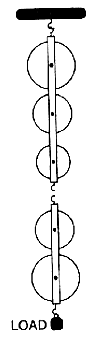
In following figure , draw a tackle to lift the load by applying the force in the downward direction. Mark the position of load and effort.
(a) If the load is raised by 1 m, through what distance will the effort move?
(b) State how many strands of tackle are supporting the load?
(c) What is the mechanical advantage of the system?
What is meant by the turning effect of force? Give two examples.
A vessel of negligible heat*capacity contains 40g of ice in it at 0°C, 8g of steam at 100°C is passed into the ice to melt it. Find the final temperature of the contents of the vessel.
(Specific latent heat of vaporization of steam = 2268 J/g, specific latent heat of fusion of ice = 336 J/f and specific heat capacity of water = 4.2 J/g°C)