Questions

[3 Mark Question Answer]

🎯

Test yourself on this topic

23 questions · timed · auto-graded

Question 13 Marks
An electromagnetic wave has a frequency of 500 MHz and a wavelength of 60 cm. Calculate the velocity of the wave. Name the medium through which it is traveling.
Answer
We know that,
$ v=f \lambda $
Here it is given that $\mathrm{c}=3 \times{ }^{\prime} 10^8 \mathrm{~m} / \mathrm{s}$
and, $\mathrm{f}=500 \mathrm{MHz}=500 \times 10^6 \mathrm{~Hz}$
$\lambda=60 \mathrm{~cm}=0.6 \mathrm{~m}$
$\therefore v=\left(500 \times 10^6\right) \times(0.6)=3 \times 10^8 \mathrm{~m} / \mathrm{s}$
which is same the velocity of the e-m wave in vacuuum or air.
The medium through which it is travelling is either air or vacuum.
View full question & answer
Question 23 Marks
Name three properties of ultraviolet radiations which are similar to visible light.
Answer
Three properties of ultraviolet radiations similar to the visible light:
1. They travel in straight lines as light does, with a speed equal to 3 x 10⁸ m/s in vacuum.
2. They obey laws of reflection and refraction.
3. They are unaffected by electric and magnetic fields.
View full question & answer
Question 33 Marks
Mention three properties of infra red radiations similar to the visible light. Give two such properties of infrared radiations which are not true for visible light.
Answer
Three properties of infrared radiations similar to the visible light:
1. They travel in straight lines as light does, with a speed equal to $3 x 10^8 m/s$ in vacuum.
2. They obey laws of reflection and refraction.
3. They are unaffected by electric and magnetic fields.
Two properties of infrared radiation different from the visible light:
1. They are absorbed by glass, but they are not absorbed by rock-salt.
2. They are detected by their heating property using a thermopile or a blackened bulb thermometer.
View full question & answer
Question 43 Marks
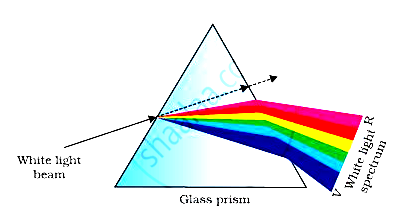
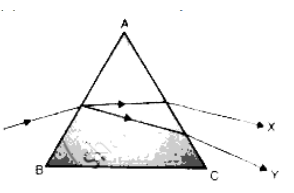
Fig. shows a ray of white light that passes through a prism and produces a spectrum.
(a) Name the phenomenon that is taking place.
(b) What colour would you see at X and Y?
(c) What radiation would you detect above X and below Y?
Image
Answer
(a) Dispersion
(b) Red colour at X and violet colour at Y.
(c) Above X, we would detect infra-red radiation and below Y, ultra-violet radiation.
View full question & answer
Question 53 Marks
Define critical angle and explain total internal reflection. What are the conditions necessary for total internal reflection?
Answer
Critical angle: The angle of incidence in the denser medium for which the angle of refraction in the rarer medium is $90^o.$
Total internal reflection: It is an optical phenomenon that occurs when a ray of light strikes the boundary of denser medium at an angle greater than the critical angle w.r.t. the normal of the surface; this ray is then totally reflected back into the denser medium.
The two necessary conditions for total internal reflection to take place are:
1.The light ray must proceed from denser to rarer medium.
2. Angle of incidence in denser medium should be greater than the critical angle for the pair of media in contact.
View full question & answer
Question 63 Marks
How is accommodation produced?
Answer
Accommodation is achieved with the help of ciliary muscles.
To focus the distant objects, the ciliary muscles are relaxed causing the eye lens to become thin and thus increasing the focal length of the eye lens.
To form the image of a near object on the retina, the ciliary muscles contract and thereby pull the ends of the choroid closer. Thus, the eye lens thickens to shorten its focal length and converges the rays to form the image.
In this manner, by changing the focal length of the eye lens, the image of the objects at different distances is brought to focus on the retina.
View full question & answer
Question 73 Marks
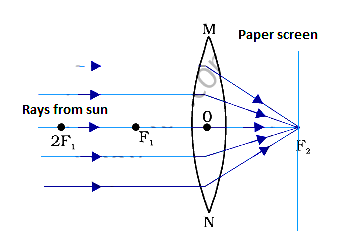
(a) Draw a sketch to show how a lens is able to produce an image of the sun on a paper screen.
(b)(i) Would you regard the rays from the sun as being divergent, parallel or convergent?
(ii) What is the name given to the point where such rays meet after they have passed through the lens?
(iii) How does the image of the sun sometimes burn a paper screen?
Answer
(a)

(b)
(i) Rays from sun can be regarded as parallel rays.
(ii) The point is called 'Focus'.
(iii) A convex lens is used to focus the sun rays on a piece of paper to burn a piece of paper. A large amount of heat gets concentrated at a point and is sufficient to burn the piece of paper.
View full question & answer
Question 83 Marks
Distinguish between concave and convex lens.
Answer
Convex lens Concave lens
1. A convex lens is thicker in the middle and thinner at its edges. 1. A concave lens is thicker at the edges and thinner in the middle
2. A light beam converges on passing through a convex lens. 2. A light beam diverges on passing through a concave lens.
3. The convex lens produces a real image that is inverted and is smaller and can be obtained on screen. 3. A concave lens always forms a virtuall image, the image is magnified and cannot be obtaiined on screen.
View full question & answer
Question 93 Marks
Define the term 'focus' of a lens.
Answer
Principal focus: Rays of light can pass through the lens in any direction and hence there will be two principal foci on either side of the lens and they are referred to as the first principal focus and the second principal focus of a lens.
First Principal Focus (F1)
It is a point on the principal axis of the lens such that the rays of light starting from it (convex lens) or appearing to meet at the point (concave lens) after refraction from the two surfaces of the lens become parallel to the principal axis of the lens.
Second Principal Focus (F2)
It is a point on the principal axis of the lens such that the rays of light parallel to the principal axis of the lens after refraction from both the surfaces of the lens pass through this point (convex lens) or appear to be coming from this point.
View full question & answer
Question 103 Marks
A pin 2 cm long is placed 12 cm away from a convex lens at right angles to the principal axis. If the focal length of the lens is 20 cm, by scale drawing find the size of the image and its magnification.
Answer
Given $\mathrm{O}=2 \mathrm{~cm}, \mathrm{u}=12 \mathrm{~cm}, \mathrm{f}=20 \mathrm{~cm}$ $\mathrm{I}=$ ?, $\mathrm{M}=$ ?
Taking the scale of measurement are : $2 \mathrm{~cm}=1 \mathrm{~cm}$ on the graph. In the drawing,
$ O=1 \mathrm{~cm}, u=6 \mathrm{~cm}, f=10 \mathrm{~cm} $
From the drawing,
$ \begin{aligned} & \mathrm{I}=2.7 \mathrm{~cm} \\ & \Rightarrow \text { actual image size } \mathrm{I}=2.7 \times 2=5.4 \mathrm{~cm} \\ & \text { Magnification } \mathrm{m}=\frac{\mathrm{I}}{\mathrm{O}}=\frac{5.4}{2}=2.7 \mathrm{~cm} \end{aligned} $
View full question & answer
Question 113 Marks
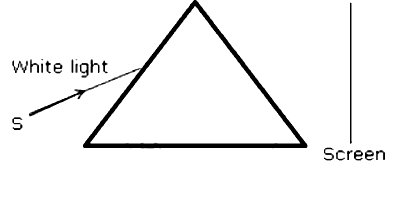
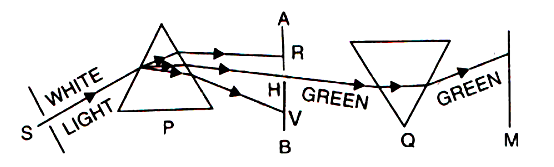
Fig shows a thin beam of white light from a source S striking on one face of prism.

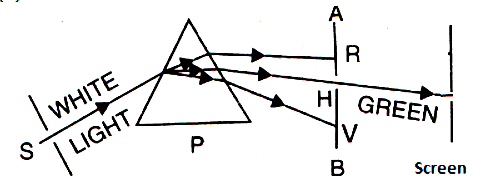
(a) Complete the diagram to show the effect of prism on the beam and to show what is seen on the screen.
(b) A slit is placed in between the prism and the sceen to pass only the light of green colour. what will you then oserve on the scren?
(c) What conclusion do you draw from the observation in (b) above?
Answer
(a)

(b)

We will observe the light of only green colour on the scren.
(c) We draw the conclusion that a prism by itself produces no colours
View full question & answer
Question 123 Marks
How does the deviation produced by a triangular prism depend on the colours (or wavelengths) of light incident on it? Which colour deviates the most and which the least?
Answer
Light of different colours have different speeds in a medium.
Therefore, the refractive index of glass (the material of prism) is different for different colours of light and the deviation caused by a prism is different for different colours of light.
Violet is deviated the most because in glass, speed of violet is least.
Red is deviated the least because in glass, speed of red is most.
View full question & answer
Question 133 Marks
Briefly, describe an experiment to show that a prism itself produces no colour.
Answer
A prism itself produces no colour. This can be demonstrated by the following experiment.
Experiment: In figure below, white light from a slit s is made to pass through a prism P which forms the spectrum VR on a while screen AB. A narrow slit H is made on the screen AB parallel to the slit S to allow the light of a particular colour to pass through it. This light of a particular colour is made to fall on a seconf prism Q placed with its base in opposite directionj to that of the prism P. The light after passing through the second prism Q is recieved on another white screen M.

It is observed that the colour of light onbtained on the screen M is sames as that of the light incident on the second prism Q through the slit H. If green light is incident on the prism Q, the screen M has only green colour. This proves that the prism itself produces no coours.
View full question & answer
Question 143 Marks
What do you understand by focal plane of a lens?
Answer
Focal plane of a lens: Rays of light can pass through the lens in any direction and hence there will be two focal planes on either side of the lens and they are referred to as the first focal plane and the second focal plane of a lens:
(i) First focal plane: It is the plane passing through the first focal point and normal to the principal axis of the lens.
(ii) Second focal plane: It is the plane passing through the second focal point and normal to the principal axis of the lens.
View full question & answer
Question 153 Marks
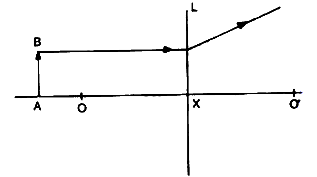
Refer to fig
(i) Name the lens L.
(ii) What are the points O, O' called?
(iii) Complete the diagram to form the image of the object AB.
(iv) Write three characteristics of the image.
Answer
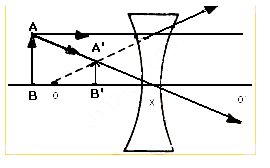
(i) concave lens
(ii) Points O and O' are second focus and first focus respectively.
(iii)

(iv) Characteristics of image : erect, dimnished and virtual.
View full question & answer
Question 163 Marks
Distinguish between a real and a virtual image.
Answer
Real image Virtual image
1. When the rays off light diverging from a point after reflection or refraction actually converge at some point, then that point is the real image of object. 1. When the rays off light diverging from a point after reflection or refraction appear to diverge from some other point.
2. A real image is always inverted and can be taken on the screen. 2. A virtual image is always arect and cannot be taken on the screen.
3. A real image is formed by eye, photographic camera, convex lens except when object is very close to the lens, concave mirror when the object is very close to concave mirror.

3. A virtual image is fromed by plane mirror, convex mirror and concave lens..

View full question & answer
Question 173 Marks
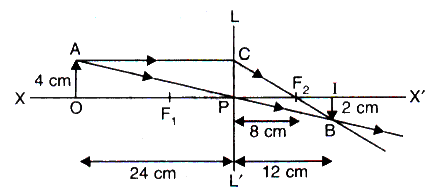
An object of height 4.0 cm is placed at a distance 24 cm in front of a convex lens of focal length 8 cm. Draw a ray diagram to find the position of image. State the characteristics of the image.
Answer
Choose a proper scale say, 4 cm = 1 cm. Mark the lens LPL' on the principal axis XX'. In front of the lens, Mark the object OA with distance OP = 24 cm and height of object OA = 4 cm.
For the object OA kept at a distance 24 cm in front of the convex lens of focal length 8 cm, the constuction of the image is shown in the figure. The distance PI of image IB, from the lens is 12 cm. thus the distance of image is 12cm. The image is real, inverted and dimnished(size 2.0 cm).
View full question & answer
Question 183 Marks
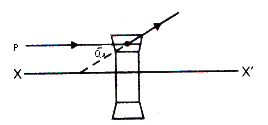
Fig shows a lens as a combination of a glass block and two prisms.
(i) Name the lens formed by the combination.
(ii) What is the line XX' called?
(iii) Complete the path of the incident ray PQ after passing through the lens.
(iv) The final emergent ray either meets XX' at a point or appears to come from a point on XX'. Label it as F, What is this point called?
Answer
(i) Concave lens.
(ii) The line XX' called the principal axis.
(iii)

(iv) The final emergent ray will appear to meet XX' at a point called its second focus of the lens.
View full question & answer
Question 193 Marks
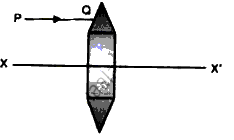
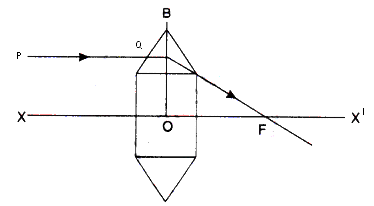
Fig shows a lens as a combination of a glass block and two prisms.

(i) Name the lens formed by the combination.
(ii) what is the XX' called?
(iii) Complete the ray diagram and show the path of the incident ray PQ after passing through the lens.
(iv) The final emergent ray will either meet XX' at a point or appear to come from a point on XX'. what is the point called?
Answer
(i) Convex lens
(ii) The line XX' is calledf the principal axis.
(iii)

(iv) The final emergent ray will meet XX' at a point called its principal focus of the lens.
View full question & answer
Question 203 Marks
Define the term refractive index of a medium. What do you understand by the statement 'the refractive index of glass is 1.5 for white light'?
Answer
When light travels from one medium (air) to another medium (glass), it bends towards the normal. The extent of bending of light depends upon the speed of light $\left( v _2\right)$ in the second medium, compared to the speed of light $\left( v _1\right)$ in the first medium. The refractive index of the second medium w.r.t. the first medium $\left( n _{21}\right)$ is given by $n _{21}=$ Speed of light $\left( v _1\right)$ in first medium / speed of light $\left( v _2\right)$ in second medium
The refractive index of glass is typically around 1.5 , meaning that light in glass travels at c / $1.5=200,000 km / s$. A low value of refractive index also indicates a large critical angle at the glass-air interface.
View full question & answer
Question 213 Marks
Define the terms critical angle and total internal reflection. State two conditions necessary for total internal reflection to occur. Write down the relation for the critical angle in terms of refractive index.
Answer
Critical angle is the angle of incidence in the denser medium for which the angle of refraction in the rarer medium is 90o .
Total internal reflection: When a ray of light travelling from an optically denser medium to an optically rare medium is incident at an angle greater than the critical angle for the pair of media in contact, the ray is totally reflected back into the denser medium. This phenomenon is referred as total internal reflection. The two necessary conditions for total internal reflection to take place are:
1. The light ray must proceed from denser to rarer medium.
2. Angle of incidence in denser medium should be greater than the critical angle for the pair of media in contact.
Relation between critical angle and r.i.: The critical angle can thus be calculated by taking the inversesine ratio of speed of light in denser medium and the speed of light in rarer.
$ \mathrm{i}_{\mathrm{c}}=\sin ^{-1}\left(\frac{\mathrm{n} \gamma}{\mathrm{n}_i}\right) $
View full question & answer
Question 223 Marks
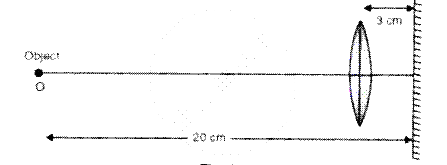
Make the rrect choices in the following items :
ln fig, , a real image of a point objert O is formed, Which of the following statements is true about each of the arrangements?
(i) The object is at the principle focus of the lens
(ii) The focal length of the lens is 17 cm
(iii) lf the mirror is moved so that it is 6 cm from the lens image will also move
Answer

(i) The object is at the principle focus of the lens

(ii) The focal length of the lens is 17 cm

(iii) lf the mirror is moved so that it is 6 cm from the lens image will also move

View full question & answer
Question 233 Marks
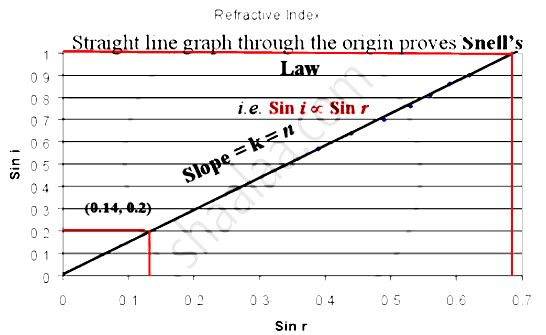
Plot a graph between
Sine of angle of incidence versus sine of angle of refraction,
Answer
Sine of angle of incidence vs. sine of angle of refraction graph : 
View full question & answer
[3 Mark Question Answer] - Physics STD 10 Questions - Vidyadip