Question
Define the term magnetic moment of a current loop. Write the expression for the magnetic moment when an electron revolves at a speed v around an orbit of radius ‘r’ in hydrogen atom.

Answer

Magnetic moment of a current loop:The torque on current loop is $\tau=\text{MB}\sin\theta$, where $\theta$ is angle between magnetic moment and magnetic field.
$\Rightarrow\text{M}=\frac{\tau}{\text{B}\sin\theta}$
If B or 1 T, $\sin\theta=1$ or $\theta=90^\circ$ then $\text{M}=\tau$.
That is the magnetic moment of a current loop is defined as the torque acting on the loop when placed in a magnetic field of 1 T such that the loop is oriented with its area vector normal to the magnetic field.
Also, M = IA
i.e., magnetic moment of a current loop is the product of current flowing in the loop and area of loop. Its direction is perpendicular to the plane of the loop and determined by using right hand thumb rule.
Magnetic moment of revolving electron,
$\text{M}=\frac{\text{evr}}{2}$

Need a full question paper?

Generate a complete, print-ready paper with questions like this in minutes — across 16+ boards, with answer keys.
Start Generating Free

Similar questions

a. State the condition for resonance to occur in series LCR a.c. circuit and derive an expression for resonant frequency.
b. Draw a plot showing the variation of the peak current $\left( i _{ m }\right)$ with frequency of the a.c, source used. Define the quality factor Q of the circuit.
The half $-$ life of $^{199}Au$ is $2.7$ days.
  1. Find the activity of a sample containing $1.00\mu\text{g}$ of $^{198}Au.$
  2. What will be the activity after $7$ days? Take the atomic weight of ${198}Au$ to be $198g/mol$.
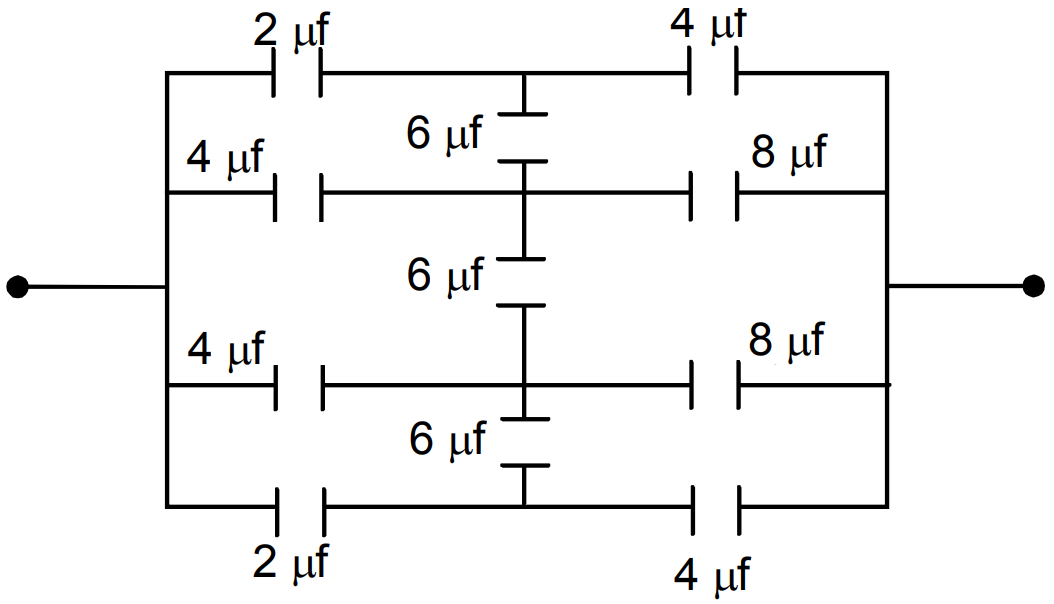
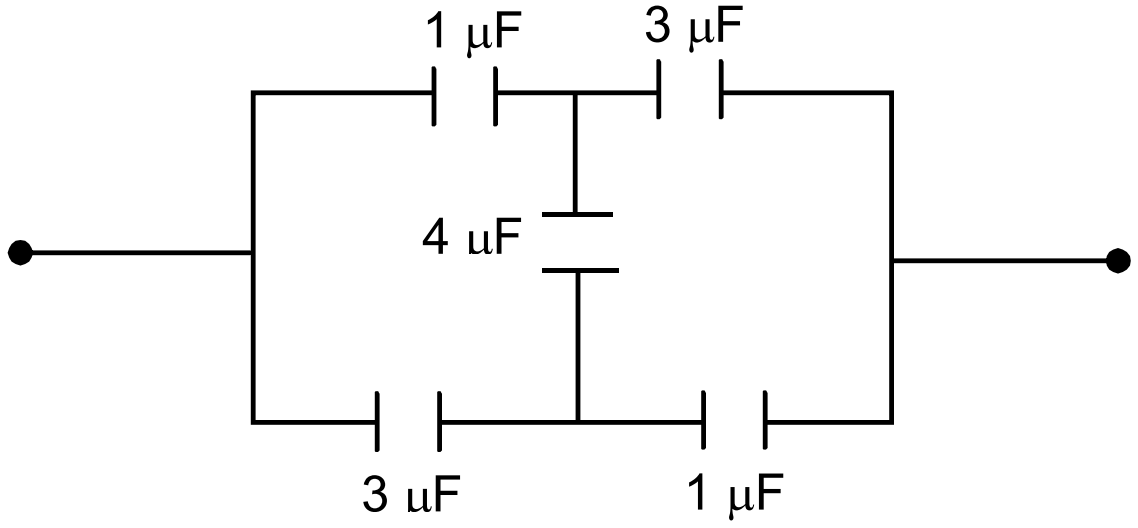
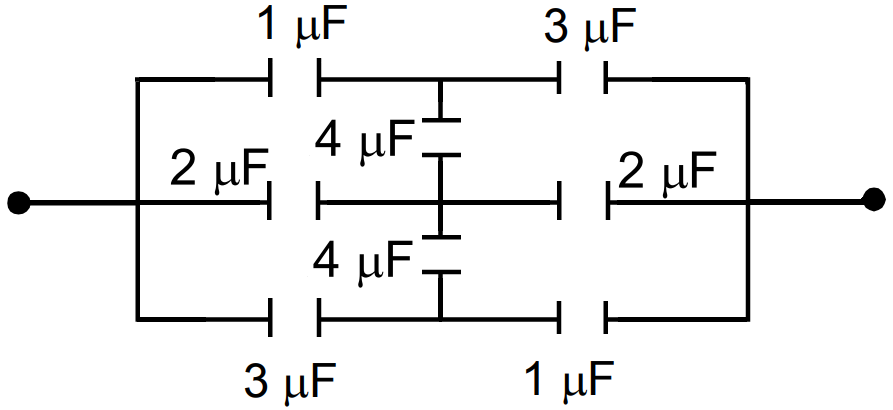
Find the equivalent capacitances of the combinations shown in figure between the indicated points.


A block of mass $2.0\ kg$ is pushed down an inclined plane of inclination $37^\circ$ with a force of $20N$ acting parallel to the incline. It is found that the block moves on the incline with an acceleration of $10m/s^2$. If the block started from rest, find the work done.
  1. By the applied force in the first second.
  2. By the weight of the block in the first second.
  3. By the frictional force acting on the block in the first second. Take $g = 10m/s^2.$
Let $\text{X}=\overline{\text{ABC}}+\overline{\text{BCA}}+\overline{\text{CAB}}.$ Evaluate X for:
  1. $\text{A}=1,\text{B}=0,\text{C}=1$
  2. $\text{A}=\text{B}=\text{C}=1$
  3. $\text{A}=\text{B}=\text{C}=0$
Explain principle of Rutherford and Soddy in relation with redioactive decay.
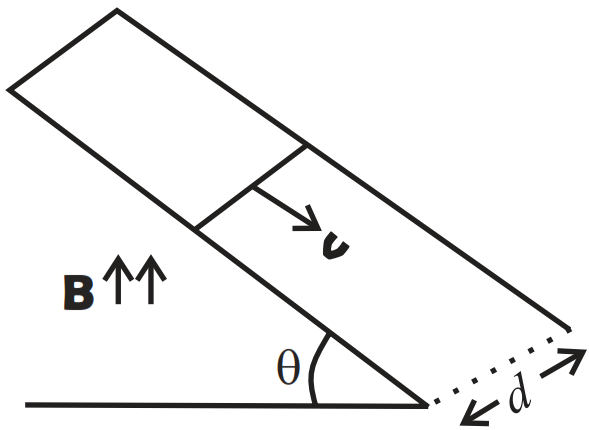
A rod of mass m and resistance $R$ slides smoothly over two parallel perfectly conducting wires kept sloping at an angle $\theta$ with respect to the horizontal $($Fig$)$. The circuit is closed through a perfect conductor at the top. There is a constant magnetic field $B$ along the vertical direction. If the rod is initially at rest, find the velocity of the rod as a function of time.
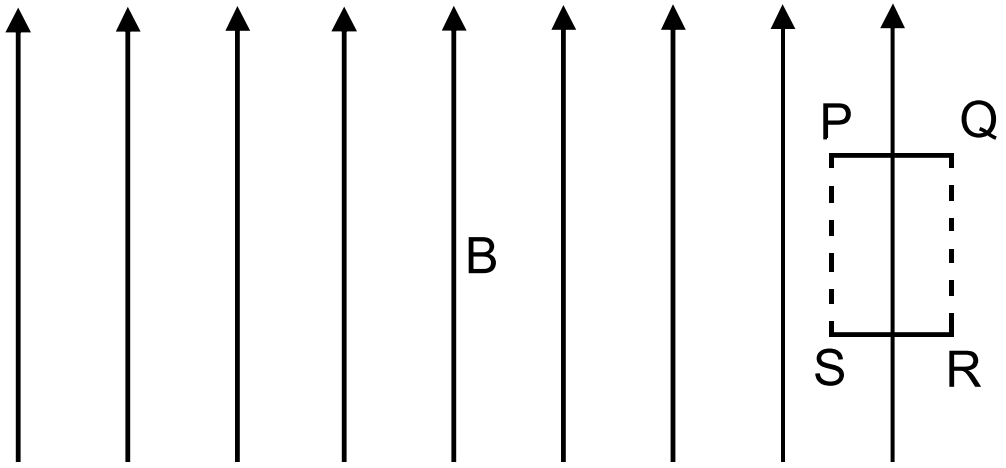
Sometimes we show an idealised magnetic field which is uniform in a given region and falls to zero abruptly. One such field is represented in figure. Using Ampere's law over the path PQRS, show that such a field is not possible.
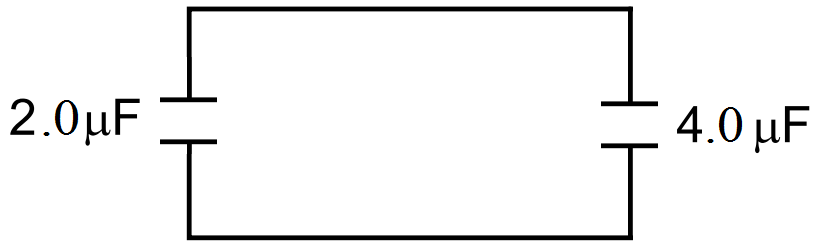
A capacitor of capacitance $2.0\mu\text{F}$ is charged to a potential difference of $12V.$ It is then connected to an uncharged capacitor of capacitance $4.0\mu\text{F}$ as shown in figure. Find:
  1. The charge on each of the two capacitors after the connection.
  2. The electrostatic energy stored in each of the two capacitors.
  3. The heat produced during the charge transfer from one capacitor to the other.
A charge of $8 \ mC$ is located at the origin. Calculate the work done in taking a small charge of $–2 \times 10^{–9} C$ from a point $P (0, 0, 3 \ cm)$ to a point $Q (0, 4 \ cm, 0),$ via a point $R (0, 6 \ cm, 9 \ cm)$.