Question
Explain principle of Rutherford and Soddy in relation with redioactive decay.

Answer

When a radioactive element emits $\alpha-$ or $\beta-$ particle the original atom of the element called the parent atom changes into a new atom of another element called the daughter atom and the parent atom is said to be disintegrated. Now, if the daughter atom is also radioactive, the process of disintegration continues till a stable element usually lead is obtained. This phenomenon is known as radioactive disintegration and this gives rise to a series of radioactive elements. There are three main series namely uranium, thorium and actinium series.
In 1903 Rutherford and Soddy together made an exhaustive study of radioactive disintegration and summed up their conclusions in the form of two laws as follows:
(1) Soddy's group displacement law : It may be stated in the following two parts :
(i) When an element is disintegrated by the emission of an $\alpha$ - particle $\left({ }_2^4 He \right)$, the daughter element obtained has an atomic mass number less by 4 and atomic number less by 2 and it falls in a group of periodic table two coloumns to the left of the parent element.
In this way if a parent element X of mass number A and atomic number Z emits an $\alpha$ - particle to form a daughter element Y then the disintegration process can be expressed as follows :
${}_{Z}^{A}X \rightarrow {}_{Z-2}^{A-4}Y + {}_{2}^{4}He$ ($\alpha$ - particle)
Image
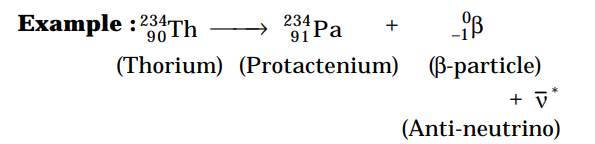
(ii) When an element is disintegrated by the emission of a $\beta$-particle $\left({ }_{-1}^0 \beta\right)$ , the daughter element obtained has an atomic mass number same as that of parent element and atomic number increased by 1 and it falls in a group of periodic table one coloumn to the right.
In this way if a parent element X with mass number A and atomic number Z emits a $\beta$-particle to form a daughter element Y then this disintegration process is expressed as follows :
${}_{Z}^{A}X \rightarrow {}_{Z+1}^{A}Y + {}_{-1}^{0}\beta + \bar{v}$
Image
Although $\gamma$-rays are emitted with the emission of a-particle and $\beta$-particle both, but if only $\gamma$-rays are emitted from some nucleus there is no change in mass number and atomic number of the parent nucleus but it falls in its excited state.
(2) Law of Decay : When a radioactive element disintegrates by emitting $\alpha-$ or β-particles, the number of atoms of the parent element goes on decreasing with passage of time because disintegration occurs spontaneously i.e. it is a continuous process. The continuous decrease in number of atoms of parent element is called radioactive decay. All the atoms of a radioactive element do not disintegrate simultaneously. Which atom will disintegrate first is simply a matter of chance. Thus, the radioactive disintegration process is statistical in nature.
The law of radioactive decay established by Rutherford and Soddy experimentally is stated as follows :
"The rate of disintegration of a radioactive element (i.e., number of atoms disintegrating per second) at any instant is directly proportional to the number of atoms present in the element at that instant."
This law is known as Rutherford-Soddy's law of radioactive decay.
Since radioactive disintegration is a continuous process hence the number of atoms present decreases with time. Therefore, the rate of disintegration decreases with time. According to this law
$\frac{ d N }{ d t }=-\lambda . N$ ...(1)
If N be the number of atoms of a radioactive element present at any given instant $t$ and $d N$, be the number of atoms that disintegrate during the time interval $d t$ (from $t$ to $t+d t)$, and $\lambda$ is called decay constant of radioactive element. The above relation (1) can also be expressed as follows :
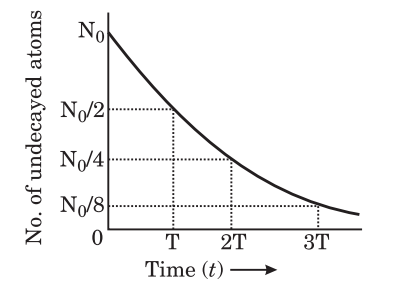
$N = N _0 \cdot e^{-\lambda t}$ ...(2)
Or $N = N _0(1 / 2)^n$ ...(3)
where $n$ = number of half-life in time '$t$'.
A graph between undecayed atoms and time is shown in the figure given here. The radioactive substance decreases exponentially with time i.e. more rapidly first and slowly afterwards.
Image

Need a full question paper?

Generate a complete, print-ready paper with questions like this in minutes — across 16+ boards, with answer keys.
Start Generating Free

Similar questions

Suppose all the electrons of $100g$ water are lumped together to form a negatively charged particle and all the nuclei are lumped together to form a positively charged particle. If these two particles are placed $10.0\ cm$ away from each other, find the force of attraction between them. Compare it with your weight.
A particle of charge $2.0 \times 10^{-8}C$ and mass $2.0 \times 10^{-10}g$ is projected with a speed of $2.0 \times 10^3m/s^{-1}$ in a region with a uniform magnetic field of $0.10T.$ The velocity is perpendicular to the field. Find the radius of the circle formed by the particle and also the time period.
Explain Hertz experiment for communication of electromagnetic waves. Draw labelled diagram of apparatus used in the experiment.
$(or)$
Explain Hertz experiment related with electromagnetic waves and also explain experiments of Jagdish Chandra Basu and Marconi.
$(or)$
Critically evaluate Hertz experiment of production and communication of electromagnetic waves.
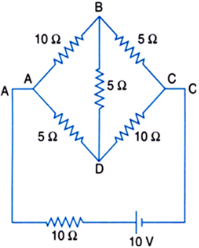
Determine the current in each branch of the network shown in Fig :
The conduction band of a solid is partially filled at 0K. Will it be a conductor, a semiconductor or an insulator?
A compound microscope has a magnifying power of $100$ when the image is formed at infinity. The objective has a focal length of $0.5\ cm$ and the tube length is $6.5\ cm$. Find the focal length of the eyepiece.
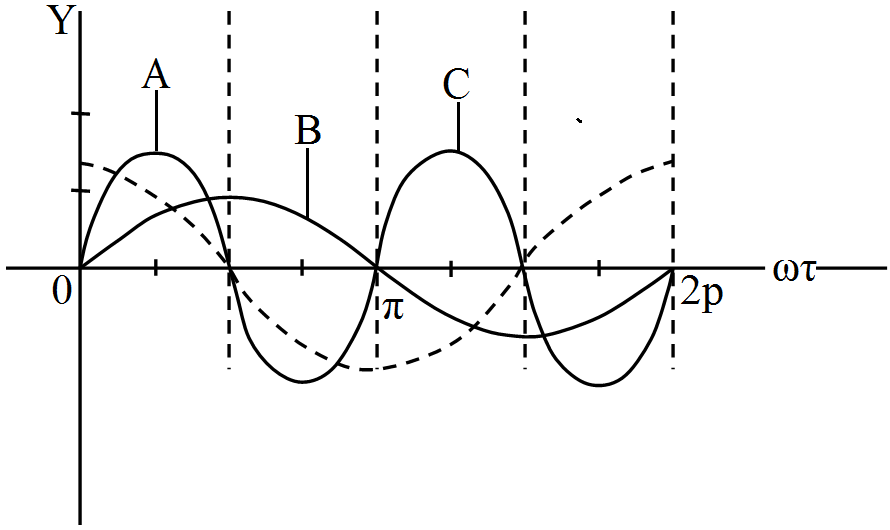
A device ‘X’ is connected to an ac source $\text{V = V}_0\sin\omega\text{t}.$ The variation of voltage, current and power in one cycle is show in the following graph:
  1. Identify the device ‘X’.
  2. Which of the curves, A, B and C represent the voltage, current and the power consumed in the circuit? Justify your answer.
  3. How does its impedance vary with frequency of the ac source? Show graphically.
  4. Obtain an expression for the current in the circuit and its phase relation with ac voltage.
  1. Draw the circuit diagrams of a $p-n$ junction diode in $(i)$ forward bias$, (ii)$ reverse bias. How are these circuits used to study the $V - I$ characteristics of a silicon diode? Draw the typical $V - I$ characteristics.
  2. What is a light emitting diode $\text{(LED)}$? Mention two important advantages of $\text{LEDs}$ over conventional lamps.
A particle of mass $m$ and charge $q$ is projected into a region that has a perpendicular magnetic field $B$. Find the angle of deviation of the particle as it comes out of the magnetic field if the width $d$ of the region is very slightly smaller than
  1. $\frac{\text{mv}}{\text{qB}}$
  2. $\frac{\text{mv}}{2\text{qB}}$
  3. $\frac{2\text{mv}}{\text{qB}}.$
Sometimes we show an idealised magnetic field which is uniform in a given region and falls to zero abruptly. One such field is represented in figure. Using Ampere's law over the path PQRS, show that such a field is not possible.