Question
Define the term ‘mutual inductance’ between the two coils.
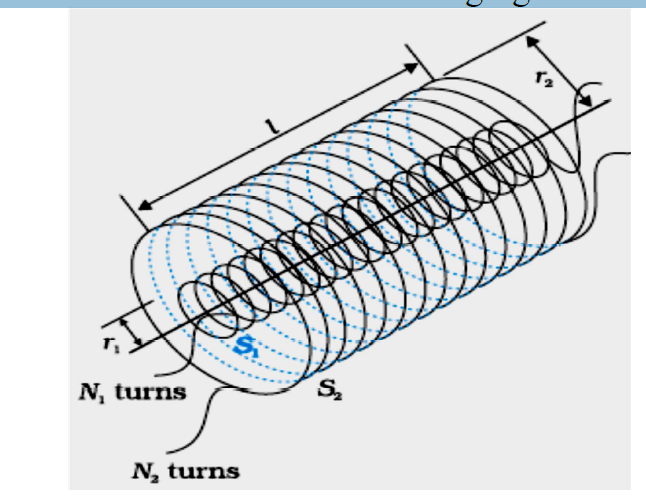
Obtain the expression for mutual inductance of a pair of long coaxial solenoids each of length $l$ and radii $r_1$ and $r_2 (r_2 >> r_1).$ Total number of turns in the two solenoids are $N_1$ and $N_2$ respectively.
Answer

Mutual inductance, between a pair of coils, equals the magnetic flux, linked with one of them, due to a unit current flowing in the other.Alternate Answer
The mutual inductance, for a pair of coils, equals the emf induced, in one of them, when the current in the

Let a current $I_2$ flow through the outer coil. The magnetic field due to this current $ = \mu_{o}\frac{\text{N}_{2}}{l}\times\text{I}_{2}$ The resulting magnetic flux linked with the inner coil $ = \phi_{12} = \text{N}_{1}.\big(\mu_{o}\frac{\text{N}_{2}}{l}\times\text{I}_{2}\big)\times\pi\text{r}_{1}^{2}$
$ = \bigg(\mu_{o}\frac{\text{N}_{1}\text{N}_{2}}{l}.\pi\text{r}^{2}_{1}\bigg)\text{I}_{2} = M_{12} I_2$
$\therefore\text{M}_{12} = \mu_{o}\frac{\text{N}_{1}\text{N}_{2}}{l}.\pi\text{r}^{2}_{1}.$

Need a full question paper?

Generate a complete, print-ready paper with questions like this in minutes — across 16+ boards, with answer keys.

Start Generating Free

Similar questions

A straight wire carrying an electric current is placed along the axis of a uniformly charged ring. Will there be a magnetic force on the wire if the ring starts rotating about the wire? If yes, in which direction?
The centre of mass is defined as $\overrightarrow{\text{R}}=\frac{1}{\text{M}}\sum\limits_\text{i}\text{m}_\text{i}\overrightarrow{\text{r}_{\text{i}}}.$ Suppose we define "centre of charge" as $\overrightarrow{\text{R}}_\text{c}=\frac{1}{\text{Q}}\sum\limits_\text{i}\text{q}_\text{i}\overrightarrow{\text{r}_{\text{i}}}$ where $q_i$ represents the $i^{th}$ charge placed at $\overrightarrow{\text{r}_\text{i}}$ and $Q$ is the total charge of the system.
  1. Can the centre of charge of a two $-$ charge system be outside the line segment joining the charges?
  2. If all the charges of a system are in $X-Y$ plane, is it necessary that the centre of charge be in $X-Y$ plane?
  3. If all the charges of a system lie in a cube, is it necessary that the centre of charge be in the cube?
Suppose that the particle in Exercise in $1.33$ is an electron projected with velocity $v_x= 2.0 \times 10^6 m s^{–1}.$ If $E$ between the plates separated by $0.5 \ cm$ is $9.1 \times 10^2N/C,$ where will the electron strike the upper plate? $(|e|=1.6 \times 10^{–19}C, m_e = 9.1 \times 10^{–31} \ kg.)$
A steel wire of mass $4.0g$ and length $80\ cm$ is fixed at the two ends. The tension in the wire is $50N$. Find the frequency and wavelength of the fourth harmonic of the fundamental.
A light of wavelength 6000 Å is incident on a metal of work function 2 eV. Will electrons be emitted? If yes, find maximum energy of emitted electrons.
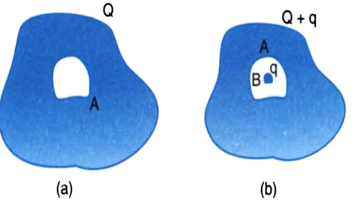
  1. A conductor A with a cavity as shown in Fig. 1.36(a) is given a charge Q. Show that the entire charge must appear on the outer surface of the conductor.
  2. Another conductor B with charge q is inserted into the cavity keeping B insulated from A. Show that the total charge on the outside surface of A is Q + q [Fig. 1.36(b)].
  3. A sensitive instrument is to be shielded from the strong electrostatic fields in its environment. Suggest a possible way.
What should be the orientation of a magnetic dipole in a uniform magnetic field so that its potential energy is maximum?
  1. When an AC source is connected to an ideal capacitor, show that the average power supplied by the source over a complete cycle is zero.
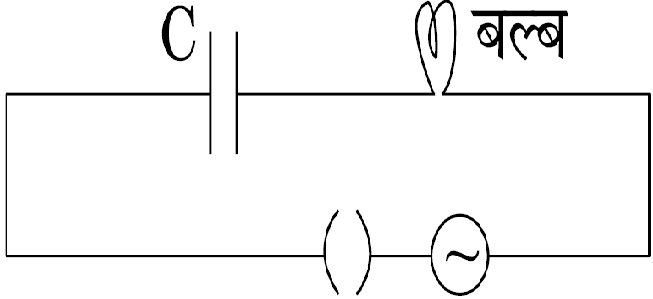
  2. A bulb is connected in series with a variable capacitor and an A.C. source as shown. What happens to the brightness of the bulb when the key is the capacitor is gradually reduced?
Write two properties and two uses of X-rays.
A block of 2kg is suspended from the ceiling through a massless spring of spring constant k = 100N/m. What is the elongation of the spring? If another 1kg is added to the block, what would be the further elongation?