Question
  1. Define the term ‘volt’.
  2. State the relation between work, charge and potential difference for an electric circuit.

Calculate the potential difference between the two terminals of a battery if 100 joules of work is required to transfer 20 coulombs of charge from one terminal of the battery to the other.
Answer

  1. One volt is the potential difference between two points in a current carrying conductor when 1 joule of work is done to move a charge of 1 coulomb from one point to another.
  2. Work = charge x potential difference $(\text{OR }\text{W = Q} \times \text{V})$

$V = \frac{W}{Q}$

$V = \frac{\text{100 J}}{\text{20 C}}$

$\therefore V = \text{5 volt}$

Need a full question paper?

Generate a complete, print-ready paper with questions like this in minutes — across 16+ boards, with answer keys.

Start Generating Free

Similar questions

A boy uses spectacles of focal length -60cm. Name the defect of vision he is suffering from. Which lens is used for the correction of this defect? Compute the power this lens.
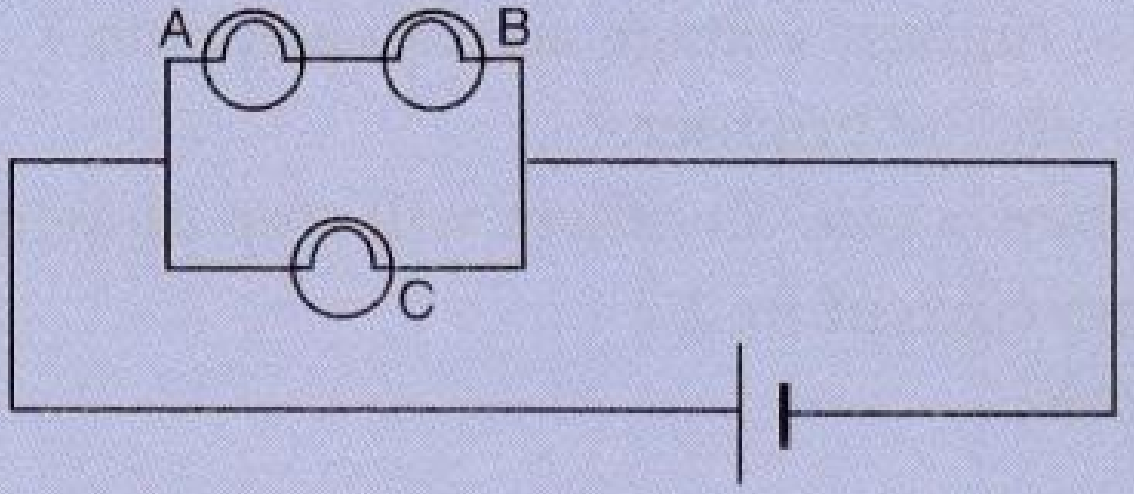
Consider the circuit given below where A, B and C are three identical light bulbs of constant resistance.

  1. List the bulbs in order of increasing brightness.
  2. If C burns out, what will be the brightness of A now compared with before?
  3. If B burns out instead, what will be the brightness of A and C compared with before?
A current of 1 ampere flows in a series circuit containing an electric lamp and a conductor of 5Ω when connected to a 10V battery. Calculate the resistance of the electric lamp.
Now if a resistance of 10Ω is connected in parallel with this series combination, what change (if any) in current flowing through 5Ω conductor and potential difference across the lamp will take place? Give reason.
It is established that an electric current through a metallic conductor produces a magnetic field around it. Is there a similar magnetic field produced around a thin beam of moving (i) alpha particles, (ii) neutrons? Justify your answer.
Explain why the planets do not twinkle.
A man sits in an optician's chair looking into plane mirror which is 2m away from him and views the image of a chart which faces the mirror and is 50cm behind his head. How far away from his eyes does the chart appear to be?
Compare and contrast biomass and hydroelectricity as sources of energy.
What are the common defects of vision that can be corrected by the use of suitable eyeglasses or spectacles?
In what respect does the construction of an A.C. generator differ from that of a D.C. generator?
State where an object must be placed so that the image formed by a concave mirror is:
  1. Erect and virtual.
  2. At infinity.
  3. The same size as the object.