Question
Explain why the planets do not twinkle.

Answer

Planets being close to earth appear larger in size. A planet can be Considered as a collection of large number of small sized objects. Twinkling effect Of these objects cancel each other. so, planets do not appear to twinkle.

Need a full question paper?

Generate a complete, print-ready paper with questions like this in minutes — across 16+ boards, with answer keys.
Start Generating Free

Similar questions

When an object is placed 10cm in front of lens A, the image is real, inverted, magnified and formed at a great distance. When the same object is placed 10cm in front of lens Bthe image formed is real, inverted and same size as the object:
  1. What is the focal length of lens A?
  2. What is the focal length of lens B?
  3. What is the nature of lens A?
  4. What is the nature of lens B?
An object of size 7.0cm is placed at 27cm in front of a concave mirror of focal length 18cm. At what distance from the mirror should a screen be placed so that a sharp focussed image can be obtained? Find the size and nature of image.
[Hint. Find the value of image distance (v) first. The screen should be placed from the mirror at a distance equal to image distance.]
If an object of 10cm height is placed at a distance of 36cm from a concave mirror of focal length 12cm, find the position, nature and height of the image.
A concave lens of focal length 15 cm forms an image 10 cm from the lens. How far is the object placed from the lens? Draw the ray diagram.
How does inserting the control rods in the graphite core affect the fission in the reactor? Explain your answer.
An object 60cm from a lens gives a virtual image at a distance of 20cm in front of the lens. What is the focal length of the lens? Is the lens converging or diverging? Give reasons for your answer.
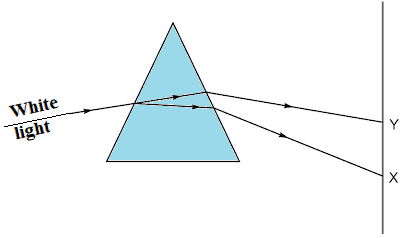
In the figure given alongside, a narrow beam of white light is shown to pass through a triangular glass prism. After passing through the prism, it produces a spectrum YX on the screen:
State the colour seen.
  1. At X, and
  2. At Y​​​​​​​​​​​​


​​​​​​​​​​​​
  1. violet.
  2. Red
  1. ​​​​​​​Why do different colours of white light bend through different angles with respect to the incident beam of light?
Two lenses of power -3.5D and + 1D are placed in contact. Find the total power of the combination of lens. Calculate the focal length of this combination.
Explain with the help of labelled ray diagram, the defect of vision called myopia and how it is corrected by a lens.
The optical prescription for a pair of spectacles is:
Right eye: 3.50D, Left eye: 4.00D
  1. Are these lenses thinner at the middle or at the edges?
  2. Which lens has a greater focal length?
  3. Which is the weaker eye?