Question
Define the terms (i) 'cut-off voltage' and (ii) 'threshold frequency' in relation to the phenomenon of photoelectric effect.
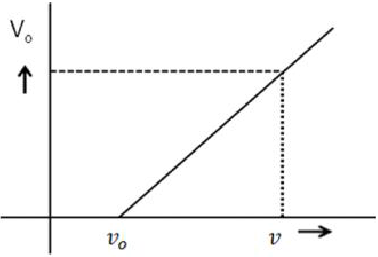
Using Einstein's photoelectric equation show how the cut-off voltage and threshold frequency for a given photosensitive material can be determined with the help of a suitable plot/graph.
Answer

Cut – off voltage: The minimum negative potential$(V_0)$ applied to the plate or anode (A) for which the photoelectric current just becomes zero, Threshold frequency: The minimum frequency of incident radiation which is required to have photo electrons emitted from a given metal surface. As per Einstein's photoelectric equation. $\text{eV}_{0} = \text{hv} - \text{hv}_{0}, \text{ for } \text{v} > \text{v}_{0}$ $\text{v}_{0} = \frac{\text{h}}{\text{e}}(\text{v} - \text{v}_{o} ) $ Hence the intercept, on the v- axis, gives $v_0.$

Need a full question paper?

Generate a complete, print-ready paper with questions like this in minutes — across 16+ boards, with answer keys.

Start Generating Free

Similar questions

Explain internal reflection and total internal reflection and also derive the necessary formula for it.
Explain isotopes, isobars, isotones and isomers by giving examples.
A water particle of mass 10.0mg and having a charge of $1.50 \times 10^{-6} C$ stays suspended in a room. What is the magnitude of electric field in the room? What is its direction?
A block at rest explodes into three equal parts. Two parts start moving along X and Y axes respectively with equal speeds of 10m/s. Find the initial velocity of the third part.
A train approaching a platform at a speed of 54km/h sounds a whistle. An observer on the platform finds its frequency to be 1620Hz. The train passes the platform keeping the whistle on and without slowing down. What frequency will the observer hear after the train has crossed the platfrom? The speed of sound in air = 332m/s.
Two narrow slits emitting iight in phase are separated by a distance of 1.0cm. The wavelength of the light is $5.0 \times 10^{-7}m$. The interference pattern is observed on a screen placed at a distance of 1.0m.
  1. Find the separation between the consecutive maxima. Can you expect to distinguish between these maxima?
  2. Find the separation between the sources which will give a separation of 1.0mm between the consecutive maxima.
What is the de Broglie wavelength of:
  1. A bullet of mass 0.040 kg travelling at the speed of 1.0 km/s,
  2. A ball of mass 0.060 kg moving at a speed of 1.0 m/s, and
  3. A dust particle of mass $1.0 \times 10^{–9} kg$ drifting with a speed of 2.2 m/s?
Using Bohr's postulates, obtain the expression for the total energy of the electron in the stationary states of the hydrogen atom. Hence draw the energy level diagram showing how the line spectra corresponding to Balmer series occur due to transition between energy levels.
A ball is projected vertically upward with a speed of 50m/s. Find:
  1. The maximum height.
  2. The time to reach the maximum height.
  3. The speed at half the maximum height. Take $g = 10m/s^2.$
There are energy bands in a solid. Do we have really continuous energy variation in a band or do we have very closely spaced but still discrete energy levels?