Question
Define the work done by a constant force on an object and describe their specific situations.
Answer

self

Need a full question paper?

Generate a complete, print-ready paper with questions like this in minutes — across 16+ boards, with answer keys.

Start Generating Free

Similar questions

The current in a conductor and the potential difference across its ends are measured by an ammeter and a voltmeter. The meters draw negligible currents. The ammeter is accurate but the voltmeter has a zero error (that is, it does not read zero when no potential difference is applied). Calculate the zero error if the readings for two different conditions are 1.75A, 14.4V and 2.75A, 22.4V.
Derive an expression for the velocity of the two masses $m_1$ and $m_2$ moving with speeds $u_1$ and $u_2$ undergoing elastic collision in one dimension.
The energy from the sun reaches just outside the earth's atmosphere at a rate of $1400W/m^2$. The distance between the sun and the earth is $1.5 \times 10^{11}m$.
  1. Calculate the rate at which the sun is losing its mass.
  2. How long will the sun last assuming a constant decay at this rate? The present mass of the sun is $2 \times 10^{80}kg$.
What is meant by resolution of a vector? Prove that a vector can be resolved along two given directions in one and only one way.
A stone of mass m is tied to an elastic string of negligble mass and spring constant k. The unstretched length of the string is L and has negligible mass. The other end of the string is fixed to a nail at a point P. Initially the stone is at the same level as the point P. The stone is dropped vertically from point P.
  1. Find the distance y from the top when the mass comes to rest for an instant, for the first time.
  2. What is the maximum velocity attained by the stone in this drop?
  3. What shall be the nature of the motion after the stone has reached its lowest point?
One end of a U-tube containing mercury is connected to a suction pump and the other end to atmosphere. A small pressure difference is maintained between the two columns. Show that, when the suction pump is removed, the column of mercury in the U-tube executes simple harmonic motion.
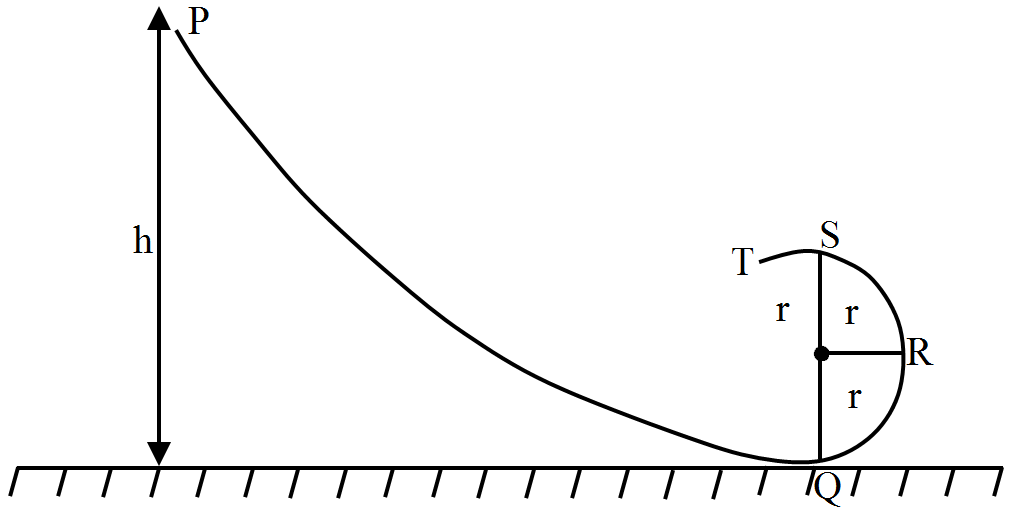
Given in figure PQRST is a channel in the vertical plane, part QRST being circular arc of radius r. A ball is released from P, and slides without friction and without rolling. Show that it will complete the loop path if h is greater than $\frac{5\text{r}}{2}.$
Add vectors $\overrightarrow{\text{A}},\overrightarrow{\text{B}}$ and $\overrightarrow{\text{C}}$ each having magnitude of 100 unit and inclined to the X-axis at angles 45°, 135° and 315° respectively.
An object is placed at a distance of 30cm from a converging lens of focal length 15cm. A normal eye (near point 25cm, far point infinity) is placed close to the lens on the other side.
  1. Can the eye see the object clearly?
  2. What should be the minimum separation between the lens and the eye so that the eye can clearly see the object?
  3. Can a diverging lens, placed in contact with the converging lens, help in seeing the object clearly when the eye is close to the lens?
  1. Write the Hooke's law.
  2. A steel wire of length $4m$ and diameter $5mm$ is stretched by $5kg-wt$. Find the increase in its length, if the young's modulus of steel wire is $2.4 \times 10^{12}$ dyne $cm^{-2}$?