Question
Derive an expression for the velocity of the two masses $m_1$ and $m_2$ moving with speeds $u_1$ and $u_2$ undergoing elastic collision in one dimension.

Answer

One dimensional elastic collision is one in which both momentum and K.E. are conserved and the body moves in the same line of motion even after the collision. If $m_1, m_2$ are the masses, $u_1 u_2$ are the initial velocities and $v_1 V_2$ are the final velocities, then $m_1 u_1+m_2 u_2=m_1 v_1+m_2 v_2 \ldots$ (i) $\frac{1}{2} m_1 u_1^2+\frac{1}{2} m_2 v_2^2=\frac{1}{2} m_1 v_1^2+\frac{1}{2} m_2 v_2^2 \cdots$ (ii) (i.e..) $m_1\left(v_1^2-u_1^2\right)=m_2\left(v_2^2-u_2^2\right)$ Form (ii) $m_1\left(v_1-u_1^2\right)=m_2\left(v_2-u_2\right)$ Form (i) Dividing both sides $v_1+u_1=$ $v_2+u_2 v_1=v_2+u_2-u_1$ substituting in (i) we have, $m_1 u_1+m_2 u_2=m_1\left(v_2+u_2-u_1\right)+m_2 v_2 2 m_1 u_1+u_2\left(m_2-m_1\right)$ $=v_2\left(m_1+m_2\right) v^2=\frac{u_2\left(m_2-m_1\right)+2 m_1 u_1}{\left(m_1+m_2\right)}$ Similartly, $v_1=\frac{u_1\left(m_1-m_2\right)+2 m_2 u_2}{\left(m_1+m_2\right)}$

Need a full question paper?

Generate a complete, print-ready paper with questions like this in minutes — across 16+ boards, with answer keys.
Start Generating Free

Similar questions

Define simple harmonic motion. Derive the differential equation of its motion and find the solution.
A wire of length $10cm$ translates in a direction making an angle of $60°$ with its length. The plane of motion is perpendicular to a uniform magnetic field of $1.0T$ that exists in the space. Find the emf induced between the ends of the rod if the speed of translation is $20cm/s^{-1}$.
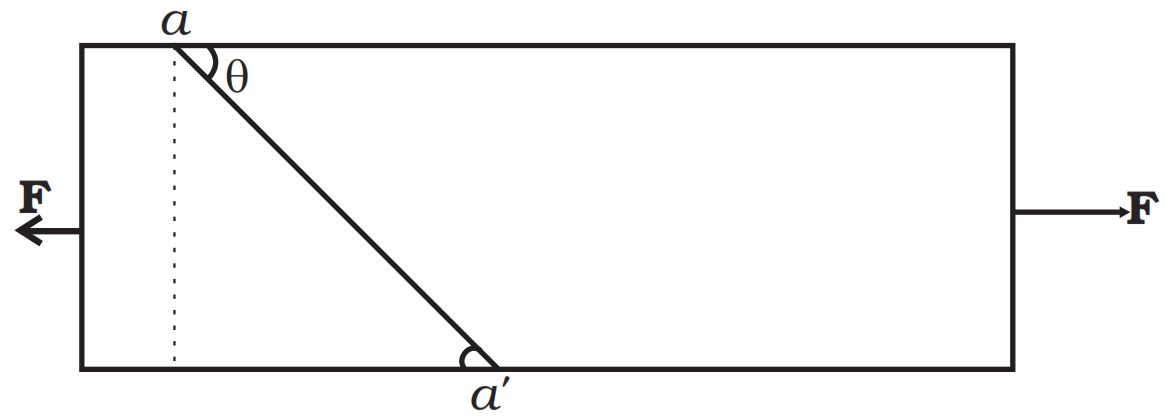
Consider a long steel bar under a tensile stress due to forces F acting at the edges along the length of the bar. Consider a plane making an angle $\Delta$ with the length. What are the tensile and shearing stresses on this plane?
  1. For what angle is the tensile stress a maximum?
  2. For what angle is the shearing stress a maximum?
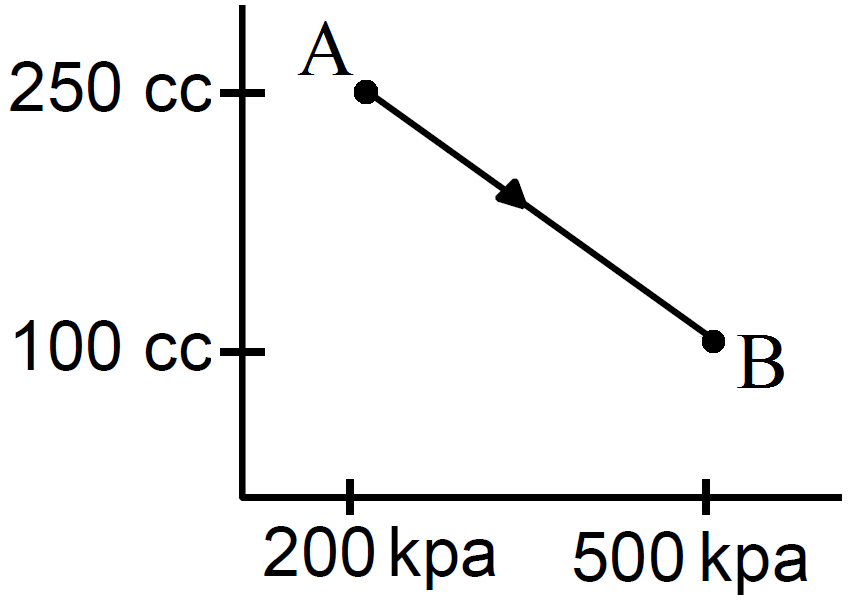
A gas is taken along the path AB as shown in figure. If 70cal of heat is extracted from the gas in the process, calculate the change in the internal energy of the system.
A load resistor of $2\text{k}\Omega$ is connected in the collector branch of an amplifier circuit using a transistor in common-emitter mode. The current gain $\beta=50.$ The input resistance of the transistor is $0.50\text{k}\Omega.$ If the input current is changed by $50\mu\text{A}.$
  1. By what amount does the output voltage change?
  2. By what amount does the input voltage change?
  3. What is the power gain?
A geostationary satellite is orbiting the earth at a height of 6R above the surface of earth. Here R is the radius of the earth. What is the time period of another satellite at a height of 2.5R from the surface of the earth?
Establish the following vector inequalities:
i. $|\vec{a}+\vec{b}| \leq|\vec{a}|+|\vec{b}|$
ii. $|\vec{a}-\vec{b}| \leq|\vec{a}|+|\vec{b}|$
When does the equality sign apply?
A box of $1.00m3$ is filled with nitrogen at $1.5$ atm at $300K$. The box has a hole of an area $0.010\ mm2$. How much time is required for the pressure to reduce by $0.10$atm, if the pressure outside is 1atm.
A ball falls on an inclined plane of inclination $\theta$ from a height h above the point of impact and makes a perfectly elastic collision. Where will it hit the plane again?
There are three forces $F_1, F_2$ and $F_3$ acting on a body, all acting on a point P on the body. The body is found to move with uniform speed.
  1. Show that the forces are coplanar.
  2. Show that the torque acting on the body about any point due to these three forces is zero.