Question
Define thermal conductivity and write its practical applications.

Answer

SELF

Need a full question paper?

Generate a complete, print-ready paper with questions like this in minutes — across 16+ boards, with answer keys.
Start Generating Free

Similar questions

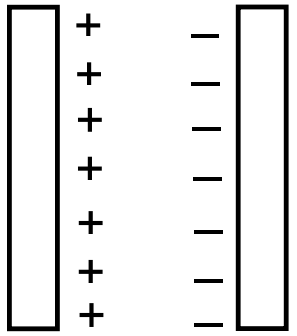
Two large conducting plates are placed parallel to each other and they carry equal and opposite charges with surface density $\sigma$ as shown in figure. Find the electric field:
  1. At the left of the plates.
  2. In between the plates.
  3. At the right of the plates.
A slightly tapering wire of length I and end radii a and b on both sides is subjected to the stretching forces F on both sides as shown in figure. If Y is the Young's modulus of the wire, calculate the extension produced in the wire.
A box of 1.00m3 is filled with nitrogen at 1.5 atm at 300K. The box has a hole of an area 0.010 mm2. How much time is required for the pressure to reduce by 0.10atm, if the pressure outside is 1atm.
Define molar specific heat capacities at constant volume and pressure. Considering thermodynamical process in a cylinder with parameters P, V and T, derive the Mayer's relation.
Find the charge required to flow through an electrolyte to liberate one atom of.
  1. A monovalent material.
  2. A divalent material.
A 6.5m long ladder rests against a vertical wall reaching a height of 6.0m. A 60kg man stands half way up the ladder.
  1. Find the torque of the force exerted by the man on the ladder about the upper end of the ladder.
  2. Assuming the weight of the ladder to be negligible as compared to the man and assuming the wall to be smooth, find the force exerted by the ground on the ladder.
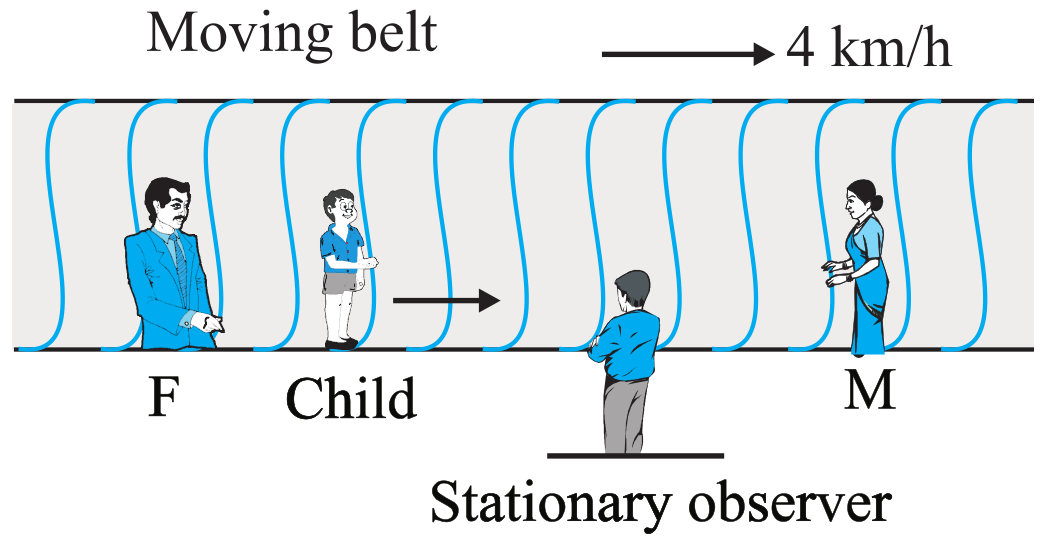
On a long horizontally moving belt a child runs to and fro with a speed $9\ km h^{–1} ($with respect to the belt$)$ between his father and mother located $50 m$ apart on the moving belt. The belt moves with a speed of $4\ km h^{–1}$. For an observer on a stationary platform outside, what is the
  1. speed of the child running in the direction of motion of the belt?.
  2. speed of the child running opposite to the direction of motion of the belt?
  3. time taken by the child in $(a)$ and $(b)?$
Which of the answers alter if motion is viewed by one of the parents?
Six point masses of mass m each are at the vertices of a regular hexagon of side l. Calculate the force on any of the masses.
The volume of a glass vessel is $1000 cc$ at $20^{\circ} \mathrm{C}$. What volume of mercury should be poured into it at this temperature so that the volume of the remaining space does not change with temperature? Coefficients of cubical expansion of mercury and glass are $1.8 \times 10^{-4}{ }^{\circ} \mathrm{C}$ and $9.0 \times 10^{-6}{ }^{\circ} \mathrm{C}^{-1}$ respectively.
A gas mixture consists of $2.0$ moles of oxygen and $4.0$ moles of neon at temperature T. Neglecting all vibrational modes, calculate the total internal energy of the system. (Oxygen has two rotational modes.)