Question
Define $\vec{\text{a}}\times\vec{\text{b}}$ and prove that $\big|\vec{\text{a}}\times\vec{\text{b}}\big|=\big(\vec{\text{a}}.\vec{\text{b}}\big)\tan\theta,$ where $\theta$ is the angle between $\vec{\text{a}}$ and $\vec{\text{b}}.$

Answer

If $\vec{\text{a}}$ and $\vec{\text{b}}$ are two non-parallel vectors, then the vectors product denoted by $\vec{\text{a}}\times\vec{\text{b}}$ is defined as $\vec{\text{a}}\times\vec{\text{b}}=|\vec{\text{a}}|\big|\vec{\text{b}}\big|\sin\theta\hat{\text{ n}}.$
Here, $\theta$ is the angle between $\vec{\text{a}}$ and $\vec{\text{b}}$ and $\hat{\text{n}}$ is the unit vector perpendicular to the plane of $\vec{\text{a}}$ and $\vec{\text{b}}$ such that $\vec{\text{a}},\vec{\text{b}}$ and $\hat{\text{n}}$ form a right
$\text{LHS}=\big|\vec{\text{a}}\times\vec{\text{b}}\big|$
$=|\vec{\text{a}}|\big|\vec{\text{b}}\big|\sin\theta$
$=|\vec{\text{a}}|\big|\vec{\text{b}}\big|\sin\theta\times\frac{\cos\theta}{\cos\theta}$
$=|\vec{\text{a}}|\big|\vec{\text{b}}\big|\cos\theta\frac{\sin\theta}{\cos\theta}$
$=|\vec{\text{a}}|\big|\vec{\text{b}}\big|\cos\theta\tan\theta$
$=\big(\vec{\text{a}}.\vec{\text{b}}\big)\tan\theta$
$=\text{RHS}$
Hence proved

Need a full question paper?

Generate a complete, print-ready paper with questions like this in minutes — across 16+ boards, with answer keys.
Start Generating Free

Similar questions

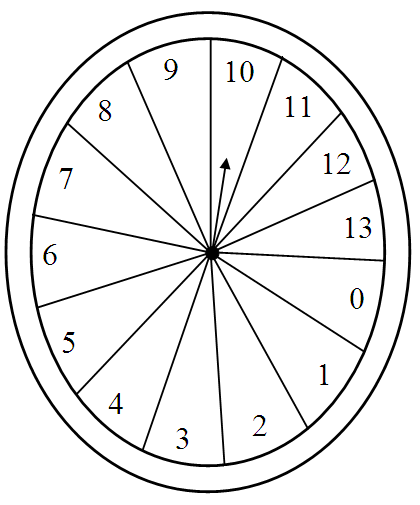
In roulette, Figure, the wheel has 13 numbers 0, 1, 2,...., 12 maked on equally spaced slots. A player sets Rs 10 on a given number. He recieves Rs 100 from the organiser of the game if the ball comes to rest in this slot; otherwise he gets nothing. If X denotes the players net gain/loss, Find E(X).
Evaluate the following intregals:
$\int\sqrt{\frac{1-\text{x}}{1+\text{x}}}\text{dx}$
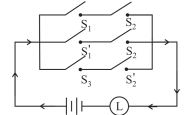
In the following switching circuit,: Simplify the circuit

Image

A vector $\vec{\text{r}}$ is inclined at equal angles to the three axes. If the magnitude of $\vec{\text{r}}$ is $2\sqrt3$, find $\vec{\text{r}}$.
Evaluate the following integrals:$\int\frac{1}{\sqrt{5\text{x}^2-2\text{x}}}\text{ dx}$
A, B, and C are independent witness of an event which is known to have occurred. A speaks the truth three times out of four, B four times out of five and C five times out of six. What is the probability that the occurrence will be reported truthfully by majority of three witnesses?
Solve the following differential equations : $x \sin \frac{d y}{d x}+(x \cos x+\sin y)=\sin x$
Find the derivative of the inverse of the following functions, and also fid their value at the points indicated against them :
$y=\sin (x-2)+x^2$, at $x=2$
Determine the value of the constant k so that the function
$\text{f}\text{(x)}=\begin{cases}\frac{\text{x}^2-3\text{x}+2}{\text{x}-1}, &\text{if}\text{ x}\neq1\\\text{k}, &\text{if}\text{ x}=1\end{cases}$ is continuous at x = 1
Classify the following functions as injection, surjection or bijection:
$f : R \rightarrow R,$ defined by $f(x) = \sin x$