Question
Define velocity and acceleration. Draw a velocity time graph for uniformly accelerated motion and prove that the area between the curve of this graph and the time axis is equal to the displacement of the moving object

Answer

self

Need a full question paper?

Generate a complete, print-ready paper with questions like this in minutes — across 16+ boards, with answer keys.
Start Generating Free

Similar questions

Explain the angle of friction and angle of repose.
A helicopter lifts a $72kg$ astronaut $15m$ vertically from the ocean by means of a cable. The acceleration of the astronaut is $\frac{\text{g}}{10}$.

How much work is done on the astronaut by:
  1. The force from the helicopter and
  2. The gravitational force on him?
  3. What are the kinetic energy and
  4. The speed of the astronaut just before he reaches the helicopter?(Take, $g = 10ms^{‑2}$)
In deriving Bernoulli’s equation, we equated the work done on the fluid in the tube to its change in the potential and kinetic energy.
  1. What is the largest average velocity of blood flow in an artery of diameter $2 × 10⁻³m$ if the flow must remain laminar?
  2. Do the dissipative forces become more important as the fluid velocity increases? Discuss qualitatively.
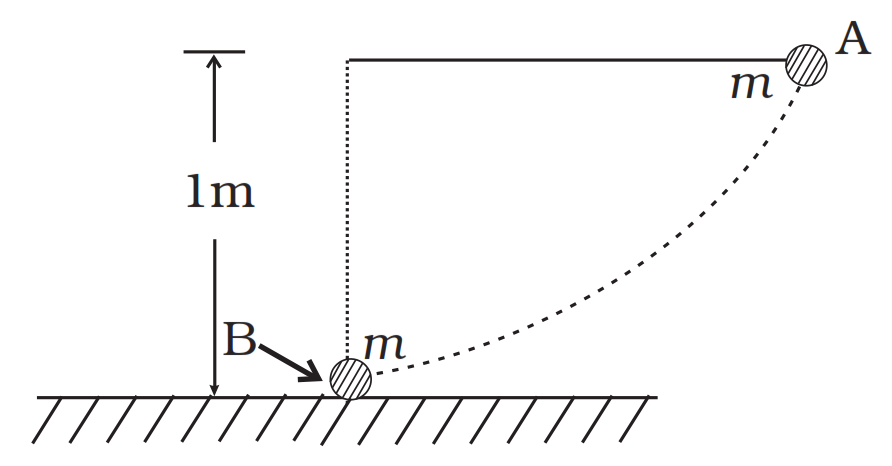
The bob A of a pendulum released from horizontal to the vertical hits another bob B of the same mass at rest on a table as shown in.
If the length of the pendulum is 1m, calculate.
  1. The height to which bob A will rise after collision.
  2. The speed with which bob B starts moving. Neglect the size of the bobs and assume the collision to be elastic.
Two identical metal balls one at $\text{T}_1=300\text{K}$ and the other at $\text{T}_2=600\text{K}$ are kept at a distance of 1m in vacuum. Will the temperatures equalise by radiation? Will the rate of heat gained by the colder sphere be proportional to $\text{T}_2^4-\text{T}_1^4$ as may be expected from the Stefan's law?
Hydrogen gas is contained in a closed vessel at $1atm$ (100kPa) and $300K$. (a) Calculate the mean speed of the molecules. (b) Suppose the molecules strike the wall with this speed making an average angle of $45^\circ$ with it. How many molecules strike each square metre of the wall per second?
A solid sphere rolls down two different inclined planes of the same heights but different angles of inclination.
  1. Will it reach the bottom with the same speed in each case?
  2. Will it take longer to roll down one plane than the other?
  3. If so, which one and why?
Two identical pith balls, each carrying a charge q, are suspended from a common point by two strings of equal length l. Find the mass of each ball if the angle between the strings is $2\theta$ in equilibrium.
Establish the relationship between angular velocity and linear velocity. Also write its vector relation.
Give the description of Carnot cycle and calculate the total work done in one cycle and establish the formula for the efficiency of Carnot engine. Also write Carnot theorem.