Question
Define:
(i) Speed (ii) Velocity. Give two differences between speed and velocity.

Answer

(i) Speed: The distance covered by a body in a unit time is called its speed. It is also defined as the rate of change position of a body in any direction.
speed = distance/time
(ii) Velocity: "Rate of change of displacement with time" is called velocity, or "The time rate of change of displacement of an object" is called the velocity.
V = distance/time
Differences between speed and velocity
Speed:
1. The rate of change of position of a body in any direction is known as its speed.
2. It is a scalar quantity.
3. It can be positive or zero.
Velocity:
1. The rate of change of position of a body in a particular direction is known velocity.
2. It is a vector quantity.
3. It can be positive, negative or zero.

Need a full question paper?

Generate a complete, print-ready paper with questions like this in minutes — across 16+ boards, with answer keys.
Start Generating Free

Similar questions

 A body of volume $100 cm^3$ weighs 1 kgf in air. Find:
(i) Its weight in water and
(ii) Its relative density.
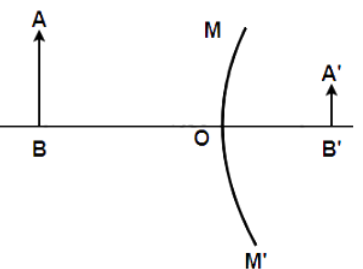
AB is the object, $A_1B_1$ is its image. MM' is the position of the mirror. Complete the ray diagram and find the position of the center of curvature and focus of the mirror. Also, measure the focal length.
Image
With the use of Archimedes' principle, state how you will find relative density of a solid denser than water and insoluble in it. How will you modify your experiments if the solid is soluble in water?
How does the presentation of data in a tabular form help us in analyzing them? Explain with one example.
A 50 m long train passes over a bridge at a speed of 30 km/h. If it takes 36 seconds to cross the bridge, calculate the length of the bridge.
(i) Calculate the height of a water column which will exert on its base the same
Pressure as the 70 cm column of mercury.
(ii) Will the height of the water column change if the cross-section of the water column is made wider?
Distinguish between a closed circuit and an open circuit, with the use of suitable labelled diagrams.
A body of volume $100 cm^3$ weighs $1$ kgf in air. Find:
(i) Its weight in water and
(ii) Its relative density.
State Newton's third law of motion and give two examples reaction are equal and opposite.
A hollow cylinder of copper of length 25 cm and area of cross-section 15 cm , floats in water with $3 / 5$ of its length inside water. Calculate:
(1) apparent density of hollow copper cylinder.
(2) wt. of cylinder.
(3) extra force required to completely submerge it in water.