Question
Demagnetisation of magnets can be done by

Answer

Demagnetization processes include heating past the Curie point, applying a strong magnetic field, applying alternating current, or hammering the metal. Demagnetization occurs naturally over time. The speed of the process depends on the material, the temperature, and other factors.

Need a full question paper?

Generate a complete, print-ready paper with questions like this in minutes — across 16+ boards, with answer keys.
Start Generating Free

Similar questions

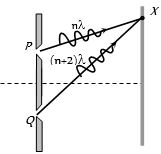
The figure shows a double slit experiment $P$ and $Q$ are the slits. The path lengths $PX $ and $ QX $ are $n\lambda $ and $(n + 2)\lambda $ respectively, where $n $ is a whole number and $\lambda $ is the wavelength. Taking the central fringe as zero, what is formed at $X$
How many wavelength of $K{r^{86}}$ are there in one metre
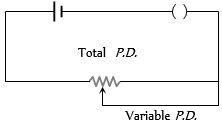
The arrangement as shown in figure is called as
The $K_{\alpha}\; X-$ray of molybdenum has wavelength $0.071\, {nm}$. If the energy of a molybdenum atoms with a $K$ electron knocked out is $27.5\, {keV}$, the energy of this atom when an $L$ electron is knocked out will be $....\,keV.$

(Round off to the nearest integer) $\left[{h}=4.14 \times 10^{-15} \,{eVs}, {c}=3 \times 10^{8}\, {ms}^{-1}\right.]$
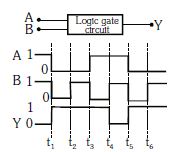
The following figure shows a logic gate circuit with two inputs $A $and $B$ and the output $Y$. The voltage waveforms of $A$, $B$, and $Y$ are as given? The logic gate is
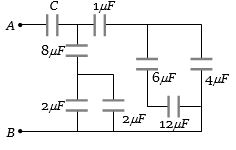
In the following circuit, the resultant capacitance between $A$ and $B$ is $1\,\mu F$. Then value of $C$ is
A long straight wire carries a current of $35\; A$. What is the magnitude of the field $B$ at a point $20\; cm$ from the wire?
$P-V$ diagram of a diatomic gas is a straight line passing through origin. The molar heat capacity of the gas in the process will be
It is found that an increase in pressure of $100\, kPa$ causes a certain volume of water to decrease by $5 × 10^{-3}$ percent of its original volume. Then the speed of sound in the water is about .... $m/s$ (density of water $10^3 \,kg/m^3$)
$A$ small bead of mass $m$ moving with velocity $v$ gets threaded on a stationary semicircular ring of mass $m$ and radius $R$ kept on a horizontal table. The ring can freely rotate about its centre. The bead comes to rest relative to the ring. What will be the final angular velocity of the system?