MCQ
Density of a $2.05\,M$ solution of acetic acid in water is $1.02\, g/mL.$ The molality of the solution is ............. $\mathrm{mol}$ $\mathrm{kg}^{-1}$
- ✓$2.28$
- B$0.44$
- C$1.14$
- D$3.28$
Here $M=$ molarity, $M$ solute $=$ molecular mass of solute, $d=$ density of solution
$\therefore m=\frac{1000 \times 2.05}{1000 \times 1.02-2.05 \times 00}=2.28$
Generate a complete, print-ready paper with questions like this in minutes — across 16+ boards, with answer keys.
$A : 1s^2\, 2s^2\, 2p^6$
$B : 1s^2\, 2s^2\, 2p^6\, 3s^2\, 3p^3$
$C : 1s^2\, 2s^2\, 2p^6\, 3s^2\, 3p^5$
$I.$ ${C_2}{H_4}$ $II.$ ${C_2}{H_2}$
$III.$ ${C_6}{H_6}$ $IV.$ ${C_2}{H_6}$
(image)
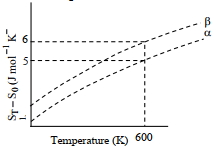
The transition temperature for $\alpha$ to $\beta$ phase change is $600 \mathrm{~K}$ and $C_{p, \beta}-C_{p, \alpha}=1 \mathrm{~J} \mathrm{~mol}^{-1} \mathrm{~K}^{-1}$. Assume $\left(C_{p, \beta}-C_{p, \alpha}\right)$ is independent of temperature in the range of 200 to $700 \mathrm{~K} . \mathrm{C}_{p, \alpha}$ and $C_{p, \beta}$ are heat capacities of $\alpha$ and $\beta$ phases, respectively.
($1$)The value of entropy change, $\mathrm{S}_\beta-\mathrm{S}_\alpha$ (in $\mathrm{J} \mathrm{mol}^{-1} \mathrm{~K}^{-1}$ ), at $300 \mathrm{~K}$ is. . . . . . .
[Use : $\ln 2=0.69$ Given : $S_\beta-S_\alpha=0$ at $\left.0 \mathrm{~K}\right]$
($2$) The value of enthalpy change, $\mathrm{H}_\beta-\mathrm{H}_\alpha$ (in $J$ mol ${ }^{-1}$ ), at $300 \mathrm{~K}$ is
Give the answer quetion ($1$) and ($2$)