Question
Derive an expression for equivalent capacitance of three capacitors when connected
i. in series and
ii. in parallel.

Answer

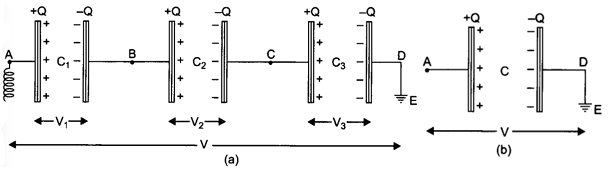
i. In fig. (a) three capacitors of capacitances $C_1, C_2, C_3$ are connected in series between points $A$ and $D$.
Image

In series first plate of each capacitor has charge +Q and second plate of each capacitor has charge -Q i.e., charge on each capacitor is Q.
Let the potential differences across the capacitors $C_1, C_2, C_3$ be $V_1, V_2, V_3$ respectively. As the second plate of first capacitor $C _1$ and first plate of second capacitor $C _2$ are connected together, their potentials are equal. Let this common potential be $V _{ B }$ Similarly the common potential of second plate of $C _2$ and first plate of $C _3$ is $V _{ C }$. The second plate of capacitor $C _3$ is connected to earth, therefore its potential $V_D=0$. As charge flows from higher potential to lower potential, therefore $V_A>V_B$ $> V _{ C }> V _{ D }$.
For the first capacitor, $V _1= V _{ A }- V _{ B }=\frac{Q}{C_1} \ldots$ (i)
For the second capacitor, $V _2= V _{ B }- V _{ C }=\frac{Q}{C_2} \ldots$ (ii)
For the third capacitor, $V _3= V _{ C }- V _{ D }=\frac{q}{c_3} \ldots$ (iii)
Adding (i), (ii) and (iii), we get
$V _1+ V _2+ V _3= V _{ A }- V _{ D }=Q\left[\frac{1}{C_1}+\frac{1}{C_2}+\frac{1}{C_3}\right] \ldots$ (iv)
If V be the potential difference between A and D, then
$V _{ A }- V _{ D }= V$
$\therefore$ From (iv), we get
$V =\left( V _1+ V _2+ V _3\right)=Q\left[\frac{1}{C_1}+\frac{1}{C_2}+\frac{1}{C_3}\right] \ldots( v )$
If in place of all the three capacitors, only one capacitor is placed between A and D such that on giving it charge Q, the potential difference between its plates become V, then it will be called equivalent capacitor. If its capacitance is C, then
$V =\frac{Q}{C} \ldots( vi )$
Comparing (v) and (vi), we get
$\frac{Q}{C}=Q\left[\frac{1}{C_1}+\frac{1}{C_2}+\frac{1}{C_3}\right]$ or $\frac{1}{C}=\frac{1}{C_1}+\frac{1}{C_2}+\frac{1}{C_3} \ldots$ (vii)
Thus in series arrangement, "The reciprocal of equivalent capacitance is equal to the sum of the reciprocals of the individual capacitors."

Need a full question paper?

Generate a complete, print-ready paper with questions like this in minutes — across 16+ boards, with answer keys.
Start Generating Free

Similar questions

How many time constants will elapse before the energy stored in the capacitor reaches half of its equilibrium value in a charging RC circuit?
A body is in translational equilibrium under the action of coplanar forces. If the torque of these forces is zero about a point, is it necessary that it will also be zero about any other point?
A system has two charges $\mathrm{q}_{\mathrm{A}}=2.5 \times 10^{-7} \mathrm{C}$ and $\mathrm{q}_{\mathrm{B}}=-2.5 \times 10^{-7} \mathrm{C}$ located at points $\mathrm{A}:(0,0,-15 \mathrm{~cm})$ and $\mathrm{B}:(0,0,+15 \mathrm{~cm})$, respectively. What are the total charge and electric dipole moment of the system?
Two Polaroids are placed 90° to each other and the transmitted intensity is zero. What happens when one more Polaroid is placed between these two bisecting the angle between them. Take intensity of unpolarised light 10. How will the intensity of transmitted light vary on further rotating the third Polaroid?
Suppose the friction coefficient between the ground and the ladder of the previous problem is 0.540. Find the maximum weight of a mechanic who could go up and do the work from the same position of the ladder.
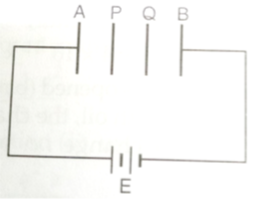
Two parallel metal plates P and Q are inserted at equal distances into a plane capacitor as shown in fig. Plates A and B of the capacitor are connected to a battery of e.m.f. V.
a. What are the potentials of the four plates?
Image
a. What are the potentials of the four plates?
b. How will the potentials of plates P and Q and the intensities of the fields in each of the three spaces change after plates P and Q have been connected by a wire?
c..What will happen to the charges on plates A and B, when plates P and Q are connected with a wire?
d. Will there be charges on the plates P and Q after connecting them with a wire?
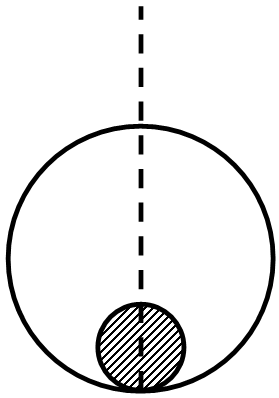
A solid sphere of mass m and radius r is placed inside a hollow thin spherical shell of mass M and radius R as shown in A particle of mass m' is placed on the line joining the two centres at a distance x from the point of contact of the sphere and the shell. Find the magnitude of the resultant gravitational force on this particle due to the sphere and the shell if,
  1. r < x < 2r.
  2. 2r < x < 2R.
  3. x > 2R.
Find the reading of the spring balance shown in figure. The elevator is going up with an acceleration of $\frac{\text{g}}{10},$ the pulley and the string are light and the pulley is smooth.
The count rate of nuclear radiation coming from a radiation coming from a radioactive sample containing $^{128}I$ varies with time as follows.
Time t(minute): 0 25 50 75 100
Ctount rate $R(10^9s^{-1}):$ 30 16 8.0 3.8 2.0
  1. Plot In $\Big(\frac{\text{R}_0}{\text{R}}\Big)$ against t.
  2. From the slope of the best straight line through the points, find the decay constant $\lambda.$
  3. Calculate the half-life $\text{t}_{\frac{1}{2}}.$
A hot body placed in a surrounding of temperature $\theta_0$ obeys Newton's law of cooling $\frac{\text{d}\theta}{\text{dt}}=-\text{k}(\theta-\theta_0).$ Its temperature at t = 0 is $\theta_1.$ The specific heat capacity of the body is s and its mass is m. Find,
  1. The maximum heat that the body can lose.
  2. The time starting from t = 0 in which it will lose 90% of this maximum heat.