Question
Derive an expression for linear velocity at lowest position, midway position and the top-most position for a particle revolving in a vertical circle, if it has to just complete circular motion without string slackening at top.
Answer

Image
Vertical circular motion
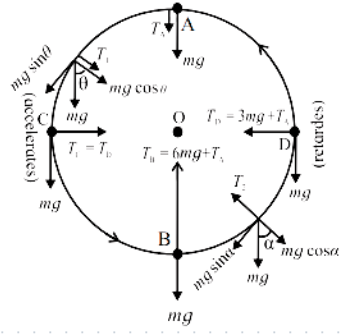
Consider a bob (treated as a point mass) tied to a (practically) massless, inextensible and flexible string. It is whirled along a vertical circle so that the bob performs a vertical circular motion and the string rotates in a vertical plane. At any position of the bob, there are only two forces acting on the bob:
1. Its weight is mg , vertically downwards, which is constant.
2. The force due to the tension along the string is directed along the string and towards the centre. Its magnitude changes periodically with time and location.
Top-most position (A):
Force due to tension in the string and mg are both in the same direction (downward).
$\therefore T_A+m g=\frac{m v_A^2}{r}$
At the topmost position, A , the tension in the string is 0 .
$\therefore T_A=0$
$\therefore m g=\frac{m v_A^2}{r}$
$\therefore\left(v_A\right)_{\min }=\sqrt{T g} \ldots \text { (i) }$
Lower-most position (B):
Force due to tension in the string is in an upward direction towards the center and opposite to the direction of mg .
$\therefore T_B-m g=\frac{m v_B^2}{r}$
While moving down from the uppermost to the lowermost point, the gravitational potential energy is converted into kinetic energy because the motion is governed only by gravity.
$\therefore m g(2 r)=\frac{1}{2} m v_B^2-\frac{1}{2} m v_A^2$
$\therefore v_B^2-v_A^2=4 r g$
$\therefore v_B^2-r g=4 r g \ldots \ldots \ldots(\text { from (i) })$
$\therefore\left(v_B\right)_{\min }=\sqrt{5 r g \ldots} \ldots \text { (ii) }$
Mid-way Positions (C and D):
Let $v_C$ be the velocity at point $C$.
Total energy at point $C=$ Kinetic energy + Potential Energy
$=\frac{1}{2} m v_C^2+m g r$
Total energy at point $B=$ Kinetic energy + Potential Energy
$=\frac{1}{2} m v_B^2+0=\frac{5}{2} m g r \ldots \text { (From (ii)) }$
From the law of conservation of energy,
Total energy at point $C=$ Total energy at point $B$
$\therefore \frac{1}{2} m v_C^2+m g r=\frac{5}{2} m g r$
$\therefore v_C^2+2 r g=5 rg$
$\therefore\left(v_C\right)_{\min }=\sqrt{3 rg}$

Need a full question paper?

Generate a complete, print-ready paper with questions like this in minutes — across 16+ boards, with answer keys.

Start Generating Free

Similar questions

Two sound waves travel at a speed of $330\ m/s.$ If their frequencies are also identical and are equal to $540\ Hz,$ what will be the phase difference between the waves at points $3.5\ m$ from one source and $3\ m$ from the other if the sources are in phase? 
Represent graphically the variation of potential energy, kinetic energy and total energy of a particle performing SHM with time.
On the basis of Huygens' wave theory of light prove that velocity of light in a rarer medium is greater than velocity of light in a denser medium.
On what factors does the resolving power of a microscope depend? How can it be increased?
When two cells of emfs. E1 and E2 are connected in series so as to assist each other, their balancing length on a potentiometer is found to be 2.7 m. When the cells are connected in series so as to oppose each other, the balancing length is found to be 0.3 m. Compare the emfs of the two cells.
A steel sphere of mass $0.02 kg$ attains a terminal speed $vi =0.5 m / s$ when dropped into a tall cylinder of oil. The same sphere is then attached to the free end of an ideal vertical spring of spring constant $8 N / m$. The sphere is immersed in the same oil and set into vertical oscillation. Find
(i) the damping constant
(ii) the angular frequency of the damped SHM.
(iii) Hence, write the equation for displacement of the damped SHM as a function of time, assuming that the initial amplitude is $10 cm .\left[ g =10 m / s ^2\right]$
What is a choke coil? What is it used for? Explain.
Write the kinematical equations for circular motion in analogy with linear motion.
On the basis of the kinetic theory of gases, derive an expression for the pressure exerted by the gas.
Explain the working of a LED.