Question
Derive an expression for the excess of pressure inside a liquid drop.
Answer

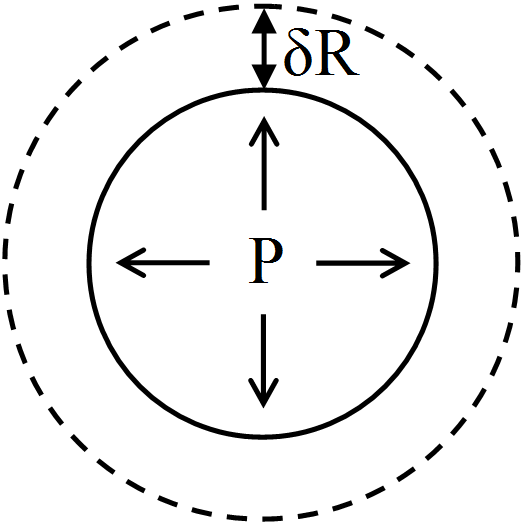
Consider a liquid drop of radius R and $\sigma$ the surface tension of liquid.

Excess pressure inside the liquid drop,

P = Pi - P0 ($\therefore$ liquid drop has only one free surface)

$\delta\text{R}=$ Small increase in radius of liquid drop due to excess pressure

$\therefore$ W = Force × Displacement.

W = (Excess pressure × Area) × Increase in radius

$\text{W}=\text{P}\times4\pi\text{R}^2\times\delta\text{R}$

Increase in surface area of liquid drop

= Final surface area - Initail surface area

$=4\pi(\text{R}+\delta\text{R})^2-4\pi\text{R}^2$

$=8\pi\text{R}(\delta\text{R})(\text{Neglecting }\delta\text{R}^2)$

Increase P.E.

= Increase in surface area × Surface tension

$=8\pi\text{R}(\delta\text{R})\times\sigma$

Since the drop is in equilibrium.

$\therefore\text{P}\times4\pi\text{R}^2\times\delta\text{R}=8\pi\text{R}(\delta\text{R})\times\sigma$

$\Rightarrow\text{P}=\frac{2\sigma}{\text{R}}$

$\Rightarrow\text{P}_\text{i}-\text{P}_\text{o}=\frac{2\sigma}{\text{R}}[\because\text{P}=\text{P}_\text{i}-\text{P}_\text{o}]$

Need a full question paper?

Generate a complete, print-ready paper with questions like this in minutes — across 16+ boards, with answer keys.
Start Generating Free

Similar questions

A dumb-bell consists of two identical small balls of mass $\frac{1}{2}\text{kg}$ each connected to the two ends of a 50cm long light rod. The dumb-bell is rotating about a fixed axis through the centre of the rod and perpendicular to it at an angular speed of 10rad/s. An impulsive force of average magnitude 5.0N acts on one of the masses in the direction of its velocity for 0.10s. Find the new angular velocity of the system.
A cylinder rotating at an angular speed of 50rev/s is brought in contact with an identical stationary cylinder. Because of the kinetic friction, torques act on the two cylinders, accelerating the stationary one and decelerating the moving one. If the common magnitude of the acceleration and deceleration be one revolution per second square, how long will it take before the two cylinders have equal angular speed?
A solid sphere is set into motion on a rough horizontal surface with a linear speed v in the forward direction and an angular speed $\frac{\text{v}}{\text{R}}$ in the anticlockwise direction as shown in figure. Find the linear speed of the sphere:
  1. When it stops rotating.
  2. When slipping finally ceases and pure rolling starts.

A particle moves in a straight line such that its displacement at any time is given by s2 = t2 +1. Find
  1. Velocity.
  2. Acceleration as a function of s.
The maximum speed and acceleration of a particle executing simple harmonic motion are 10cm/s and 50cm/s2. Find the position(s) of the particle when the speed is 8cm/s.
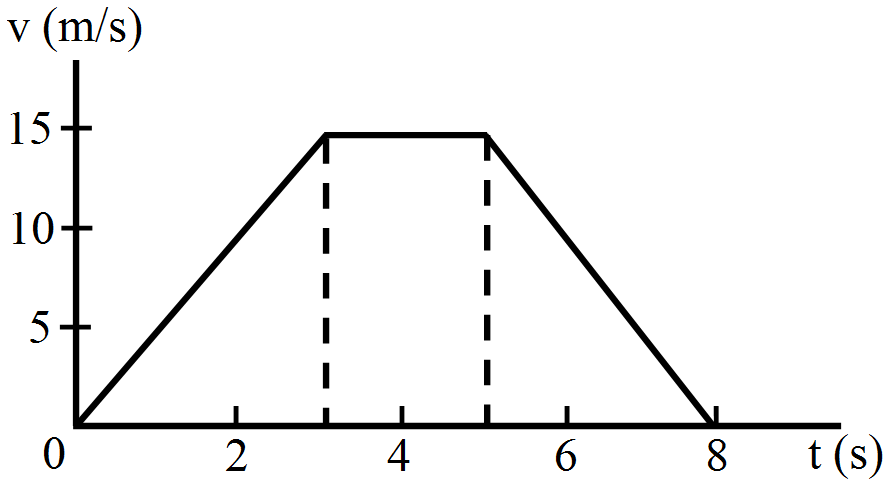
A particle of mass 50g moves on a straight line. The variation of speed with time is shown in figure. Find the force acting on the particle at t = 2, 4 and 6 seconds.

In defining the ideal gas temperature scale, it is assumed that the pressure of the gas at constant volume is proportional to the temperature T. How can we verify whether this is true or not? Are we using the kinetic theory of gases? Are we using the experimental result that the pressure is proportional to temperature?
A body oscillates with SHM according to the equation (in SI unit)

$\text{x}=5\cos\Big[2\pi\text{t}+\frac{\pi}{4}\Big]$

At t = 1.5 second, calculate (i) displecement, (ii) speed.

What is escape velocity? Obtain the expression for the escape velocity on earth. Why is it that there is no atmosphere on the moon? Explain.
  1. According to Kepler's second law, the radius vector to a planet from the sun sweeps out equal areas in equal interval of time. The law is consequence of which conservation law?
  2. State Kepler's third law.