Question
  1. Derive an expression for the excess pressure inside a soap bubble.
  2. State Bernoulli's theorem.

Answer

  1.  

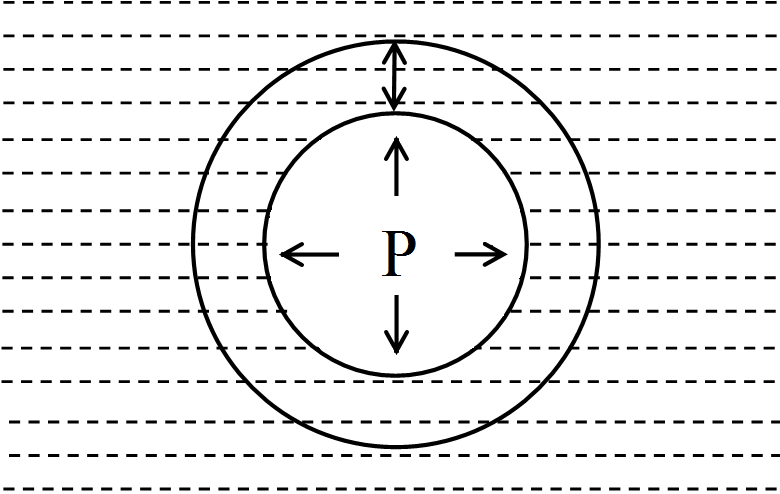
Consider a bubble of radius R with $\sigma$ the surface tension of liquid. Excess pressure inside the bubble,
$P = P_i - P_0$
($\because$ air bubble has only one free surface)
$\delta\text{R}=$ Small increase in radius of bubble due to excess pressure
Work done,
W = Force × Displacement
= (Excess pressure × Area) × Increase in radius
$=\text{P}\times4\pi\text{R}^2\times\delta\text{R}$
Increase in surface area of bubble,
= Final surface area - Initial surface area
$=4\pi(\text{R}+\delta\text{R})^2-4\pi\text{R}^2$
$=8\pi\text{R}(\delta\text{R})$ $($Neglecting $\delta\text{R}^2)$
$\therefore\text{P}\times4\pi\text{R}^2\times\delta\text{R}=8\pi\text{R}(\delta\text{R})\times\sigma$
Increase in P.E. = Increase in surface area × Surface tension
$=8\pi\text{R}(\delta\text{R})\times\sigma$
Since the drop is in equilibrium.
$\therefore\text{P}\times\text{R}^2\times\delta\text{R}=8\pi\text{R}(\delta\text{R})\times\sigma$
$\text{P}=\frac{2\sigma}{\text{R}}$
  1. Bernoulli's Theorem: For an incompressible, non-viscous, irrotational liquid having streamlined flow, the sum of the pressure energy, kinetic energy and potential energy per unit mass is a constant, i.e.,
$\frac{\text{P}}{\rho}+\frac{\text{V}^2}{2}+\text{gh}=\text{constant}$
$\Rightarrow\frac{\text{P}}{\rho\text{g}}+\frac{\text{V}^2}{2\text{q}}+\text{h}=\text{constant}$

Need a full question paper?

Generate a complete, print-ready paper with questions like this in minutes — across 16+ boards, with answer keys.

Start Generating Free

Similar questions

The potentiometer wire AB shown in the figure. is 40cm long. Where should the free end of the galvanometer be connected on AB so that the galvanometer may show zero deflection?
Suppose that the radius of cross-section of the wire used in the previous problem is r. Find the increase in the radius of the loop if the magnetic field is switched off. Young's modulus of the material of the wire is Y.
Show that if n equal rain droplets falling through air with equal steady velocity of $10cm s^{-1}$ coalesce, the resultant drop attains a new terminal velocity of $10n^{2/3}cm s^{-1}$​​​​​​​.
Find the diameter of the image of the moon formed by a spherical concave mirror of focal length $7.6m$. The diameter of the moon is $3450km$ and the distance between the earth and the moon is $3.8 \times 10^5km$.
What is meant by elastic potential energy? Derive an expression for the elastic potential energy of a stretched wire. Prove that its elastic energy density is equal to $\frac{1}{2}\text{stress}\times\text{strain}.$
A fighter plane flying horizontally at an altitude of $1.5km$ with speed $720km/h$ passes directly overhead an anti-aircraft gun. At what angle from the vertical should the gun be fired for the shell with muzzle speed $600ms^{-1}$ to hit the plane? At what minimum altitude should the pilot fly the plane to avoid being hit? (Take $g = 10ms^{-2}$).
A truck is pulling a car out of a ditch by means of a steel cable that is $9.1m$ long and has a radius of $5mm$. When the car just begins to move, the tension in the cable is $800N$. How much has the cable stretched?
(Young’s modulus for steel is $2 \times 10^{11}N m^{–2}$.)
A capacitor having a capacitance of $100\mu\text{F}$ is charged to a potential difference of $50V$.
  1. What is the magnitude of the charge on each plate?
  2. The charging battery is disconnected and a dielectric of dielectric constant $2.5$ is inserted. Calculate the new potential difference between the plates.
  3. What charge would have produced this potential difference in absence of the dielectric slab.
  4. Find the charge induced at a surface of the dielectric slab.
An oxygen cylinder of volume 30 litres has an initial gauge pressure of 15 atm and a temperature of 27°C. After some oxygen is withdrawn from the cylinder, the gauge pressure drops to 11 atm and its temperature drops to 17°C. Estimate the mass of oxygen taken out of the cylinder $(R = 8.31J\ mol^{-1}K^{-1},$ molecular mass of $O_2 = 32u).$
A progressive harmonic wave on a string is expressed as follow
$
y(x, t)=7.5 \sin (0.0050 x+12 t+\pi / 4)
$
(a) Find the speed at a point $x=1 cm$ on time $t=1$ sec. Is this speed is equal to the speed of wave propagation?
(b) Find the location of those points of the string whose tranverse displacement and speed are the same as that of the point located at $x=1 cm$ at times $t =2 s, 5 s$ and $11s.$