Question
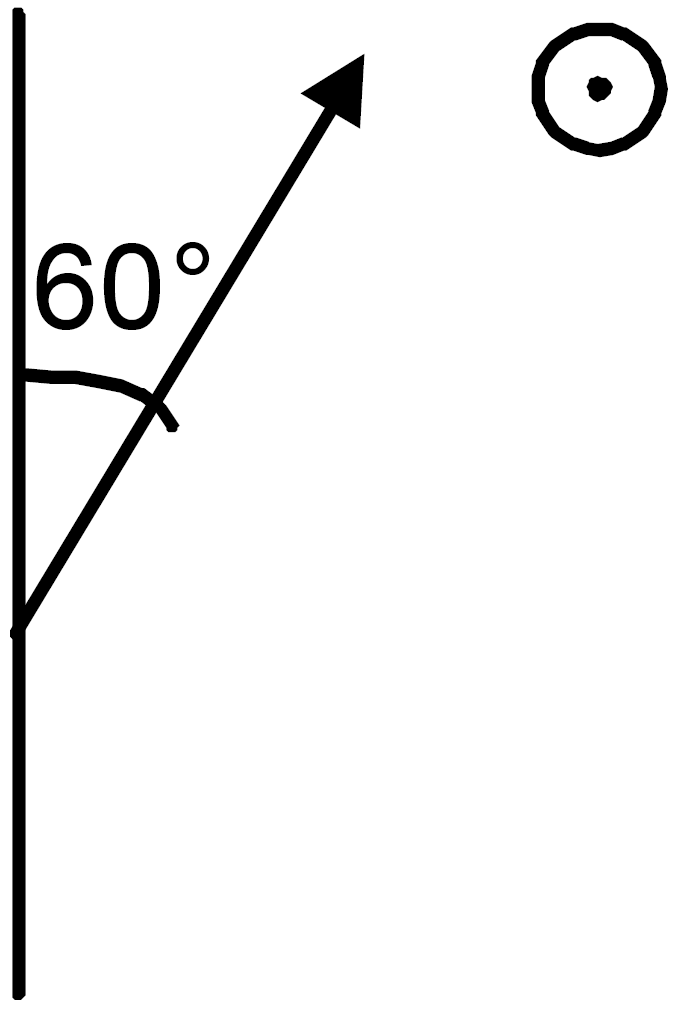
A wire of length $10cm$ translates in a direction making an angle of $60°$ with its length. The plane of motion is perpendicular to a uniform magnetic field of $1.0T$ that exists in the space. Find the emf induced between the ends of the rod if the speed of translation is $20cm/s^{-1}$.
Answer


$\text{l}=10\text{cm}=0.1\text{m};$
$\theta=60^{\circ}; \ \text{B}=1\text{T}$
$\text{V}=20\text{cm}/\text{s}=0.2\text{m}/\text{s}$
$\text{E}=\text{Bvl}\sin60^{\circ}$
[As we have to take that component of length vector which is $\perp\text{r}$ to the velocity vector]
$=1\times0.2\times0.1\times\frac{\sqrt{3}}{2}$
$=1.732\times10^{-2}=17.32\times10^{-3}\text{V}.$

Need a full question paper?

Generate a complete, print-ready paper with questions like this in minutes — across 16+ boards, with answer keys.

Start Generating Free

Similar questions

A marble rolls along a table at a constant speed of $1.00 m / s$ and then falls off the edge of the table to the floor 1.00 m below,
i. How long does the marble take to reach the floor?
ii. At what horizontal distance from the edge of the table does the marble land?
iii. What is its velocity as it strikes the floor?
A copper wire is held at the two ends by rigid supports. At 30°C, the wire is just taut, with a negligible tension, find the speed of the transverse waves in this wire at 10°C.
$\alpha=1.7\times10^{-5}/^{\circ}\text{C},$
$\text{Y}=1.3\times10^{11}\text{N/m}^2,$
$\rho=9\times10^3\text{kg/m}^3.$
For the wave described in Exercise 15.8, plot the displacement (y) versus (t) graphs for x = 0, 2 and 4cm. What are the shapes of these graphs? In which aspects does the oscillatory motion in travelling wave differ from one point to another: amplitude, frequency or phase?
To simulate car accidents, auto manufacturers study the collisions of moving cars with mounted springs of different spring constants. Consider a typical simulation with a car of mass $1000 \ kg$ moving with a speed $18.0 \ km / h$ on a smooth road and colliding with a horizontally mounted spring of spring constant $5.25 \times 10^3 N m ^{-1}$. What is the maximum compression of the spring?
Consider the above Example taking the coefficient of friction, $\mu,$ to be $0.5$ and calculate the maximum compression of the spring.
Prove the result that the velocity v of translation of a rolling body (like a ring, disc, cylinder or sphere) at the bottom of an inclined plane of height h given by $\text{v}^2=\frac{2\text{gh}}{\big(1+\frac{\text{K}^2}{\text{R}^2}\big)}$ using dynamical consideration. Note K is the radius of gyration of the body about its symmetry axis, and R is the radius of the body. The body starts from rest at the top of the plane.
An artificial satellite is revolving around a planet of mass M and radius R, in a circular orbit of radius r. From Kepler’s Third law about the period of a satellite around a common central body, square of the period of revolution T is proportional to the cube of the radius of the orbit r. Show using dimensional analysis, that $\text{T}=\frac{\text{k}}{\text{R}}\sqrt{\frac{\text{r}^3}{\text{g}}},$ where k is a dimensionless constant and g is acceleration due to gravity.
Two cylindrical hollow drums of radii R and 2R, and of a common height h, are rotating with angular velocities $\omega$ (anti-clockwise) and $\omega$ (clockwise), respectively. Their axes, fixed are parallel and in a horizontal plane separated by $(3\text{R}+\delta).$ They are now brought in contact $(\delta\rightarrow0){:}$
  1. Show the frictional forces just after contact.
  2. Identify forces and torques external to the system just after contact.
  3. What would be the ratio of final angular velocities when friction ceases?
The velocity of a body of mass 2kg as a function of t is given by $\text{v}(\text{t})=2\text{t}\hat{\text{i}}+\text{t}^2\hat{\text{j.}}$ Find the momentum and the force acting on it, at time $\text{t}=2\text{s}.$
A wave is described by the equation$\text{y}=(1.0\text{mm})\sin\pi\Big(\frac{\text{x}}{2.0\text{cm}}-\frac{\text{t}}{0.01\text{s}}\Big).$
  1. Find the time period and the wavelength.
  2. Write the equation for the velocity of the particles. Find the speed of the particle at x = 1.0cm at time t = 0.01s.
  3. What are the speeds of the particles at x = 3.0cm, 5.0cm and 7.0cm at t 0.01s?
  4. What are the speeds of the particles at x 1.0cm at t = 0.011, 0.012, and 0.013s?
Consider a p-n junction diode having the characteristic $\text{i}-\text{i}_0\Big(\text{e}^{\frac{\text{eV}}{\text{kT}}}-1\Big)$ where $\text{i}_0=20\mu\text{A}.$ The diode is operated at T = 300K.
  1. Find the current through the diode when a voltage of 300mV is applied across it in forward bias.
  2. At what voltage does the current double?