Question
Derive an expression for the work done in an isothermal process.

Answer

For a small change in volume, work done is given by, DW =P dV We, know, PV = nRT $\Rightarrow\text{P}=\frac{\text{nRT}}{\text{V}}$ For T = costant, $\text{dW}=\text{nRT}=\frac{\text{dV}}{\text{V}}$ Net work done under isothermal condition to change the valume from $V_i$ to $V_f$ is, $\text{W}=\int\limits^{\text{V}_\text{f}}_{\text{V}_\text{i}}\text{dW}=\text{nRT}\int\limits^{\text{V}_\text{f}}_{\text{V}_\text{i}}\frac{\text{dV}}{\text{V}}$
$=\text{nRT}\Big|\log_\text{e}\text{V}\Big|^{\text{V}_\text{f}}_{\text{V}_\text{i}}$
$\text{W}=\text{nRT}\log_\text{e}\Big(\frac{\text{V}_\text{f}}{\text{V}_\text{i}}\Big)$
$\therefore\text{W}=2.3026\text{ nRT }\log_{10}\Big(\frac{\text{V}_\text{f}}{\text{v}_i}\Big)$ Where n is the number of moles. If $P_f$ and $P_i$ are the pressures, we can also write, $\text{W}=2.3026\text{ nRT }\log_{10}\Big(\frac{\text{P}_\text{i}}{\text{P}_\text{i}}\Big)$

Need a full question paper?

Generate a complete, print-ready paper with questions like this in minutes — across 16+ boards, with answer keys.
Start Generating Free

Similar questions

In a car race, car A takes a time t seconds less than the car B and passes the finishing point with a velocity v more than that of the car B. If the cars start from rest and travel with constant acceleration $a_1$ and $a_2$ respectively, show that $\text{v}=\text{t}\sqrt{\text{a}_1\text{a}_2}.$
A particle executes the motion described by $\text{x}(\text{t})=\text{x}_0(1-\text{e}^{-\gamma\text{t}});\text{t}\ge0,\text{x}_0>0.$
Find maximum and minimum values of x(t), v(t), a(t). Show that x(t) and a(t) increase with time and v(t) decreases with time.
Find the acceleration of the moon with respect to the earth from the following data:
Distance between the earth and the moon = $3.85 \times 10^5km$ and the time taken by the moon to complete one revolution around the earth = $27.3\ days$.
A 40cm wire having a mass of 3.2g is stretched between two fixed supports 40.05cm apart. In its fundamental mode, the wire vibrates at 220Hz. If the area of cross-section of the wire is $1.0mm^2$, find its Young's modulus.
A tank is filled with water up to a height of H meter and there is a hole in it at a height from the bottom. Find the volume of water coming out of that hole and how far from the tank will it fall on the ground?
The driver of a truck travelling with a velocity v suddenly notices a brick wall in front of him at a distance d. Is it better for him to apply brakes or to make a circular turn without applying brakes in order to just avoid crashing into the wall? Why?
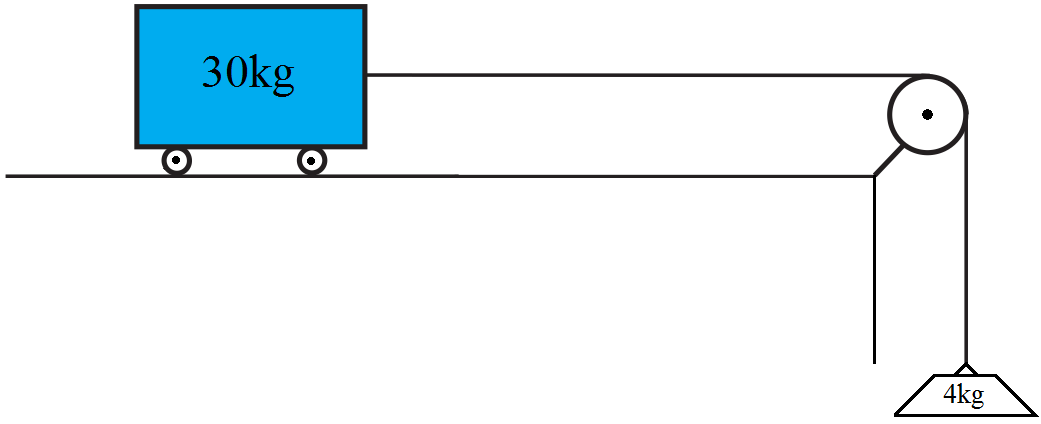
Compute the acceleration of the block and trolley system as shown. If the coefficient of kinetic friction between the trolley and the surface is $0.04$, what is the tension in the string? [Take $g = 10ms^{-2}]$
By using the method of dimension, check the accuracy of the following formula : $ \text{T}=\frac{\text{rh}\rho\text{g}}{2\cos\theta},$where T is the surface tension, h is the height of the liquid,$\rho$ is the density of the liquid, g acceleration due to gravity $\theta$ angle of contact, and r is the radius of the tube.
Water is filled in a rectangular tank of size $3m \times 2m \times 1m$.
  1. Find the total force exerted by the water on the bottom surface of the tank.
  2. Consider a vertical side of area $2m \times 1m$. Take a horizontal strip of width $ox$ metre in this side, situated at a depth of $x$ metre from the surface of water. Find the force by the water on this strip.
  3. Find the torque of the force calculated in part.$(b)$ about the bottom edge of this side.
  4. Find the total force by the water on this side.
  5. Find the total torque by the water on the side about.
The bottom edge. Neglect the atmospheric pressure and take $g = 10m/s^2$.
Displacement versus time curve for a particle executing $\text{S.H.M}$. is shown in Fig. Identify the points marked at which,
  1. Velocity of the oscillator is zero,
  2. Speed of the oscillator is maximum.