Question
What is an adsorption isotherm? Describe Freundlich adsorption isotherm.

Answer

Adsorption isotherm: A graph between extent of adsorption (x/m) and the pressure 'p' of the gas at constant temperature is called adsorption isotherm.
Freundlich Isotherm: The relationship between $\frac{\text{x}}{\text{m}}$ and pressure of the gas at constant temperature is called adsorption isotherm and given
as by $\frac{\text{x}}{\text{m}}=\text{k}\text{p}^{1/\text{n}}(\text{n}>1)$ k and n depend upon the nature of gas and the solid.
$\frac{\text{x}}{\text{m}}$ first increase with increase in pressure at low pressure but becomes independent of pressure at high pressure.
Thus three cases arise from the graph
At low pressure, extent of adsorption is directly proportional to pressure (raised to power one).
$\frac{\text{x}}{\text{m}}\propto\text{P}^1$
At high pressure, extent of adsorption is independent of pressure (raised to power zero).
$\frac{\text{x}}{\text{m}}\propto\text{P}^0$
Therefore at intermediate value of pressure, adsorption is directly proportional to pressure raised to power 1/n .Here n is a variable whose value is greater than one.
$\therefore\ \frac{\text{x}}{\text{m}}\propto\text{P}^{\frac{1}{\text{n}}}$
Using constant of proportionality, k, also known as adsorption constant we get
$\frac{\text{x}}{\text{m}}\propto\text{k}\text{P}^{\frac{1}{\text{n}}}$
Taking logarithm on both sides, we get
$\log\frac{\text{x}}{\text{m}}=\log\text{k}+\frac{1}{\text{n}}\log\text{p}$
Here x is the weight of the gas absorbed by m mass of the adsorbent at a pressure p, k and n are constant (at a particular temperature) and for a particular adsorbate-adsorbent pair.
The equation above equation is comparable with comparable with equation of straight line,
y = mx + c where, m represents slope of the line and c represents intercept on y axis.
Plotting a graph between log(x/m) and log p, we will get a straight line with value of slope equal to 1/n and log k as y-axis intercept.
log(x/m) vs. log p graph.

Need a full question paper?

Generate a complete, print-ready paper with questions like this in minutes — across 16+ boards, with answer keys.
Start Generating Free

Similar questions

What is order of reaction? Discuss elementary and complex reactions, Explain units of rate constant in detail.
  1. The cell in which the following reaction occurs:
$2 Fe^{3+} (aq) + 2 I^- (aq) \longrightarrow 2 Fe^{2+}(aq) + I_2(s)$

has $\text{E}^0_{\text{cell}}$ = 0·236 V at 298 K. Calculate the standard Gibbs energy of the cell reaction. (Given : $1 F = 96,500 C mol^{-1}$)
  1. How many electrons flow through a metallic wire if a current of 0·5 A is passed for 2 hours? (Given : $1 F = 96,500 C mol^{-1}$)
Short note on: Maltose
Write one difference in each of the following:
  1. Multimolecular colloid and Associated colloid.
  2. Coagulation and Peptization.
  3. Homogeneous catalysis and Heterogeneous catalysis.
Write the name of monomers and their structures in the following:
  1. Buna-N
  2. PVC
  3. Neoprene
Give reasons :
(i) Carbon-oxygen bond length in phenol is slightly less than that of methanol.
(ii) The $C - O - C$ bond angle present in ether is greater than the tetrahedral angle.
(iii) The boiling point of isomeric alcohols decreases with increase in branching.
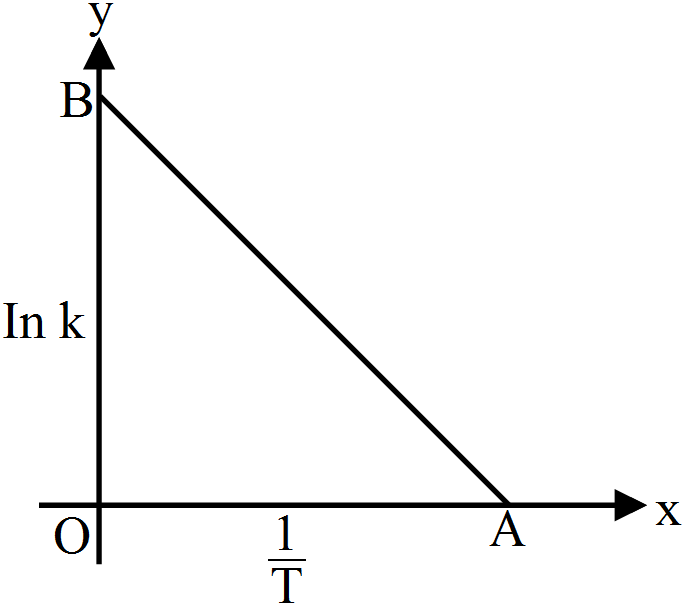
A graph between ln $k$ and $\frac{1}{\text{t}}$ for a reaction is given. Here k is rate constant and $T$ is temperature in Kelvin.If $OA = a$ and $OB = b,$ answer the following:
  1. What is the activation energy $(Ea)$ of the reaction?
  2. What is the frequency factor $(A)$ for the reaction?
Account for any two of the following:
  1. Amines are basic substances while amides are neutral.
  2. Nitro compounds have higher boiling points than the hydrocarbons having almost the same molecular mass.
  3. Aromatic amines are weaker bases than aliphatic amines.
State Raoult’s law for a solution containing volatile components. How does Raoult’s law become a special case of Henry’s law?
The reaction between $A$ and $B$ is first order with respect to $A$ and zero order with respect to $B$. Fill in the blanks in the following table:
Experiment $[A]/mol\ L^{-1}$ $[B]/mol\ L^{-1}$ Initial rate$/mol\ L^{-1}\ min^{-1}$
$I$ $0.1$ $0.1$ $2.0 \times 10^{-2}$
$II$ $-$ $0.2$ $4.0 \times 10^{-2}$
$III$ $0.4$ $0.4$ $-$
$IV$ $-$ $0.2$ $2.0 \times 10^{-2}$