Question
Derive nernst equation for general reaction $a A+b B \rightarrow c C+d D$

Answer

$→ aA + bB \xrightarrow{ ne ^{-}} cC + dD
$
Nernst equation can be written as :
$
\begin{aligned}
E _{\text {(cell) }} & = E _{\text {(cell) }}^{\ominus}-\frac{ RT }{ nF } \ln Q \\
& = E _{\text {(cell) }}^{\ominus}-\frac{ RT }{ nF } \ ln \frac{[ C ]^{ c }[ D ]^d}{[A]^{ a }[ B ]^{ b }} \\
& = E _{\text {(cell) }}^0-\frac{0.059}{ n } \ log \frac{[ C ]^c[ D ]^d}{[A]^{ a }[ B ]^{ b }}
\end{aligned}$

Need a full question paper?

Generate a complete, print-ready paper with questions like this in minutes — across 16+ boards, with answer keys.
Start Generating Free

Similar questions

Using the standard electrode potentials given in Table $3.1,$ predict if the reaction between the following is feasible$: Br_2 (aq)$ and $Fe^{2+} (aq).$
The standard electrode potential $(E^\circ)$ for Deniell cell is $+1.1V.$ Calculated the $ʌG^\circ$ for the reaction
$Zn (s) + Cu^{2+ }(aq) \rightarrow Zn^{2 }(aq) + Cu (s)$
$(1 F = 96500\ C\ mol^{-1}).$
What are the hydrolysis products of (i) sucrose, and (ii) lactose?
Answer the following.
  1. What type of linkage is responsible for the primary structure of proteins?
  2. Name the location where protein synthesis occurs in our body.
Complete the following reaction sequence.
$\ \ \ \ \ \ \ \ \ \ \ \ \text{O}\\\ \ \ \ \ \ \ \ \ \ \ \ \ ||\\\text{CH}_3-\text{C}-\text{CH}_3\xrightarrow[(\text{ii})\text{H}_2\text{O}]{(\text{i})\text{CH}_3\text{MgBr}}\text{(A)}\xrightarrow[\text{Ether}]{\text{Na}\ \text{Metal}}\text{(B)}\xrightarrow{\text{CH}_3-\text{Br}}\text{(C)}$
Explain the displacement equation of diazonium group of benzene diazonium salt by iodide ion and chloride ion.
What are glycogens? How it is different from starch?
What is meant by tertiary structure of proteins?
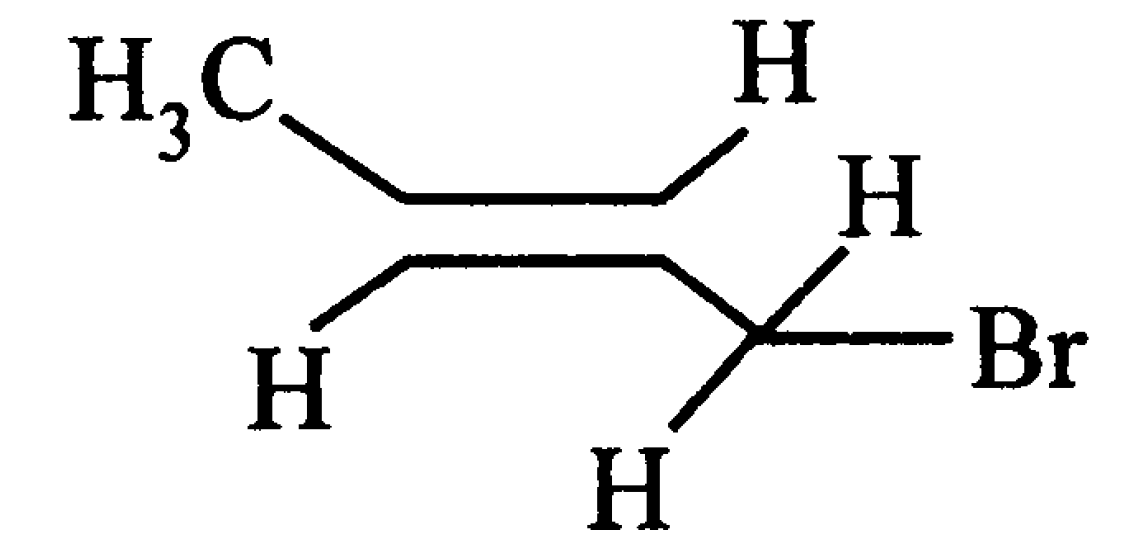
  1. State the $\text{IUPAC}$ name of the following compound:
  1. Complete the following chemical equation:
$\ce{CH_3CH_2CH=CH_2 + HBr} \xrightarrow{\text{peroxide}}.........$
18 g of glucose ($ C_{6}H_{12}O_{6} $) was added to 1 kg of water at 1.013 bar atmospheric pressure in a vessel. At which temperature will water boil? $ K_{b} $ for $ H_{2}O $ is 0.52 K kg $ mol^{-1} $.