Question
Derive the expression for excess pressure inside:
- A liquid drop.
- A liquid bubble.
- An air bubble.
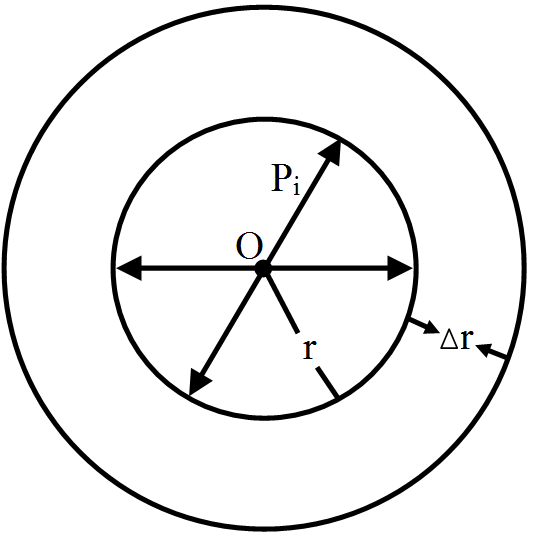
T = surface tension of the liquid.
Let Pi and P0 be the values of pressure inside and outside the drop.
$\therefore$ Excess pressure inside the liquid drop = Pi - P0.
Let $\Delta\text{r}$ be the increase in its radius due to excess pressure. It has one free surface outside.
$\therefore$ Increase in surface area of the liquid drop
$=4\pi(\text{r}+\Delta\text{r})^2-4\pi\text{r}^2$
$=4\pi[\text{r}^2+(\Delta\text{r})^2+2\text{r}\Delta\text{r}-\text{r}^2]$
$=8\pi\text{r}\ \Delta\text{r}\dots\text{(i)}$ $(\because\Delta\text{r}$ is small $\therefore\Delta\text{r}^2$ is neglected$)$
$\therefore$ Increase in surface energy of the drop is
W = Surface tension × increase in area
$=\text{T}\times8\pi\text{r }\Delta\text{r}\dots\text{(ii)}$
Also W = Force due to excess of pressure × dispplacement
= Excess pressure × Area of drop × increase in raduis
$=(\text{P}_\text{i}-\text{P}_0)4\pi\text{r}^2\Delta\text{r}\dots\text{(iii)}$
$\therefore$ From equations (ii) and (iii), we get
$(\text{P}_\text{i}-\text{P}_0)\times4\pi\text{r}^2\Delta\text{r}$
$=\text{T}\times\text{8}\pi\text{r }\Delta\text{r}$
$\Rightarrow\text{P}_\text{i}-\text{P}_0=\frac{\text{T}}{\text{r}}$
Thus increase in its surface area
$=2[4\pi(\text{r}+\Delta\text{r})^2-4\pi\text{r}]$
$=2\times8\pi\text{r}\Delta\text{r}=16\pi\text{r}\Delta\text{r}$
$\therefore\text{W}=\text{T}\times16\pi\text{r }\Delta\text{r}\dots\text{(i)}$
Also $\text{W}=(\text{P}_\text{i}-\text{P}_0)4\pi\text{r}^2\times\Delta\text{r}\dots\text{(ii)}$
From equations (i) and (ii), we get
$(\text{P}_\text{i}-\text{P}_0)\times4\pi\text{r}^2\times\Delta\text{r}=\text{T}\cdot16\pi\text{r}\Delta\text{r}$ or $\text{P}_\text{i}-\text{P}_0=\frac{4\text{T}}{\text{r}}.$
If r = radius of air bubble
$\Delta\text{r}=$ increase in its radius due to excess of pressure
$(\text{P}_\text{i}-\text{P}_0)$ inside it.
T = surface tension of the liquid in which bubble is formed.
$\therefore$ Increase in surface area $=8\pi\text{r}\Delta\text{r}.$
$\therefore\text{W}=\text{T}\times8\pi\text{r}\Delta\text{r}$
Also $\text{W}=(\text{P}_\text{i}-\text{P}_0)\times4\pi\text{r}^2\Delta\text{r}$
$\therefore(\text{P}_\text{i}-\text{P}_0)\times4\pi\text{r}^2\Delta\text{r}=\text{T}\times8\pi\text{r }\Delta\text{r}$ or $\text{P}_\text{i}-\text{P}_0=\frac{2\text{T}}{\text{r}}.$
Generate a complete, print-ready paper with questions like this in minutes — across 16+ boards, with answer keys.