Question
  1. Derive the expression for the torque acting on the rectangular current carrying coil of a galvanometer. Why is the magnetic field made radial?
  2. An $\alpha-$particle is accelerated through a potential difference of 10kV and moves along x-axis. It enters in a region of uniform magnetic field B = 2 × 10⁻³T acting along y-axis. Find the radius of its path. (Take mass of $\alpha-$particle = 6.4 × 10–27kg).

Answer

  1.  

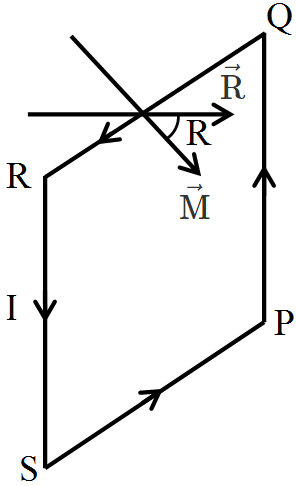
$\text{PQ}=\text{RS}=1$

$\text{PS}=\text{QR}=\text{b}$

Area $\text{A}=\text{lb}$

$\vec{\text{M}}\times\vec{\text{IA}}$

$\overrightarrow{\text{F}_{\text{PQ}}}=\text{IlB}\otimes$

$\overrightarrow{\text{F}_{\text{RS}}}=\text{IlB}\ominus$

$\overrightarrow{\text{F}_{\text{QR}}}=\text{IbB}\sin(90^\circ-\theta)=\text{IbB}\cos\theta\text{ up}$

$\overrightarrow{\text{F}_{\text{SP}}}=\text{IbB}\sin(90^\circ-\theta)=\text{IbB}\cos\theta\text{ down}$

Only $\overrightarrow{\text{F}_{\text{PB}}}\ \& \ \overrightarrow{\text{F}_{\text{RS}}}$ form a couple to apply torque on loop,
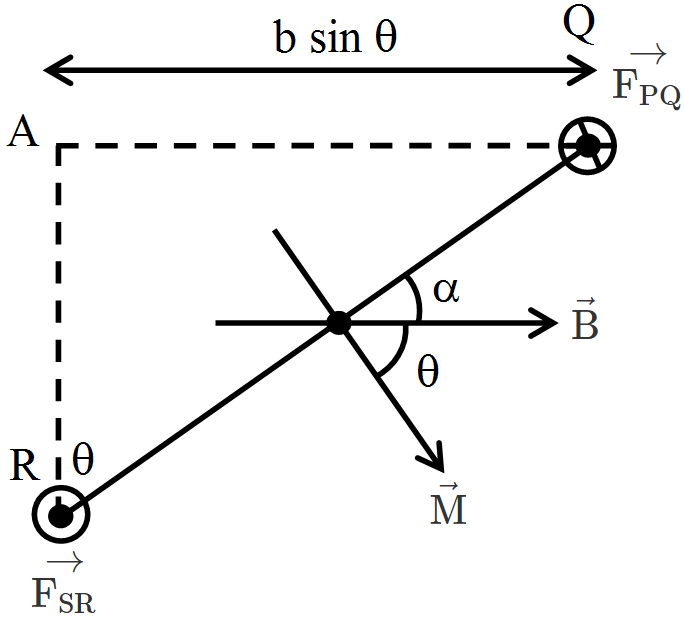
$\tau=\text{MB}\sin\theta$

Magnetic field is taken radial in Galvanometer coil in order to create $\theta=90^\circ$ at every orientation of coil in the magnetic field so that current varies linearly with deflection.

  1. $\text{qV}=\frac{1}{2}\text{mv}^2$

$\Rightarrow\text{v}=\sqrt{\frac{2\text{qV}}{\text{m}}}$

$\because\vec{\text{v}}=\text{vi}\perp\vec{\text{B}}(=\text{Bj})$

$\therefore$ Particle deflects along circular path of radius $\text{r}=\frac{\text{mv}}{\text{qB}}=\frac{\text{m}}{\text{qB}}\sqrt{\frac{2\text{qv}}{\text{m}}}=\frac{1}{\text{B}}\sqrt{\frac{2\text{mv}}{\text{q}}}$

$\text{r}=\frac{1}{2\times10^{-3}}\sqrt{\frac{2\times6.4\times10^{-27}\times10^4}{2\times1.6\times10^{-19}}}$

$=\frac{1}{2\times10^{-3}}\times2\times10^{-2}$

$=10^1\text{m}=10\text{m}.$
Need a full question paper?

Generate a complete, print-ready paper with questions like this in minutes — across 16+ boards, with answer keys.

Start Generating Free

Similar questions

Two large conducting plates are placed parallel to each other with a separation of 2.00cm between them. An electron starting from rest near one of the plates reaches the other plate in 2.00 microseconds. Find the surface charge density on the inner surfaces.
Three identical charges, each having a value 1.0 × 10-8C, are placed at the corners of an equilateral triangle of side 20cm. Find the electric field and potential at the centre of the triangle.
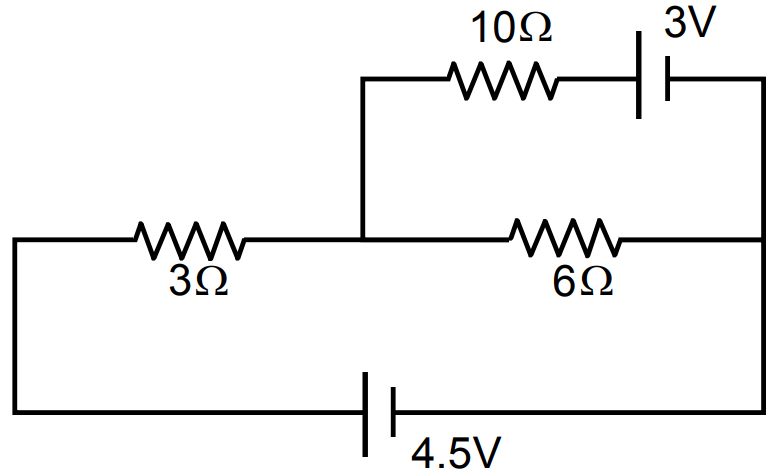
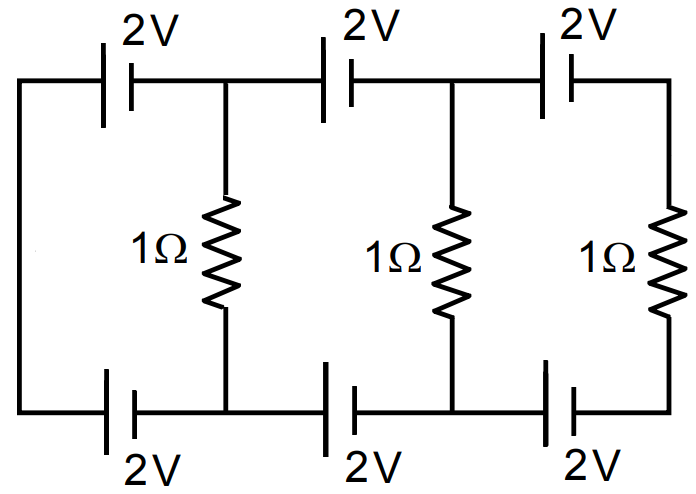
Find the circuit in the three resistors shown in the figure.

A simple pendulum of length I is suspended through the ceiling of an elevator. Find the time period of small oscillations if the elevator,
  1. Is going up with an acceleration a0
  2. Is going down with an acceleration a0.
  3. Is moving with a uniform velocity.
Find the current through the $10\Omega$ resistor shown in figure.

A thin convex lens of focal length 25cm is cut into two pieces 0.5cm above the principal axis. The top part is placed at (0, 0) and an object placed at (-50cm, 0). Find the coordinates of the image.
The intensity of the sunlight reaching Earth is 1380Wm-2. Assume this light to be a plane, monochromatic wave. Find the amplitudes of electric and magnetic fields in this wave.
  1. Draw the circuit diagram of a fullwave rectifier using p-n junction diode. Explain its working and show the output, input waveforms.
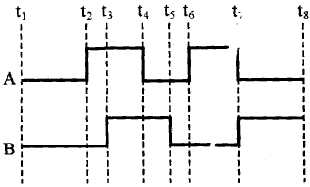
  2. Show the output waveforms (Y) for the following inputs A and B of
    1. OR gate.
    2. NAND gate.

In many experimental set-ups the source and screen are fixed at a distance say D and the lens is movable. Show that there are two positions for the lens for which an image is formed on the screen. Find the distance between these points and the ratio of the image sizes for these two points.
In a Young's double slit experiment using monochromatic light, the fringe pattern shifts by a certain distance on the screen when a mica sheet of refractive index 1.6 and thickness 1.964 micron (1 micron = 10-6m) is introduced in the path of one of the interfering waves. The mica sheet is then removed and the distance between the screen and the slits is doubled. It is found that the distance between the successive maxima now is the same as the observed fringe-shift upon the introduction of the mica sheet. Calculate the wavelength of the monochromatic light used in the experiment.