Question
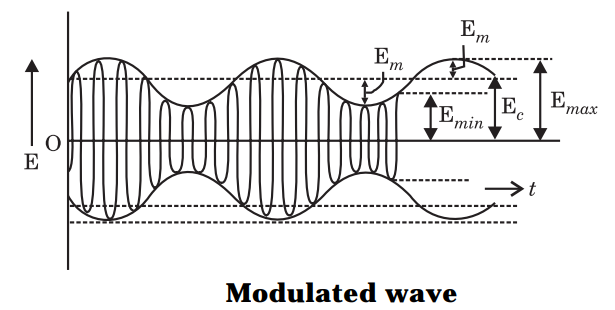
What do you mean by modulation ? Define modulation index. For an amplitude modulated wave the maximum and minimum amplitude is ' $a$ ' and ' $b$ '. Calculate modulation index for it.

Need a full question paper?

Generate a complete, print-ready paper with questions like this in minutes — across 16+ boards, with answer keys.
Start Generating Free

Similar questions

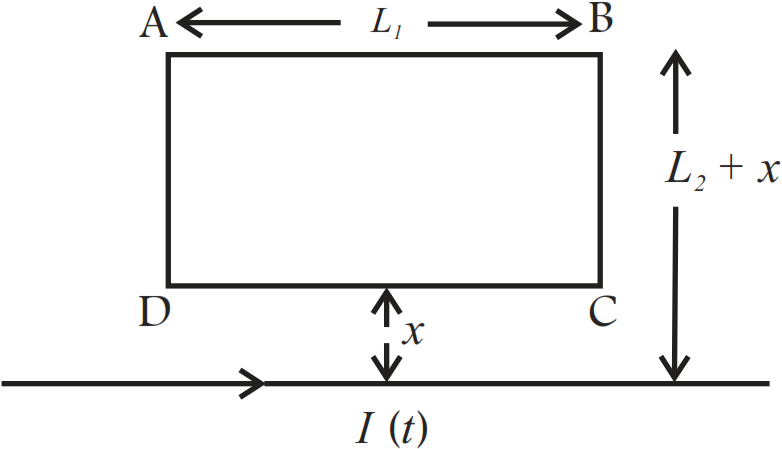
A rectangular loop of wire ABCD is kept close to an infinitely long wire carrying a current $\text{I}(\text{t})=\text{I}_0\Big(1-\frac{\text{t}}{\text{T}}\Big)$ for 0 and I(0) = 0 for t > T (Fig). Find the total charge passing through a given point in the loop, in time T. The resistance of the loop is R.

Consider an excited hydrogen atom in state n moving with a velocity u(ν << c). It emits a photon in the direction of its motion and changes its state to a lower state m. Apply momentum and energy conservation principles to calculate the frequency ν of the emitted radiation. Compare this with the frequency ν0 emitted if the atom were at rest.
A nuclide 1 is said to be the mirror isobar of nuclide 2 if Z1 =N2 and Z2 =N1.
  1. What nuclide is a mirror isobar of 1123Na?
  2. Which nuclide out of the two mirror isobars have greater binding energy and why?
An adiabatic cylindrical tube of cross-sectional area 1cm2 is closed at one end and fitted with a piston at the other end. The tube contains 0.03g of an ideal gas. At 1atm pressure and at the temperature of the surrounding, the length of the gas column is 40cm. The piston is suddenly pulled out to double the length of the column. The pressure of the gas falls to 0.355atm. Find the speed of sound in the gas at atmospheric temperature.
Find the typical de Broglie wavelength associated with a He atom in helium gas at room temperature (27ºC) and 1 atm pressure; and compare it with the mean separation between two atoms under these conditions.
Suppose a 'n' - type wafer is created by doping Si crystal having 5 × 1028 atoms/m3 with 1ppm concentration of As. On the surface 200 ppm Boron is added to create ‘P’ region in this wafer. Considering ni = 1.5 × 1016m-3.
  1. Calculate the densities of the charge carriers in the n & p regions.
  2. Comment which charge carriers would contribute largely for the reverse saturation current when diode is reverse biased.
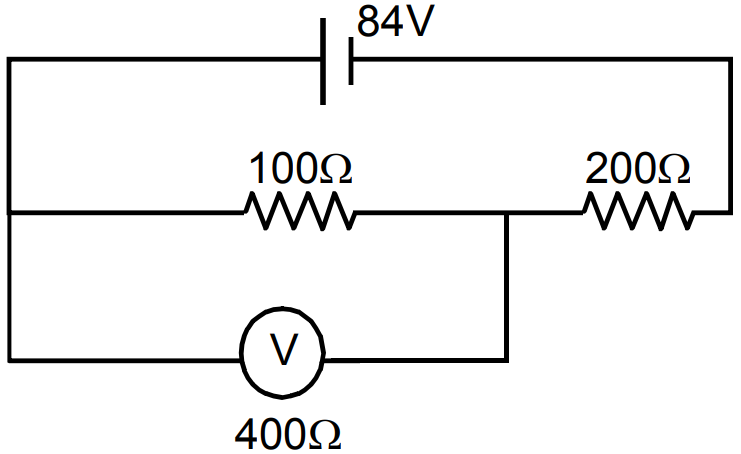
A voltmeter of resistance $400\Omega$ is used to measure the potential difference across the $100\Omega$ resistor in the circuit shown in the figure. (a) What will be the reading of the voltmeter? (b) What was the potential difference across $100\Omega$ before the voltmeter was connected?

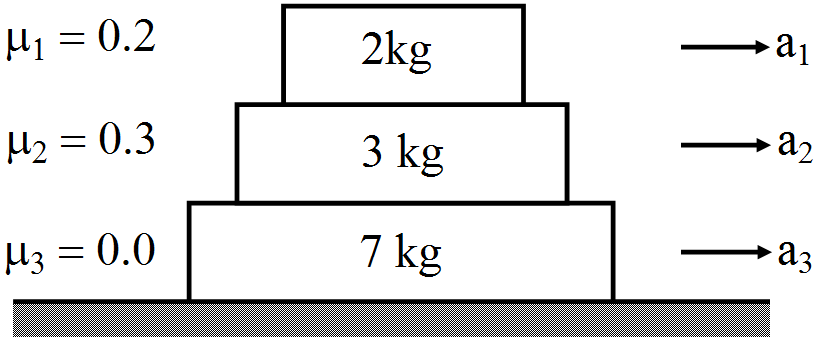
Find the accelerations a1, a2, a3 of the three blocks shown in figure if a horizontal force of 10N is applied on:

  1. 2kg block.
  2. 3kg block.
  3. 7kg block. Take g = 10m/s2.

In a p-n junction diode, the current I can be expressed as,
$I=I_0\ \text{exp}\Big(\frac{\text{eV}}{2\text{k}_{\text{B}}\text{T}}-1\Big)$
where $I_0$ is called the reverse saturation current, V is the voltage across the diode and is positive for forward bias and negative for reverse bias, and $I$ is the current through the diode, kg is the Boltzmann constant (8.6×10⁻⁵ eV/K) and T is the absolute temperature. If for a given diode $I_0$ = 5×10-12 A and T = 300 K, then,
  1. What will be the forward current at a forward voltage of 0.6V?
  2. What will be the increase in the current if the voltage across the diode is increased to 0.7V?
  3. What is the dynamic resistance?
  4. What will be the current if reverse bias voltage changes from 1V to 2V?
In en experiment on photoelectric effect, light of wavelength 400 run is incident on a cesium plate at the rate of 5.0W. The potential of the collector plate is made sufficiently positive with respect to the emitter so that the current reaches its saturation value. Assuming that on the average one out of every 10° photons is able to eject a photoelectron, find the photocurrent in the circuit.