Question
  1. Derive the expression for the torque on a rectangular current carrying loop suspended in a uniform magnetic field.
  2. A proton and a deuteron having equal momenta enter in a region of uniform magnetic field at right angle to the direction of the field. Depict their trajectories in the field.

Answer

  1.  

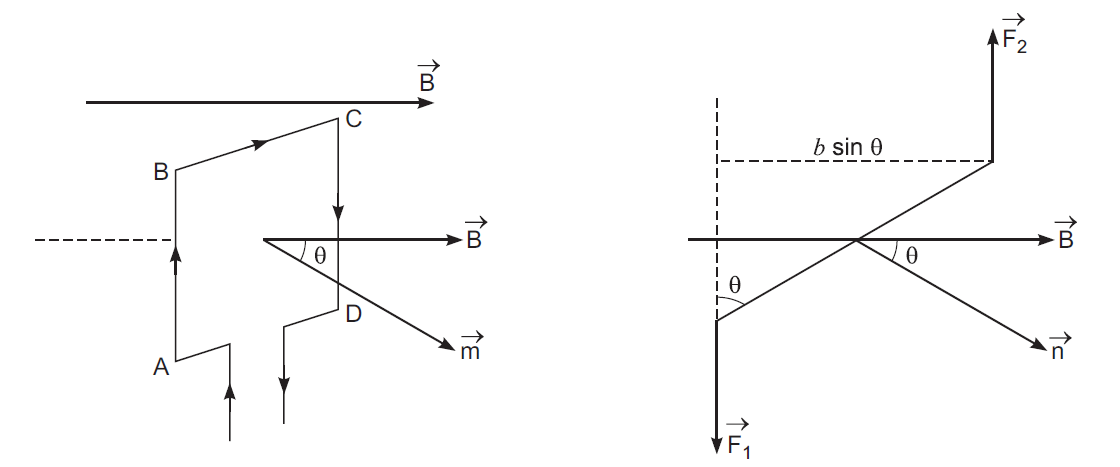
A rectangular loop ABCD of dimensions l and b, carrying a steady current is placed in uniform magnetic field as shown in fig; such that normal of the plane is at angle q with the magnetic field lines.

The force FBC and FAD on arms BC and AD are equal, opposite and along the axis of the coil, so they cancel each other.

The forces FAB and FCD are also equal and opposite, but are not collinear, so they constitute a couple, and the magnitude of the torque can be given as

$\tau = \text{F}_{AB}.\frac{\text{b}}{2}\sin\theta + \text{F}_{CD}.\frac{\text{b}}{2}\sin\theta$

Since

$|\text{F}_{AB}| = |\text{F}_{CD}| =\text{BI}\ell$

$\tau = \text{BI}\ell\times\text{b}\times\sin\theta$

$ = \text{BI}(\ell\text{b})\sin\theta$

= BI A sin $\theta$

$[\text{A} = \ell \text{b} = \text{ area of the rectangle}]$

Since magnetic moment m = I |A|

$\tau = \text{mB} \sin \theta$

In vector from $\overrightarrow{\tau} = \overrightarrow{\text{m}}\times\overrightarrow{\text{B}}$

  1. If a charge particle enters right angle to the direction of magnetic field, it follows a circular trajectory, and radius can be given as

$\text{q}v\text{B} = \frac{\text{m}v^{2}}{\text{r}}$

$\Rightarrow\text{r} = \frac{\text{m}v}{\text{qB}} = \frac{\text{p}}{\text{qB}}$

Since momentum are equal, and they have equal charges.

So, rp : rd = 1:1.
Need a full question paper?

Generate a complete, print-ready paper with questions like this in minutes — across 16+ boards, with answer keys.

Start Generating Free

Similar questions

Calculate the Q-values of the following fusion reactions:
  1. $\text{ }^2_1\text{H}+\text{ }^2_1\text{H}\rightarrow\text{ }^3_1\text{H}+\text{ }^1_1\text{H}$
  2. $\text{ }^2_1\text{H}+\text{ }^2_1\text{H}\rightarrow\text{ }^3_2\text{H}+\text{n}$
  3. $\text{ }^2_1\text{H}+\text{ }^3_1\text{H}\rightarrow\text{ }^4_1\text{H}+\text{n}$
Atomic masses are
$\text{m}\big(\text{ }^2_1\text{H}\big)=2.014102\text{u}$
$\text{m}\big(\text{ }^3_1\text{H}\big)=3·016049\text{u}$
$\text{m}\big(\text{ }^3_2\text{H}\big)=3.016029\text{u}$
$\text{m}\big(\text{ }^4_2\text{He}\big)=4·002603\text{u}$
Explain the Function of a $n-p-n$ transistor as a switch with necessary circuit diagram.
An ideal gas at pressure 2.5 × 10⁵Pa and temperature 300K occupies 100cc. It is adiabatically compressed to half its original volume. Calculate,
  1. The final pressure.
  2. The final temperature.
  3. The work done by the gas in the process. Take $\gamma=1.5.$
A rectangular wire loop of sides 8 cm and 2 cm having a small cut is moving out of a region of uniform magnetic field of magnitude 0.3 T directed normal to the loop. What is the emf developed across the cut if the velocity of the loop is $1 cm s ^{-1}$ in a direction normal to the (a) longer side (b) shorter side of the loop? For how long does the induced voltage last in each case?
In a Young's double slit interference experiment the fringe pattern is observed on a screen placed at a distance D from the slits. The slits are separated by a distance d and are illuminated by monochromatic light of wavelength $\lambda$. Find the distance from the central point where the intensity falls to,
  1. Half the maximum.
  2. One fourth of the maximum.
The magnetic field inside a long solenoid having 50 turns/cm is increased from 2·5 × 10.3T to 2.5T when an iron core of cross-sectional area 4cm2 is inserted into it. Find:
  1. The current in the solenoid.
  2. The magnetization I of the core.
  3. The pole strength developed in the core.
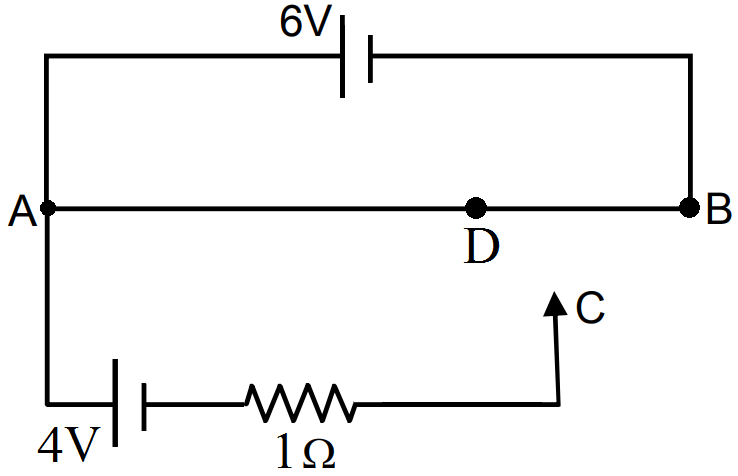
A 6 volt battery of negligible internal resistance is connected across a uniform wire AB of length 100cm. The positive terminal of another battery of emf 4V and internal resistance $1\Omega$ is joined to the point A, as shown in the figure. Take the potential at B to be zero. (a) What are the potentials at the points A and C? (b) At which point D of the wire AB, the potential is equal to the potential at C? (c) If the points C and D are connected by a wire, what will be the current through it? (d) If the 4V battery is replaced by a 7.5V battery, what would be the answers of parts (a) and (b)?

An X-OR gate has following truth table:
A B Y
0 0 0
0 1 1
1 0 1
1 1 0
It is represented by following logic relation
$\text{Y}=\bar{\text{A}}.\text{B}+\text{A}.\bar{\text{B}}$
Build this gate using AND, OR and NOT gates.
Write Bohr's postulates of hydrogen atom.
An electron of kinetic energy 100eV circulates in a path of radius 10cm in a magnetic field. Find the magnetic field and the number of revolutions per second made by the electron.