Question
Derive the relationship between mechanical advantage, velocity ratio and efficiency of a machine.

Answer

Let a machine overcome a load L by the application of an effort E. In time $t$, let the displacement
of effort be $dE$ and the displacement of load be dL.
Work input $=$ Effort X displacement of effort
$= EXdE$
Efficiency $n=\frac{\text { work output }}{\text { work input }}$
$
\begin{aligned}
& n =\frac{L \times d L}{E \times d E}=\frac{L}{E} \times \frac{1}{d E / d L} \\
& \text { But } \frac{L}{E}=M \cdot A \\
& \frac{d E}{d L}=V \cdot R \\
& n =\frac{M \cdot A}{V \cdot R} \\
& \text { M.A }= n \times V \cdot R
\end{aligned}
$
Thus, mechanical advantage of a machine is equal to the product of its efficiency and velocity ratio.

Need a full question paper?

Generate a complete, print-ready paper with questions like this in minutes — across 16+ boards, with answer keys.

Start Generating Free

Similar questions

State three common properties of beta rays and cathode rays.
Name two isotopes of uranium.

Which of the isotope mentioned in part (a) above is easily fissionable? Give reason.

State whether the neutron needed for fission reaction of the isotope mentioned in part (b) above, is slow or fast?
A light mass and a heavy mass have equal momentum. Which will have more kinetic energy?
(Hint : Kinetic energy $K = P^2/2m$ where P is the momentum)
(a) Draw a sketch to show how a lens is able to produce an image of the sun on a paper screen.
(b)(i) Would you regard the rays from the sun as being divergent, parallel or convergent?
(ii) What is the name given to the point where such rays meet after they have passed through the lens?
(iii) How does the image of the sun sometimes burn a paper screen?
What is optical centre of a thin lens? Draw diagram/diagrams to illustrate it.
A concave lens forms the image of an object kept at a distance 20 cm in front of it, at a distance 10 cm on the side of the object.
What is the nature of the image?
Find the focal length of the lens.
How does the deviation produced by a triangular prism depend on the colours (or wavelengths) of light incident on it? Which colour deviates the most and which the least?
State Fleming's left hand rule.
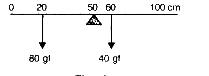
State the principle of moments. A meter scale is pivoted at 30 cm mark and it is in equilibrium when a mass of 40 g is suspended from 10 cm mark. Calculate the mass of the ruler.
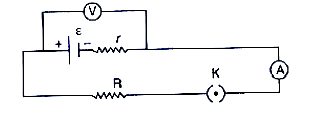
The diagram below in Fig. 8.40 shows a cell of e.m.f. ε = 2 volt and internal resistance r = 1 ohm to an external resistance R = 4 ohm. The ammeter A measures the current in the circuit and the
voltmeter V measures the terminal voltage across the cell. What will be the readings of the ammeter and voltmeter when (i) the key K is open, (ii) the key K is closed.