Questions

[3 Mark Question Answer]

🎯

Test yourself on this topic

36 questions · timed · auto-graded

Question 13 Marks
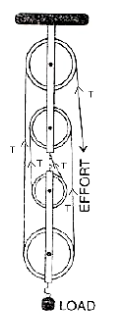
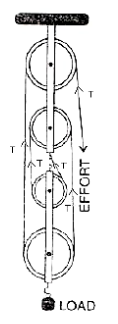
In following figure , shows a block and tackle system of pulleys used to lift a load.
(a) How many strands of tackle are supporting the load?
(b) Draw arrows to represent tension in each strand.
(c) What is the mechanical advantage of the system?
(d) When load is pulled up be a distance 1 m, how far does the effort end move?
Answer
(a) There are 4 strands of tackle supporting the load.
(b)
Image
(c) The mechanical advantage of the system
$
MA =\frac{\text { Load }}{\text { effort }}=\frac{4 T}{T}=4
$
(d) When load is pulled up by a distance $1 m$, the effort end will move by a distance $=1 \times 4=4 m$.
View full question & answer
Question 23 Marks
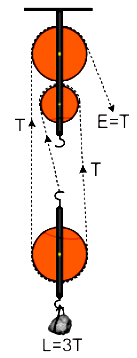
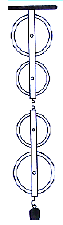
In following figure , shows a system of four pulleys, The upper two pulleys are fixed and the lower two are movable.
(a) Draw a string around the pulleys. Also show the place and direction in which the effort if applied.
(b) What is the velocity ratio of the system?
(c) How are load and effort of the pulley system related?
(d) What assumption do you make in arriving at your answer in part(c)?
Answer
Image
(b) Velocity ratio of the system $=n=4$
(c) The relation between load and effort
$
\text { MA }=\frac{\text { Load }}{\text { effort }}=n=4
$
(d)
(i) There is no friction in the pulley bearing,
(ii) weight of lower pulleys is negligible and
(iii) the effort is applied downwards.
 
View full question & answer
Question 33 Marks
A pulley system has a velocity ratio 3 and an efficiency of 80%. Draw a labelled diagram of this pulley system Calculate:
(a) the mechanical advantage of the system and
(b) the effort required to raise a load of 300 N.
Answer


A pulley system has a velocity ratio $=3$
Efficiency of system $=80 \%=0.8$
Mechanical advantage of the system M.A $=$ V.A $\times \eta=3 \times 0.8=2.4$
Effort required to raise the load $=$ Effort $=\frac{\text { Load }}{M \cdot A}=\frac{300}{2 \cdot 4}=125 N$
View full question & answer
Question 43 Marks
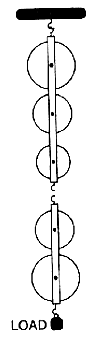
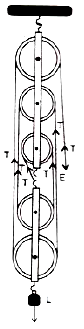
In following figure , draw a tackle to lift the load by applying the force in the downward direction. Mark the position of load and effort.
(a) If the load is raised by 1 m, through what distance will the effort move?
(b) State how many strands of tackle are supporting the load?
(c) What is the mechanical advantage of the system?
Answer

(a) The effort move $=1 \times 5=5 m$
(b) Five strands of tackle are supporting the load.
(c) Mechanical advantage of the system $=$ M.A $=\frac{\text { load }}{\text { effort }}=\frac{5 T}{T}=5$
View full question & answer
Question 53 Marks
A single fixed pulley and a movable pulley both are separately used to lift a load of 50 kgf to the same height. Compare the efforts applied.
Answer
In case of a single fixed pulley, the effort ( $E _f$ needed to lift a load) is equal to the load itself.
Thus, $E _{ f }= L$
$\rightarrow E_f=50 kgf$
In case of a single movable pulley, the effort needed to lift a load is equal to half the load.
$
\begin{aligned}
& \rightarrow E _{ m }=\frac{ L }{2} \\
& \rightarrow E _{ m }=\frac{50 kgf }{2}=25 kgf
\end{aligned}
$
Thus, the ratio of efforts applied by the respective pulley is
$
\frac{ E _{ f }}{ E _{ m }}=\frac{2}{1}
$
$
E _{ f }: E _{ m }=2: 1
$
View full question & answer
Question 63 Marks
A fixed pulley is driven by a 100 kg mass falling at a rate of 8.0 m in 4.0 s. It lifts a load of 75.0 kgf.
Calculate the efficiency of the pulley.
Answer
Load pulled by the pulley is $L=75 \times 10=750 N$
Therefore, M.A. is
$
\text { M.A. }=\frac{ L }{ E }=\frac{750}{1000}=0.75
$
When the effort moves by a distance $d$ downwards, the load moves by the same distance upwards. So, V.R. $=1$
Hence, efficiency is
$
\eta=\frac{\text { M.A. }}{\text { V.R. }}=\frac{0.75}{1}=0.75 \text { (or } 75 \% \text { ) }
$
View full question & answer
Question 73 Marks
A fixed pulley is driven by a 100 kg mass falling at a rate of 8.0 m in 4.0s. It lifts a load of 75.0 kgf.
Calculate the power input to the pulley taking the force of gravity on 1 kg as 10 N.
Answer
Load $=75.0 kgf$
Mass of falling object $=100 kg$
Displacement of effort $=8.0 m$
Time taken $=4.0 s$
Effort $=100 \times 10=1000 kgf$
Power Input
$
P_{\text {in }}=\frac{\text { displacement } \times \text { effort }}{\text { time }}=\frac{8 \times 1000}{4}=2000 W
$
View full question & answer
Question 83 Marks
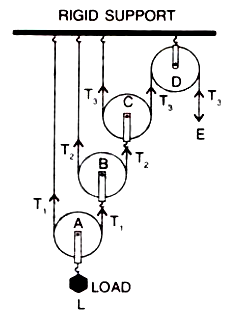
You are given four pulleys and three strings. Draw a neat and labelled diagram to use them so as to obtain a maximum mechanical advantage equal to 8. In you diagram make the directions of load, effort and tension in each strand.
What assumptions have you made to obtain the required mechanical advantage?
Answer

Assumptions:
(i) There is no friction in the pulley bearing,
(ii) the pulleys and the string are massless.
View full question & answer
Question 93 Marks
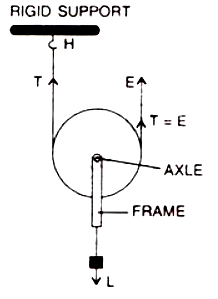
Name the type of single pulley that can act as a force multiplier. Draw a labelled diagram of the pulley mentioned by you.
Answer
A single movable pulley act as a force multiplier.
Diagram:
View full question & answer
Question 103 Marks
A block and tackle pulley system has a velocity ratio 5. Draw a labelled diagram of this system. In your diagram, indicate clearly the points of application and the directions of the load and effort.
View full question & answer
Question 113 Marks
Differentiate between a single fixed pulley and a single movable pulley.
Answer
Single fixed pulley Single movable pulley
1. It is fixed to a rigid support. 1. It is not fixed to a rigid support
2. Its mechanical advantage is one . 2. Its mechanical advantage is two.
3. Its velocity ratio is one. 3. Its velocity ratio is two.
4. The weight of pulley itself does not affect its mechanical advantage. 4. The weight of pulley itself reduces its mechanical advantage.
5. It is used to change the direction of effort 5. It is used as force multiplie
View full question & answer
Question 123 Marks
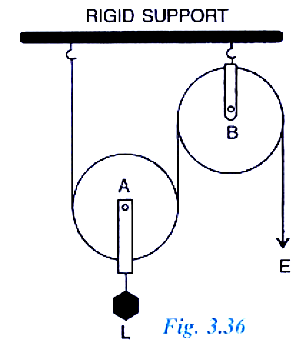
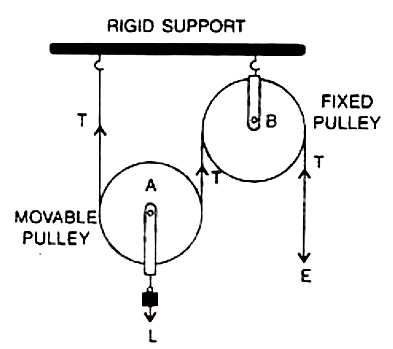
The diagram below shows a pulley arrangement.
(a) In the diagram, mark the direction of tension on each strand of string.
(b) What is the purpose of the pulley B?
(c) If the tension is T, Deduce the relation between T and E.
(d) What is the velocity ratio of the arrangement?
(e) Assuming that the efficiency of the system is 100%, What is the mechanical advantage?

Answer
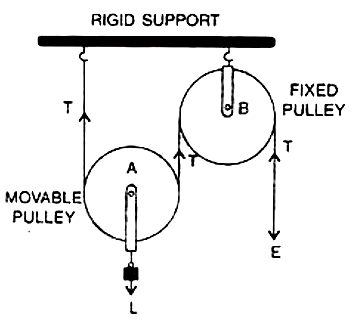
(a)

(b) The fixed pulley B is used to change the direction of effort to be applied from upward to downward.
(c) The effort E balances the tension T at the free end, so E=T
(d) The velocity ratio of this arrangement is 2.
(e) The mechanical advantage is 2 for this system (if efficiency is 100%).
View full question & answer
Question 133 Marks
Draw a labelled diagram of an arrangement of two pulleys, one fixed and other movable. In the diagram, mark the directions of al forces acting on it. What is the ideal mechanical advantage of the system? How can it be achieved?
Answer

Ideal mechanical advantage of this system is 2. This can be achieved by assuming that string and the pulley are massless and there is no friction in the pulley bearings or at the axle or between the string and surface of the rim of the pulley.

View full question & answer
Question 143 Marks
A lever of length 9 cm has its load arm 5 cm long and the effort arm is 9 cm long.
What is the mechanical advantage and velocity ratio if the efficiency is 100%?
Answer
Mechanical advantage is
$
\begin{aligned}
& \text { M.A. }=\frac{\text { effect arm }}{\text { load arm }}=\frac{9 cm }{5 cm } \\
& C=1.8
\end{aligned}
$
Relation between MA, efficiency and V.R. is
$
\text { M.A. }=\eta \times V . R \text {. }
$
$
\therefore \text { M.A. }=\text { V.R. }=1.8 \quad(\eta=100 \%=1)
$
View full question & answer
Question 153 Marks
A lever of length 9 cm has its load arm 5 cm long and the effort arm is 9 cm long.
Draw diagram of the lever showing the position of fulcrum F and directions of both the load L and effort E.
View full question & answer
Question 163 Marks
A 4 m long rod of negligible weight is to be balanced about a point 125 cm from one end. A load of 18 kgf is suspended at a point 60 cm from the support on the shorter arm.
(a) a weight W is placed 250 cm from the support on the longer arm Find W.
(b) If W = 5 kgf, where must it be kept to balance the rod?
(c) To which class of lever does it belong?
Answer
Total length of rod=4 m = 400 cm
(a) 18kgf load is placed at 60 cm from the support.
W kgf weight is placed at 250 cm from the support.
By the principle of moments
18 x 60 = W x 250
W = 4.32 kgf
(b) Given W=5 kgf
18kgf load is placed at 60 cm from the support.
Let 5 kgf of weight is placed at d cm from the support.
By the principle of moments
18 x 60 = 5 x d
d = 216 cm from the support on the longer arm
(c) It belongs to class I lever.
View full question & answer
Question 173 Marks
A pair of scissors is used to cut a piece of a cloth by keeping it at a distance 8.0 cm from its rivet and applying an effort of 10 kgf by fingers at a distance 2.0 cm from the rivet. (a) Find : (i) the mechanical advantage of scissors and (ii) the load offered by the cloth (b) How does the pair of scissors act: as a force multiplier or as speed multiplier?
Answer
Effort arm $=2 cm$
Load arm $=8.0 cm$
Given effort $=10 kgf$
(i) Mechanical advantage M.A $=\frac{\text { Effort arm }}{\text { Load arm }}=\frac{2}{8}=0.25$
(ii) load $=$ M.A $\times$ effort $=0.25 \times 10=2.5 kgf$
The pair of scissors acts as a speed multiplier because $M A<1$.
View full question & answer
Question 183 Marks
A man uses a crowbar of length 1.5 m to raise a load of 75 kgf by putting a sharp edge below the bar at a distance 1 m from his hand. Draw a diagram of the arrangement showing the fulcrum (F), load (L) and effort (E) with their directions. State the kind of lever. Calculate: (1) load arm, (2) effort arm, (3) mechanical advantage and (4) the effort needed.
Answer
Diagram


Crowbar is a class I lever.
(1) Total length of crowbar $=1.5 m$
Effort arm $=1 m$
Load arm $=1.5-1=0.5 m$
(2) Effort arm $=1 m$
(3) Mechanical advantage M.A $=\frac{\text { Effort arm }}{\text { Load arm }}=\frac{1}{0.5}=2$
(4) The effort needed
Effort $=\frac{\text { Load }}{M \cdot A}=\frac{75}{2}=37.5 kgf$
View full question & answer
Question 193 Marks
A force of 5 kgf is required to cut a metal sheet. A shears used for cutting the metal sheet has its blades 5 cm long, while its handles is 10 cm long. What effort is needed to cut the sheet?
Answer
Effort arm $=10 cm$
Load arm $=5 cm$
Mechanical advantage $=$ M.A $=\frac{\text { Effort arm }}{\text { Load arm }}=\frac{10}{5}=2$
Load $=5 kgf$
Effort $=\frac{\text { Load }}{M \cdot A}=\frac{5}{2}=2.5 kgf$
View full question & answer
Question 203 Marks
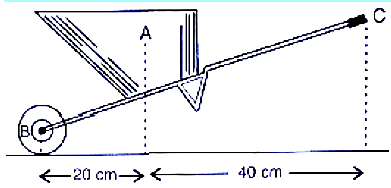
Fig 3.19 below shows a wheel barrow of mass $15 kg$ carrying a load of $30 kgf$ with its centre of gravity at A. The points B and C are the centre of wheel and tip of the handle such that the horizontal distance $A B=20 cm$ and $A C=40 cm$.


Calculate: (i) the load arm, (ii) the effort arm, (iii) the mechanical advantage and (iv) the minimum effort required to keep the leg just off the ground.
Answer
(i) Load arm AF $=20 cm$
(ii) Effort arm $CF =60 cm$
(iii) Mechanical advantage $M \cdot A=\frac{C F}{A F}=\frac{60}{20}=3$
(iv) Total load $=30+15=45 kgf$
Effort $=\frac{\text { Load }}{\text { M.A }}=\frac{30+15}{3}=15 kgf$
View full question & answer
Question 213 Marks
How Does Ideal Machine Differ from a Practical Machine ?
Answer
Ideal machine Practical machine
1. Efficiency is 100%. 1. Efficiency is less than 100%
2. Its parts are weightless, elastic and perfectly smooth. 2. Its parts are not weightless, elastic or perfectly smooth.
3. There is no loss in energy due to friction 3. There is always some loss of energy due to friction
4. Work output of such a machine is equal to the work input. 4. Work output is always less than the work input.
View full question & answer
Question 223 Marks
Give example of each class of lever in a human body?
Answer
(i) Class I lever in the action of nodding of the head: In this action, the spine acts as the fulcrum, load is at its front part, while effort is at its rear part.
(ii) Class II lever in raising the weight of the body on toes: The fulcrum is at toes at one end, the load is in the middle and effort by muscles is at the other end.
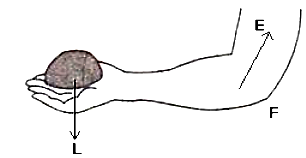
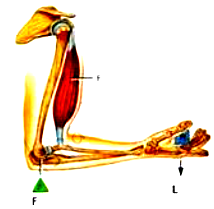
(iii) Class III lever in raising a load by forearm: The elbow joint acts as fulcrum at one end, biceps exerts the effort in the middle and a load on the palm is at the other end.
View full question & answer
Question 233 Marks
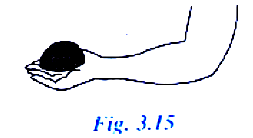
Indicate the positions of load, effort and fulcrum in the forearm shown below in Fig 3.15 Name class of lever.
Answer

It is Class III lever.

View full question & answer
Question 243 Marks
What type of lever is formed by the human body while raising a load on the palm ?
Answer
Class III.
Here, the fulcrum is the elbow of the human arm. Biceps exert the effort in the middle and load on the palm is at the other end.
View full question & answer
Question 253 Marks
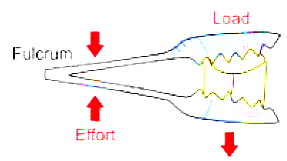
State the class of levers and the relative positions of load (L) effort (E) and fulcrum (F) in sugar tongs.
Answer
Sugar tongs are a lever of the third-order as the effort is in the middle, load at one end, and fulcrum at the other end.
View full question & answer
Question 263 Marks
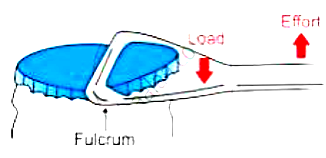
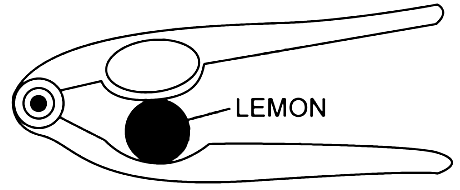
State the class of levers and the relative positions of load (L) effort (E) and fulcrum (F) in a bottle opener?
Answer
A bottle opener is a lever of the second order, as the load is in the middle, fulcrum at one end, and effort at the other.
View full question & answer
Question 273 Marks
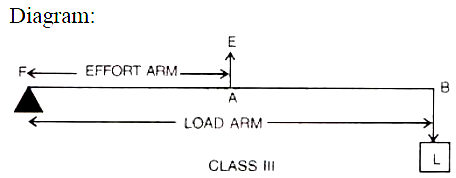
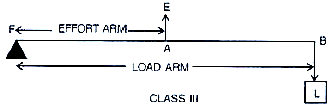
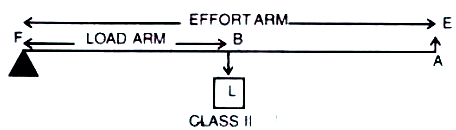
Draw a labelled sketch of a class III lever. Give one example of this kind of lever.
Answer

Examples: foot treadle.
View full question & answer
Question 283 Marks
State the kind of lever which always has the mechanical advantage less than 1. Draw a labelled diagram of such lever.
Answer
Classes III levers always have mechanical advantage less than one.
Diagram:
View full question & answer
Question 293 Marks
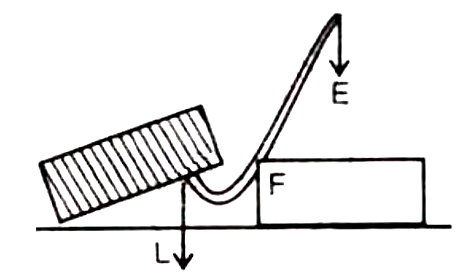
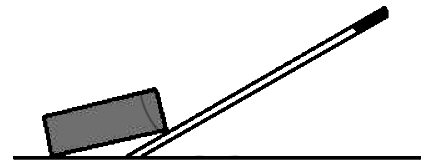
The diagram below shows a rod lifting a stone.
(a) Mark position of fulcrum F and draw arrows to show the directions of load L and effort E.
(b) What class of lever is the rod?
(c) Give one more example of the same class of lever stated in part (b).

Answer
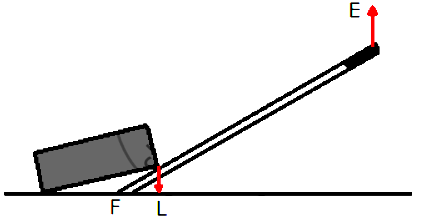
(a)


(b) This rod is a class II lever as load is between fulcrum and effort
(c) An example of class II lever is a bottle opener.
View full question & answer
Question 313 Marks
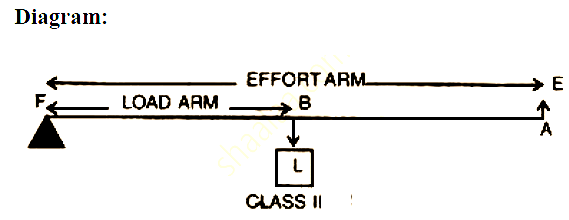
Draw a labelled diagram of a class II lever. Give one example of such a lever.
Answer
Diagram

Example: a bottle opener.
View full question & answer
Question 323 Marks
Draw a diagram of a lever which is always used as a force multiplier. How is the effort arm related to the load arm in such a lever?
Answer

The effort arm is longer than load arm in such a lever.
View full question & answer
Question 333 Marks
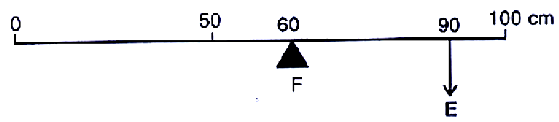
shows a uniform metre scale of weight W supported on a fulcrum at the 60 cm mark by applying the effort E at the 90 cm mark.
(a) state with reason whether the weight W of the scale is greater than, less than or equal to the effort E.
(b) Find the mechanical advantage in an ideal case.

Answer
(a) Reason: The weight $W$ of a uniform metre scale acts at $50 cm$ mark. Since distance of weight of scale from fulcrum $F$ is less then that of the effort E., so the weight W of scale is greater than the effort E.
It is because arm on the side of effort $E$ is $30 cm$ and on the side of weight of scale is $10 cm$. So, to balance the scale, weight $W$ of scale should be more than effort $E$.
$
\text { (b)MA }=\frac{\text { Effort arm }}{\text { Load arm }}
$
Here, effort arm $=3 cm$
Load arm $=10 cm$
$
\therefore M \cdot A=3010=3
$
View full question & answer
Question 343 Marks
What is the use of the lever if its mechanical advantage is
  1. more than 1,
  2. equal to 1, and
  3. less than 1?
Answer
  1. When the mechanical advantage is more the 1, the lever serves as force multiplier means it enables us to overcome a large resistive force by a small effort.
  2. When the mechanical advantage is equal to 1, the lever has effort arm and load arm of equal lengths.
  3. When the mechanical advantage is less than 1, the levers are used to obtain the gain in speed. This implies that the displacement of load is more as compared to the displacement of effort.
View full question & answer
Question 353 Marks
Name the three classes of levers and distinguish between them. Give two examples of each class.
Answer
The three classes of levers are:
(i) Class I levers: In these types of levers, the fulcrum F is in between the effort E and the load L. Example: a seesaw, a pair of scissors, crowbar.
(ii) Class II levers: In these types of levers, the load L is in between the effort E and the fulcrum F. The effort arm is thus always longer than the load arm. Example: a nut cracker, a bottle opener.
(iii) Class III levers: In these types of levers, the effort E is in between the fulcrum F and the load L and the effort arm is always smaller than the load arm. Example: sugar tongs, forearm used for lifting a load.
View full question & answer
Question 363 Marks
Derive the relationship between mechanical advantage, velocity ratio and efficiency of a machine.
Answer
Let a machine overcome a load L by the application of an effort E. In time $t$, let the displacement
of effort be $dE$ and the displacement of load be dL.
Work input $=$ Effort X displacement of effort
$= EXdE$
Efficiency $n=\frac{\text { work output }}{\text { work input }}$
$
\begin{aligned}
& n =\frac{L \times d L}{E \times d E}=\frac{L}{E} \times \frac{1}{d E / d L} \\
& \text { But } \frac{L}{E}=M \cdot A \\
& \frac{d E}{d L}=V \cdot R \\
& n =\frac{M \cdot A}{V \cdot R} \\
& \text { M.A }= n \times V \cdot R
\end{aligned}
$
Thus, mechanical advantage of a machine is equal to the product of its efficiency and velocity ratio.
View full question & answer
[3 Mark Question Answer] - Physics STD 10 Questions - Vidyadip