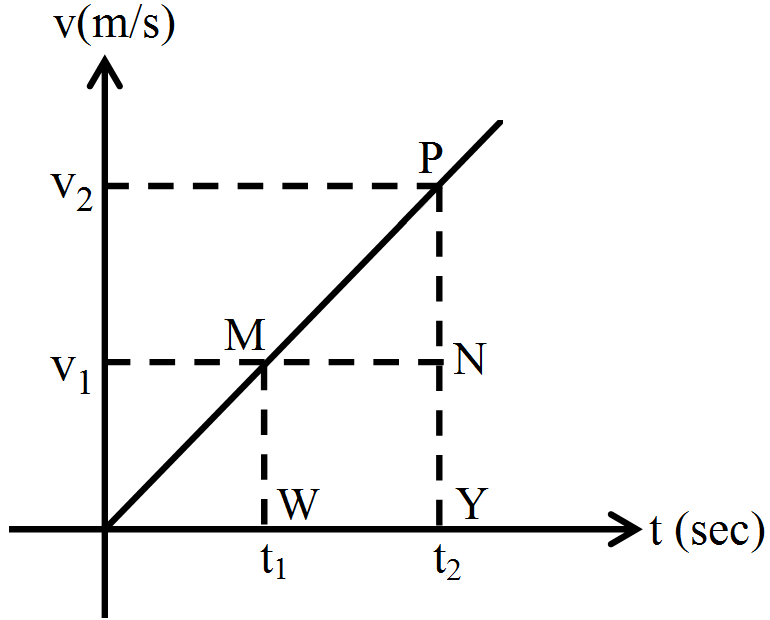
Consider a body starting from x1 and reaching x2 at time t2. Starting with a velocity v1 at time t1 with a uniform acceleration ‘a'. The motion can be described by the v-t graph as shown. Area below v-t graph is PMWYNP $=\text{WM}\times\text{WY}\times\frac{1}{2}\text{WY}\times\text{NP}$$=\text{v}_1(\text{t}_2-\text{t}_1)+\frac{1}{2}(\text{t}_2-\text{t}_1)\times(\text{v}_2-\text{v}_1)$ Since area below v-t graph is displacement and v2 - v1 = a(t2 - t1), we get $\text{x}_2-\text{x}_1=\text{v}_1(\text{t}_2-\text{t}_1)+\frac{1}{2}(\text{t}_2-\text{t}_1)\times\text{a}(\text{t}_2-\text{t}_1)$