Temperature, pressure, impulse, time, power, total path length, energy, gravitational potential, coefficient of friction, charge.
64 questions · self-marked practice — reveal the answer and mark yourself.
$=\hat{\text{i}}\begin{vmatrix}3&-4\\-4&5\end{vmatrix}-\hat{\text{j}}\begin{vmatrix}-2&-4\\3&5\end{vmatrix}+\hat{\text{k}}\begin{vmatrix}-2&3\\3&-4\end{vmatrix}$
$=\hat{\text{i}}(15-16)-\hat{\text{j}}(-10+12)+\hat{\text{k}}(8-9)$
$=-\hat{\text{i}}-2\hat{\text{j}}-\hat{\text{k}}$
$=-6-12-20=-38$
then,
$\text{R}_1=\frac{\text{u}^2\sin2(45^\circ+\alpha)}{\text{g}}=\frac{\text{u}^2}{\text{g}}\cos2\alpha\dots(\text{i})$$\therefore\ \text{R}_2=\frac{\text{u}^2\sin2(45^\circ-\alpha)}{\text{g}}=\frac{\text{u}^2}{\text{g}}\cos2\alpha\dots(\text{ii})$
Comparing eq. (i) and (ii), we have R1 = R2$\tan\theta=4$
$\Rightarrow\ \theta=75^\circ58'$
Because directions are perpendicular to X and Y, it may be interpreted for a circular motion with radius a.
$\text{R}=\sqrt{\text{A}^2+\text{B}^2+2\text{AB}\cos\theta}$
$\text{F}=\sqrt{\text{F}^2+\text{F}^2+2\text{F}.\text{F}\cos\theta}$
$\text{F}=\text{F}\sqrt{2(1+\cos\theta)}$
$1=2(1+\cos\theta)$
$\cos\theta=-\frac{1}{2}=\cos120^\circ$
$\theta=120^\circ$

$=\cot60^\circ=\frac{1}{\sqrt{3}}$
As,
$\theta=60^\circ,\ \cot60^\circ=\frac{1}{\sqrt{3}}$$(\text{A}+\text{B}).(\text{A}-\text{B})=0$
$\text{A}.\text{A}-\text{A}.\text{B}+\text{B}.\text{A}-\text{B}.\text{B}=0$
$\text{A}-\text{B}=0\ \ [\because\ \text{A}.\text{B}=\text{B}.\text{A}]$
$\Rightarrow\ \text{A}=\text{B}$


The goal man is 25m away in the direction of the ball, so to catch the ball, he is to cover a distance
= 40.82 - 25 = 15.82m in time 2.886s.
$\therefore$ Velocity of the goal man to catch the ball
$\text{v}=\frac{15.82}{2.886}=5.48\text{m/ s}$
$\therefore$
using $\text{R}^2=\text{P}^2+\text{Q}^2+2\text{PQ}\cos\theta$we get,
$\text{p}^2=\text{p}^2+\text{p}^2+2\text{p}^2\cos\theta$
$\cos\theta=-\frac{1}{2};\ \theta=120^\circ$
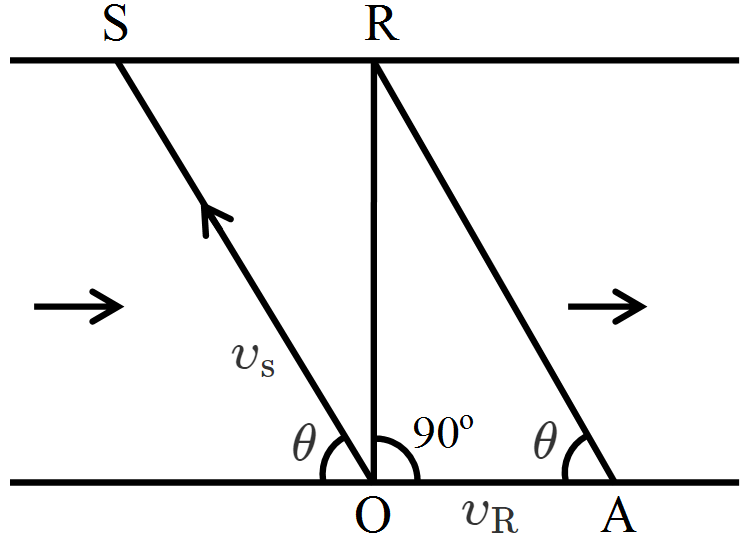
vR = 5km/ h
vS = 10km/ h
$\cos\theta=\frac{5}{10}=\frac{1}{2}$
$\theta=60^\circ$
⇒ with the direction of river, the angle would be
120° to reach the opposite point.
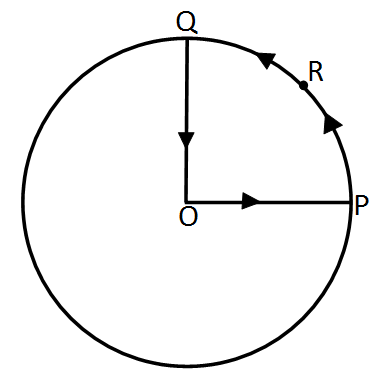
The path of the cyclist at R is circular of constant radius 1km with centre O and he is moving with constant speed 10m/ s. So his motion is uniform circular motion at R.
Hence, the R = 1000m, v =10m/ s
$\therefore\ \text{a}_\text{c}=\frac{\text{v}^2}{\text{R}}=\frac{10\times10}{1000}=\frac{1}{10}=0.1\text{m/ s}^2$ along RO.
$\text{F}^2=\text{F}^2+\text{F}^2+2\text{F}^2\cos\theta$
$\Rightarrow\ \cos\theta=\frac{-1}{2}\Rightarrow\ \theta=120^\circ$
$=\frac{\sin^2\alpha}{\cos^2\alpha}=\tan^2\alpha$
$\text{R}_1=\text{R}_2,\ \frac{\text{R}_1}{\text{R}_2}=1$
$\text{F}^2=\text{F}^2+\text{F}^2+2\text{F}^2\cos\theta$
$\cos\theta=-\frac{1}{2}$
or $\theta=120^\circ.$
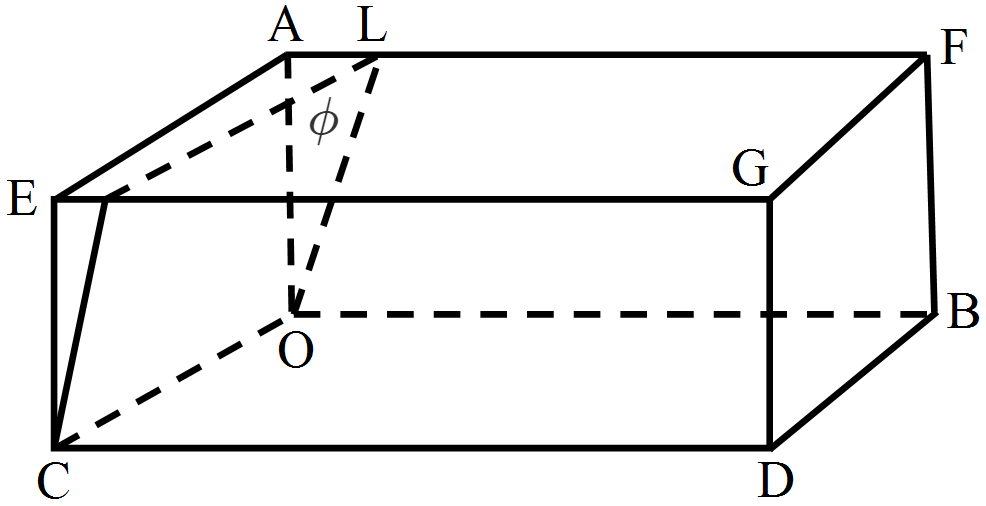
Consider $\vec{\text{OA}}=\vec{\text{a}}$
$\vec{\text{OB}}=\vec{\text{b}}$
$\vec{\text{OC}}=\vec{\text{c}}$
Then $\vec{\text{b}}\times\vec{\text{c}}$ is a vector perpendicular to the plane of $\vec{\text{b}}$ and $\vec{\text{c}}.$
Let $\phi$ be the angle between $\vec{\text{a}}$ and $\vec{\text{b}}\times\vec{\text{c}}$ and $\hat{\text{n}}$ unit vector along $\vec{\text{b}}\times\vec{\text{c}}.$
$\vec{\text{a}}.(\vec{\text{b}}\times\vec{\text{c}})=$ (area of parallelogram OBDC)
= area of parallelogram OBDC $(\hat{\text{n}}.\vec{\text{a}})$
= area of parallelogram OBDC $|\vec{\text{a}}|\cos\phi$
$(\because\ |\hat{\text{n}}|=1)$
= (area of parallelogram OBDC) (OL)
$[\because\ \text{OA}\cos\phi=\text{OL}]$
= (area of parallelogram OBDC) × (height)
= volume of parallelopiped with edges $\vec{\text{a}},\vec{\text{b}},\vec{\text{c}}$
$\theta=45^\circ+\alpha.$
Range, $\text{R}_1=\frac{\text{u}^2\sin2(45^\circ+\alpha)}{\text{g}}$
$=\frac{\text{u}^2\cos2\alpha}{\text{g}}$
Case II: When angle of projection.
$\theta=45^\circ-\alpha.$
Range, $\text{R}_2=\frac{\text{u}^2\sin2(45^\circ-\alpha)}{\text{g}}$
$=\frac{\text{u}^2}{\text{g}}\sin(90^\circ-2\alpha)$
$=\frac{\text{u}^2}{\text{g}}\cos^2\alpha=\text{R}_1$
The direction of the vector $(\vec{\text{B}}\times\vec{\text{C}})$ will be perpendicular to the plane containing by vectors $\vec{\text{B}}$ and $\vec{\text{C}}$ by Right-hand thumb or Right-hand grip rule (RHGR).
The direction of the vector $\vec{\text{A}}\times(\vec{\text{B}}\times\vec{\text{C}})$ will be perpendicular to $\vec{\text{A}}$ and in a plane containing $\vec{\text{B}}$ and $\vec{\text{C}}$ by Right-hand grip rule.
or
$\text{r}=\Big(\frac{1250}{9}\Big)^2\frac{\sqrt{3}}{1}\times\frac{1}{9.8}$$\Big[\because5000\text{ km/hr}=\frac{1250}{9}\text{ m/s}\Big]$
or,
$\text{r}=3.41\times10^3\text{m}\Big[\because\tan30^\circ=\frac{1}{\sqrt{3}}\Big]$
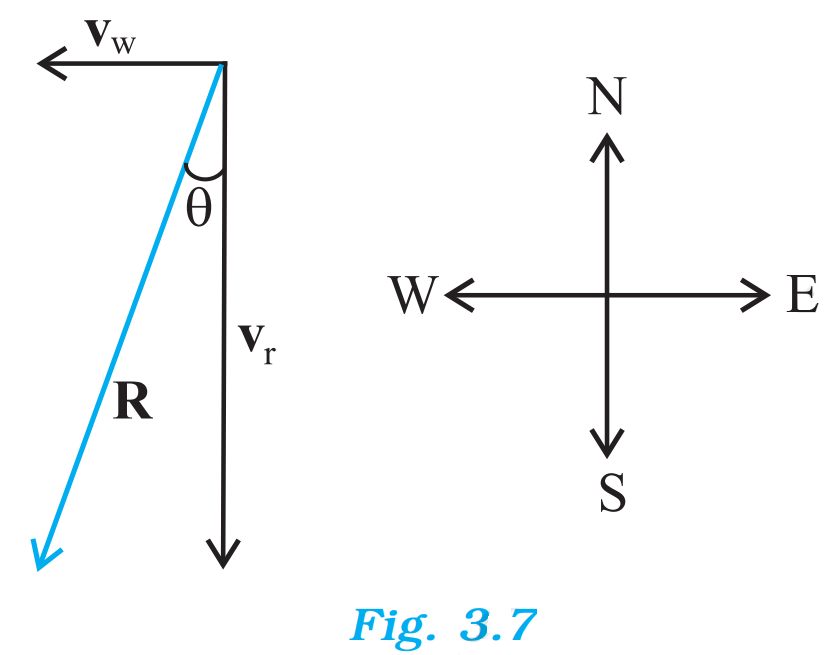
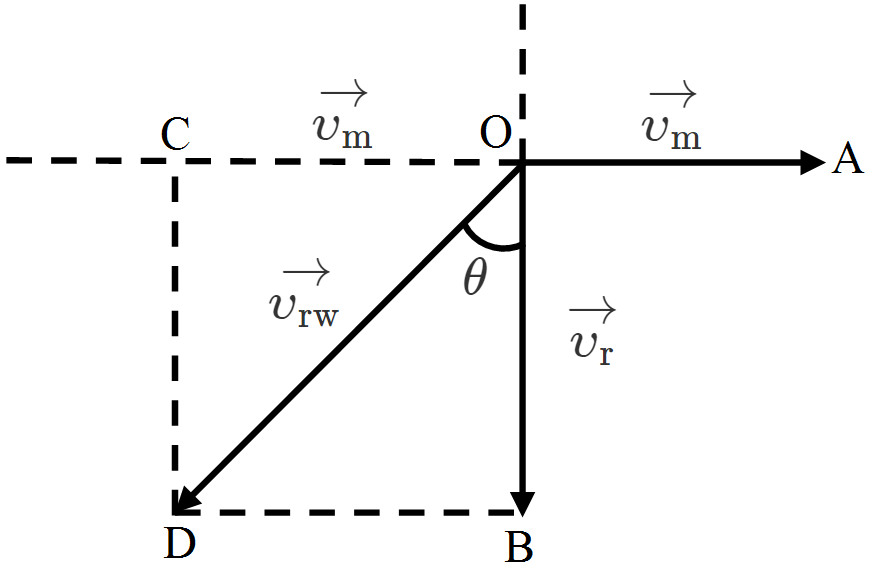
$\vec{\text{v}_\text{w}}=10\text{ m/s}=\vec{\text{OA}}$
$\vec{\text{v}_\text{r}}=30\text{ m/s}=\vec{\text{OB}}$
$\therefore\ \vec{\text{v}_\text{rw}}=\sqrt{\text{v}_\text{r}^2+\text{v}_\text{w}^2}$
$=\sqrt{(10)^2+(30)^2}=31.6\text{ m/s}$
$\tan\theta=\frac{\text{BD}}{\text{OB}}=\frac{10}{30}=0.33\ (\text{BD}=\text{OA})$
$\theta=18^\circ16'$
with vertical direction.