Question
Describe a method for the identification of primary, secondary and tertiary amines. Also write chemical equations of the reaction involved.

Answer

Identification of primary, secondary and tertiary amines are performed by these methods.
(i) Carbyl amine reaction : Aliphatic and aromatic primary amine are heated with chloroform and ethanolic potassium hydroxide then pungent smelling substance isocyanide or carbyl amine is formed. This reaction is not shown by secondary and tertiary amines.
Image
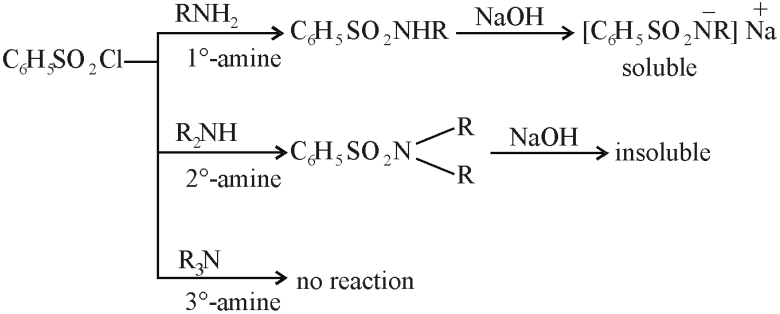
(ii) Reaction with Hinsberg reagent : In the Hinsberg method mixture of $1^{\circ}, 2^{\circ}$ and $3^{\circ}$ amines is treated with Hinsberg reagent $\left( C _6 H _5 SO _4\right)$ then product obtained from $1^{\circ}$ amine is soluble in alkali and the product obtained from $2^{\circ}$ amine is insoluble in alkali $( NaOH )$ while $3^{\circ}$ amine does not react with Hinsberg reagent.
Image
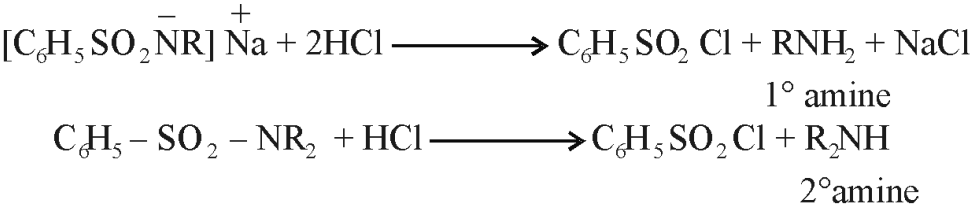
When steam distillation of reaction mixture is done then $3^{\circ}$ amine is distilled and remaining part is filtered so $C _6 H _5 SO _2 NR _2$ insoluble in $NaOH$ is separated. So $\left( C _6 H _5 SO _2 \stackrel{-}{ NR }\right) \stackrel{+}{ Na }$ is left. Both of these are treated with $25 \% HCl$ followed by hydrolysis then free $1^{\circ}$ and $2^{\circ}$ amines are obtained.
Image
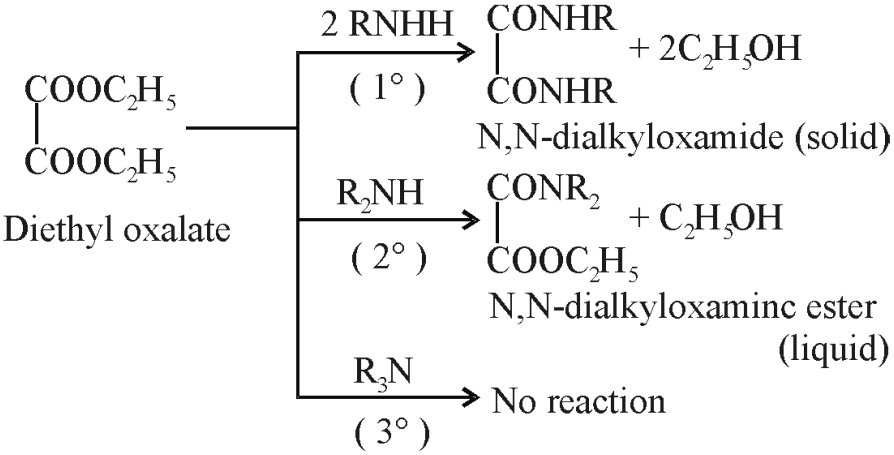
(iii) Hoffman method (Reaction with oxalic ester) : In Hoffman method mixture of amines is treated with oxalic esters $3^{\circ}$-amine does not react, liquid product from $2^{\circ}$-amine and solid product is formed from $1^{\circ}$-amine.
Image
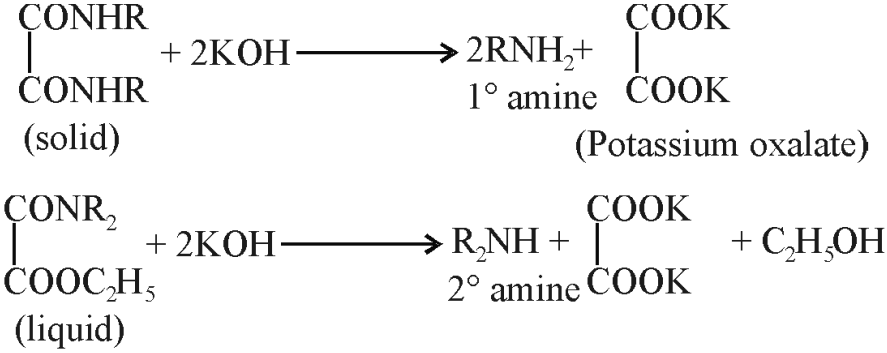
When reaction mixture is distilled then unreacted $3^{\circ}-$ amine is distilled. Remaining residue is filtered and solid and liquid products are separated. Then these are distilled with KOH or NaOH separately so $1^{\circ}$ and $2^{\circ}$ amine become free.
Image

Need a full question paper?

Generate a complete, print-ready paper with questions like this in minutes — across 16+ boards, with answer keys.

Start Generating Free

Similar questions

  1. Give reasons for the following:
  1. Mn3+ is a good oxidizing agent.
  2. Eo m2+/M values are not regular for first row transition metals. (3d series)
  3. Although ‘F’ is more electronegative then ‘O’, the highest Mn fluoride is Mnf4, whereas the highest oxide is Mn2O7.
  1. Complete the following equations:

$\text{2CrO}_{4}^{2}+\text{2H}^{+}\rightarrow$

$\text{KMnO}_{4}\xrightarrow{heat}$
Explain the energy distribution curve of gaseous molecules and also discuss the effect of temperature on it.
How are carboxylic acids prepared from the following compounds? Explain with examples:
(a) Primary alcohol
(b) Acyl halide
(c) Acid anhydride
(d) Grignard reagent
(e) Alkyl benzene.
Write short notes :
Acetylation
Describe the following with one example in each case :
(i) Analgesic
(ii) Disinfectants
(iii) Antibiotics
i. Write one chemical reaction for each
a. Carbylamine reaction
b. Acetylation reaction
ii. Write structure of N,N-ethylmethylethanamide
Two elements A and B form compounds having formula AB2 and AB4. When dissolved in 20 g of benzene $\left( C _6 H _6\right), 1 g$ of $AB _2$ lowers the freezing point by 2.3 K whereas 1.0 g of AB4 lowers it by 1.3 K. The molar depression constant for benzene is 5.1 K kg mol-1. Calculate atomic masses of A and B.
Write the structure of A, B, C, D and E in the following reactions:
Image
What is the difference between order of a reaction and its molecularity?
  1. Define the following terms:
  1. Molarity.
  2. Molal elevation constant(Kb).
  1. A solution containing 15 g urea (molar mass = 60 g mol–1) per litre of solution in water has the same osmotic pressure (isotonic) as a solution of glucose (molar mass = 180 g mol–1) in water. Calculate the mass of glucose present in one litre of its solution.