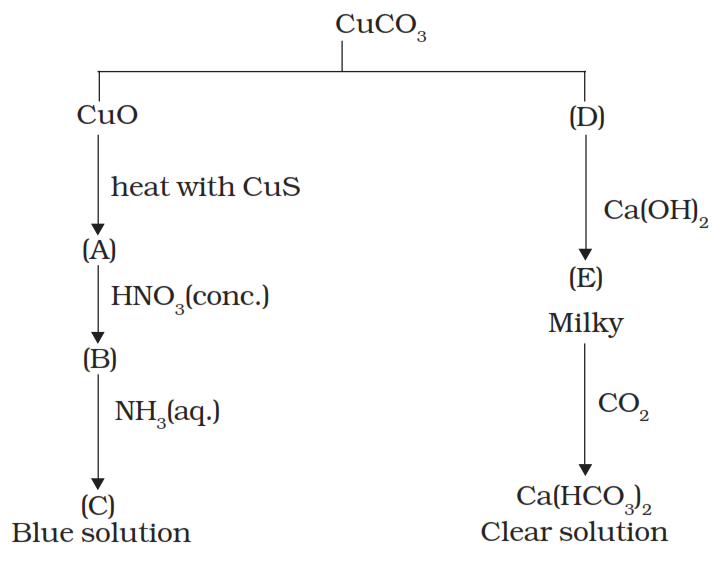
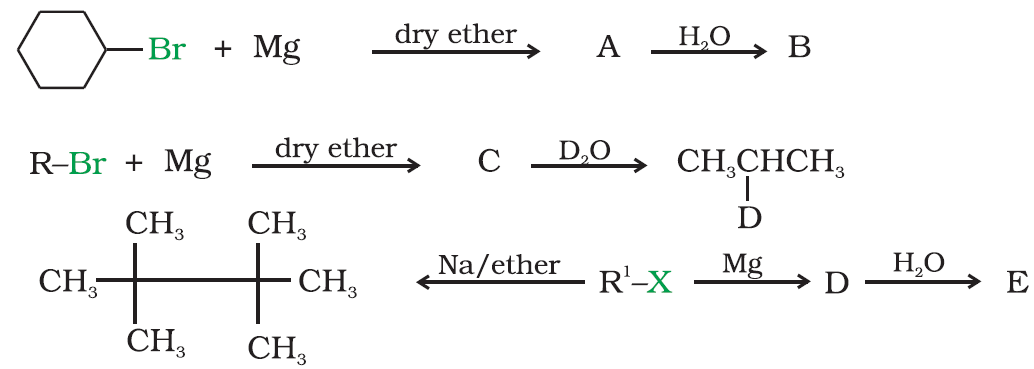
Question
Write the structure of A, B, C, D and E in the following reactions:
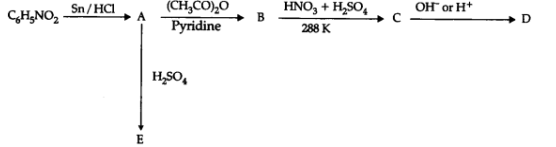
Image

Answer

Get the step-by-step solution for this question inside the Vidyadip app.

Get the answer in the app

Need a full question paper?

Generate a complete, print-ready paper with questions like this in minutes — across 16+ boards, with answer keys.

Start Generating Free

Similar questions

  1.  
  1. How is the variability in oxidation states of transition metals different from that of the p-block elements?
  2. Out of Cu+ and Cu2+, which ion is unstable in aqueous solution and why?
  3. Orange colour of Cr2O72– ion changes to yellow when treated with an alkali. Why?
  1. Chemistry of actinoids is complicated as compared to lanthanoids. Give two reasons.
Answer the following questions:
Give chemical reactions for the following observations:
  1. Potassium permanganate is a good oxidising agent in basic medium.
  2. Inter convertibility of chromate ion and dichromate ion in aqueous solution depends upon pH of the solution.
  3. Potassium permanganate is thermally unstable at 513K.
Draw the structures of optical isomers of :
(i) $\left[ Cr \left( C _2 O _4\right)_3\right]^{3-}$
(ii) $\left[ PtCl _2( en )_2\right]^{2+}$
(iii) $\left[ Cr \left( NH _3\right)_2 Cl _2( en )\right]^{+}$
Magnetic properties of coordination compounds. Explain in detail.
Match the compounds/elements given in Column I with uses given in Column II.

 
Column I (Compound/element)
 
Column II (Use)
(i)
Lanthanoid oxide
(a)
Production of iron alloy
(ii)
Lanthanoid
(b)
Television screen
(iii)
Misch metal
(c)
Petroleum cracking
(iv)
Magnesium based alloy is constituent of
(d)
Lanthanoid metal + iron
(v)
Mixed oxides of lanthanoids are employed
(e)
Bullets
 
 
(f)
In X-ray screen


Derive the equation required for finding the activation energy.
Write the formulas for the following coordination compounds:
a. Tetraammineaquachloridocobalt(III) chloride
b. Potassium tetrahydroxidozincate(II)
c. Potassium trioxalatoaluminate(III)
d. Dichloridobis(ethane-1, 2-diamine)cobalt(III)
e. Tetracarbonylnickel(0)
The experimental data for decomposition of N2O5
[2N2O5 → 4NO2 + O2]
in gas phase at 318K are given below:
t/s 0 400 800 1200 1600 2000 2400 2800 3200
102 × [N2O5]/mol L-1 1.63 1.36 1.14 0.93 0.78 0.64 0.53 0.43 0.35
  1. Plot [N2O5] against t.
  2. Find the half-life period for the reaction.
  3. Draw a graph between log[N2O5] and t.
  4. What is the rate law?
  5. Calculate the rate constant.
  6. Calculate the half-life period from k and compare it with (ii).