Tamilnadu BoardEnglish MediumSTD 12ChemistryCoordination Chemistry5 Marks
Question
Describe about the postulate of VB theory (or) Valence bond theory.
✓
Answer
1. The ligand → metal bond in a coordination complex is covalent in nature. It is formed by the sharing of electrons between the central metal atom and electron donor ligand.
2. Each ligand should have atleast one filled orbital containing a lone pair of electrons.
3. In order to accommodate the electron pairs donated by the ligands, the central metal ion present in a complex provides required number of vacant orbitals.
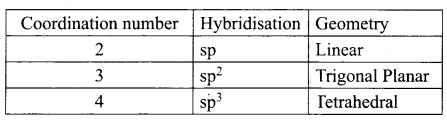
4. These vacant orbitals of central metal atoms undergo hybridisation, the process of mixing of atomic orbitals of comparable energy to form equal number of new orbitals called hybridised orbitals with same energy.
5. The vacant hybridised orbitals of the central metal ion, linearly overlap with filled orbitals of the ligands to form coordinate covalent sigma bonds between the metal and the ligand.
6. The hybridised orbitals are directional and their orientation in space gives a definite geometry to the complex ion.
7. In the octahedral complexes, if the $(n-1) d$ orbitals are involved in hybridisation they are called inner orbital complexes or low spin complexes (or) spin paired complexes. If the nd orbitals are involved in hybridisation, such complexes are called outer orbital complexes (or) high spin (or) spin free complexes. Here " $n$ " represents the principal quantum number of the outermost shell.
8. The complexes containing a central metal atom with unpaired electron ( s ) are paramagnetic. If all the electrons are paired, then the complexes will be diamagnetic.
9. Ligands such as $CO , CN ^{-}$, en and $NH _3$ present in the complexes cause pairing of electrons present in the central metal atom. Such ligands are called strong field ligands.
10. Greater the overlapping between, the ligand orbitals and the hybridised metal orbital, greater is the bond strength.
Need a full question paper?
Generate a complete, print-ready paper with questions like this in minutes — across 16+ boards, with answer keys.