Describe an experiment for the study of characteristics of photoelectric effect.
(July 2019)
Download our app for free and get started
- A laboratory experimental set-up for the photoelectric effect consists of an evacuated glass tube with a quartz window.
- The glass tube contains photosensitive metal plates. One is the emitter E and another plate is the collector C.
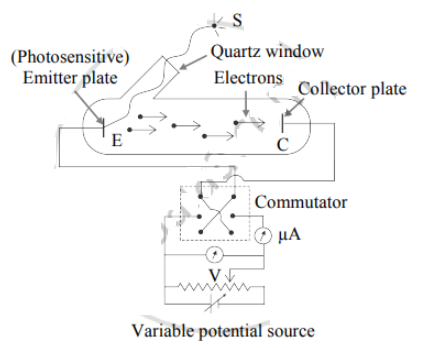
- The emitter and collector are connected to a voltage source whose voltage can be changed and to an ammeter to measure the current in the circuit.
- A potential difference of V, as measured by the voltmeter, is maintained between the emitter E and collector C. Generally, C (the anode) is at a positive potential with respect to the emitter E (the cathode). This potential difference can be varied and C can even be at a negative potential with respect to E.
- When the anode potential (V) is positive, it accelerates the electrons. This potential is called accelerating potential. When the anode potential (V) is negative, it retards the flow of electrons. This potential is known as retarding potential.
- A source S of monochromatic light of sufficiently high frequency (short wavelength$ \leq 10^{–7} m$) is used.

Download our appand get started for free
Experience the future of education. Simply download our apps or reach out to us for more information. Let's shape the future of learning together!No signup needed.*
Similar Questions
- 1View SolutionThe work function for a metal surface is \(2.2 eV\). If light of wavelength 5000Å is incident on the surface of the metal, find the threshold frequency and incident frequency. Will there be an emission of photoelectrons or not? \(\left(c=3 \times 10^8 m / s , 1 eV =1.6 \times 10^{-19} J , h =6.63 \times 10^{-34} J . s\right.\). \()\)
- 2View SolutionLight of wavelength 3000Å falls on a metal surface having work function \(2.3 eV\). Calculate the maximum velocity of ejected electrons. (Planck's constant \(h=6.63 \times 10^{34}\) J.s., Velocity of light \(c=3 \times 10^8 m / s\), Mass of an electron \(=9.1 \times 10^{-31} kg\) )
- 3View SolutionThe photoelectric threshold wavelength of a metal is \(230 nm\). Determine the maximum kinetic energy in joule and in \(eV\) of the ejected electron for the metal surface when it is exposed to a radiation of wavelength \(180 nm\), [Planck's constant : \(h=6.63 \times 10^{-34} Js\), Velocity of light : \(c=3 \times 10^8 m / s\).]
- 4View SolutionThe photoelectric current in a photoelectric cell can be reduced to zero by a stopping potential of 1.8 volt. Monochromatic light of wavelength 2200Å is incident on the cathode. Find the maximum kinetic energy of the photoelectrons in joules. [Charge on electron \(=1.6 \times 10^{-19} C\)]
- 5View SolutionDraw a well labelled diagram of photoelectric cell. Explain the observations made by Hertz and Lenard about the phenomenon of photoelectric emission.
- 6View SolutionWith a neat, labelled schematic diagram, explain the experimental set-up for photoelectric effect
- 7View SolutionState Einstein's photoelectric equation. Explain two characteristic of photoelectric effect on the basis of Einstein photoelectron equation.
- 8View SolutionThe work functions for potassium and cesium are \(2.25 eV\) and \(2.14 eV\) respectively. Is the photoelectric effect possible for either of them if the incident wavelength is 5180 ?
[Given : Planck's constant \(=6.63 \times 10^{-34} J . s\); Velocity of light \(=3 \times 10^8 m / s ; 1 eV =1.6 \times 10^{-19} J\) ] - 9View SolutionState Einstein's photoelectric equation. Explain any two characteristics of photoelectric effect on the basis of this equation.
- 10View SolutionWith neat labelled circuit diagram, describe an experiment to study the characteristics of photoelectric effect.