Questions

Answer the questions.[Che-5M]

🎯

Test yourself on this topic

13 questions · timed · auto-graded

Question 15 Marks
What are the features and drawbacks of Rutherford’s nuclear model of an atom?
Answer
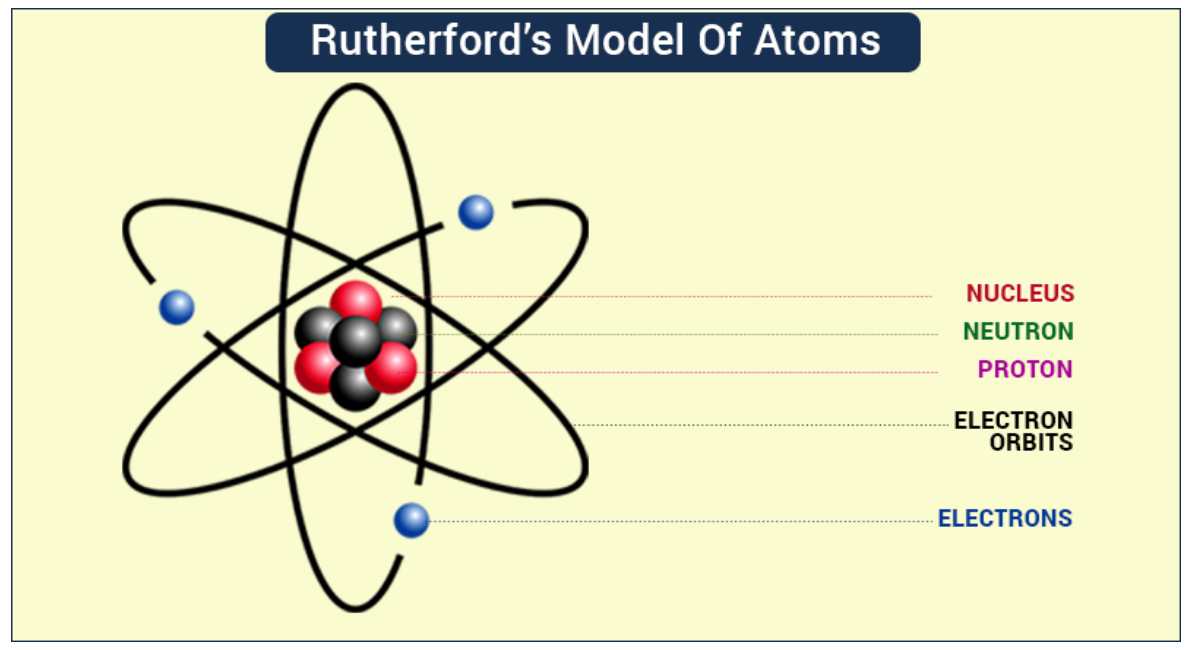
The major features of the model are as follows.

  1.  All protons are present inside the nucleus, which is situated at the center of the atom.
  2. Electrons reside outside the nucleus and revolve around the nucleus in well-defined orbits.
  3. The size of the nucleus is very small in comparison to the size of an atom. As per Rutherford’s calculations, the size of the nucleus is 105 times smaller than an atom.
  4. As the mass of the electron is negligible in comparison to the mass of the proton, almost all the mass of the atom is concentrated in the nucleus.

Drawbacks of Rutherford’s nuclear model:

  • It could not explain line spectra of atom.
  • It could not explain stability of an atom because this model does not obey Maxwell law of electrodynamics. According to Maxwell electron should continuous emit radiation and thus and gradually lose energy, so its distance from nucleus should become shorter and finally it should fall into the nucleus. However this never happen
View full question & answer
Question 25 Marks
The electronic configuration of an element Z is 2, 8, 8.
  1. What is the atomic number of the element?
  2. State whether element Z is a metal or a non-metal.
  3. What type of ion (if any) will be formed by an atom of element Z? Why?
  4. What is special about the outermost electron shell or the atom of this element?
  5. Give the name and symbol of element Z.
  6. Name the group of elements to which Z belongs.
Answer
  1. Atomic no. of the element = 18
  2. Element Z is a non-metal
  3. Element Z will not form any ion because its outermost shell is complete.
  4. Outermost electronic shell of the atom of this element is completely filled with electrons.
  5. Name of element Z is Argon Symbol is Ar.
  6. Z belongs to the noble gases group or the zero group of the periodic table.
View full question & answer
Question 35 Marks
The atom of an element X has 7 electrons in its M shell:
  1. Write the electronic configuration of element X.
  2. What is the atomic number of element X?
  3. Is it a metal or a non-metal?
  4. What type of ion will be formed by an atom of element X? Write the symbol of the ion formed.
  5. What could element X be?
Answer
  1. Electronic configuration of the element X is,

Element X: $\text{K}\ \ \ \ \ \ \text{L}\ \ \ \ \ \ \text{M}\\2\ \ \ \ \ \ \ 8\ \ \ \ \ \ \ 7$

  1. Atomic number of the element X will be 17
  2. Element X is a non-metal because there are 7 electrons in its outermost orbit. In order to complete its octet (to get 8 electrons), it will gain one electron. An element which gains electrons in order to complete its octet is a non-metal.
  3. The element will form an anion by gaining an extra electron in order to complete its octet. Symbol of an ion of X will be X-
  4. X is Chlorine.
View full question & answer
Question 45 Marks

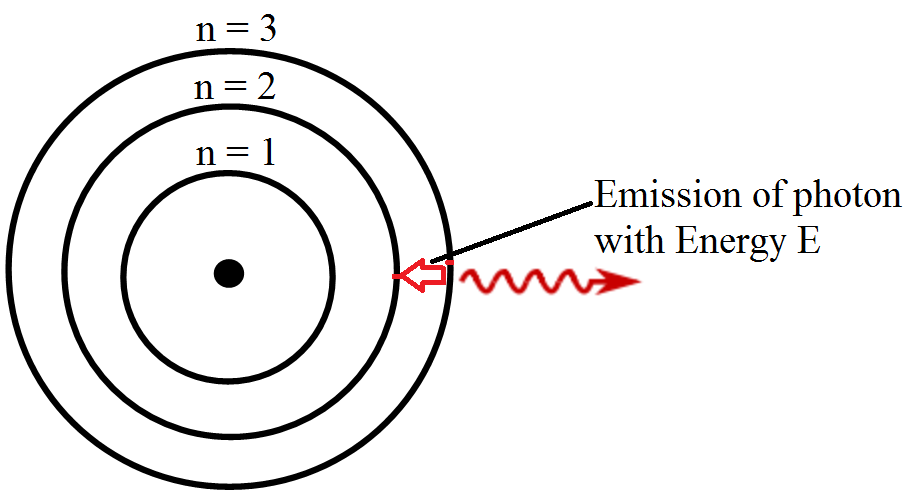
What are the postulates of Bohr’s model of an atom?

Answer
The postulates of Bohr’s model of atom are as follows:

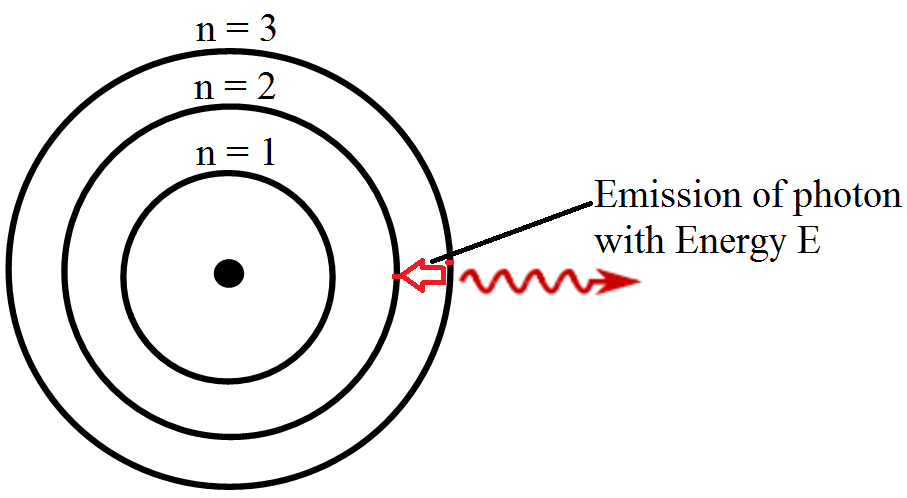
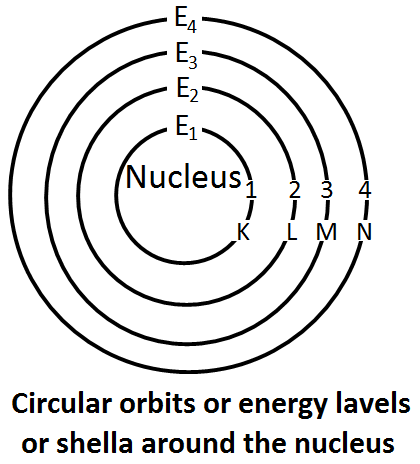
In an atom, the electrons revole around the nucleus in certain definite circular paths called orbits or shells. These are represented by the letters K, L, M, N ______ or the numbers n = 1,2, 3, 4 ______

  1. The maximum number of electrons present in a shell is given by the formula 2n2, where W is the orbit number or energy level index, 1,2, 3…. Hence, the maximum number of electrons in different shells are as follows.

First orbit (K shell) will be = 2 × 12 = 2, second orbit (or L shell) will be = 2 × 22 = 8, third orbit (M shell) will be = 2 × 32 =18 and so on.

  1. The maximum number of electrons that can be accomadated in the outermost orbit is 8.
  2. Electrons are not accomodated in a given shell, unless the inner shells are filled. That is the shells are filled in a step-wise manner.
  3. While revolving in discrete orbits the electrons do not radiate energy.
View full question & answer
Question 55 Marks

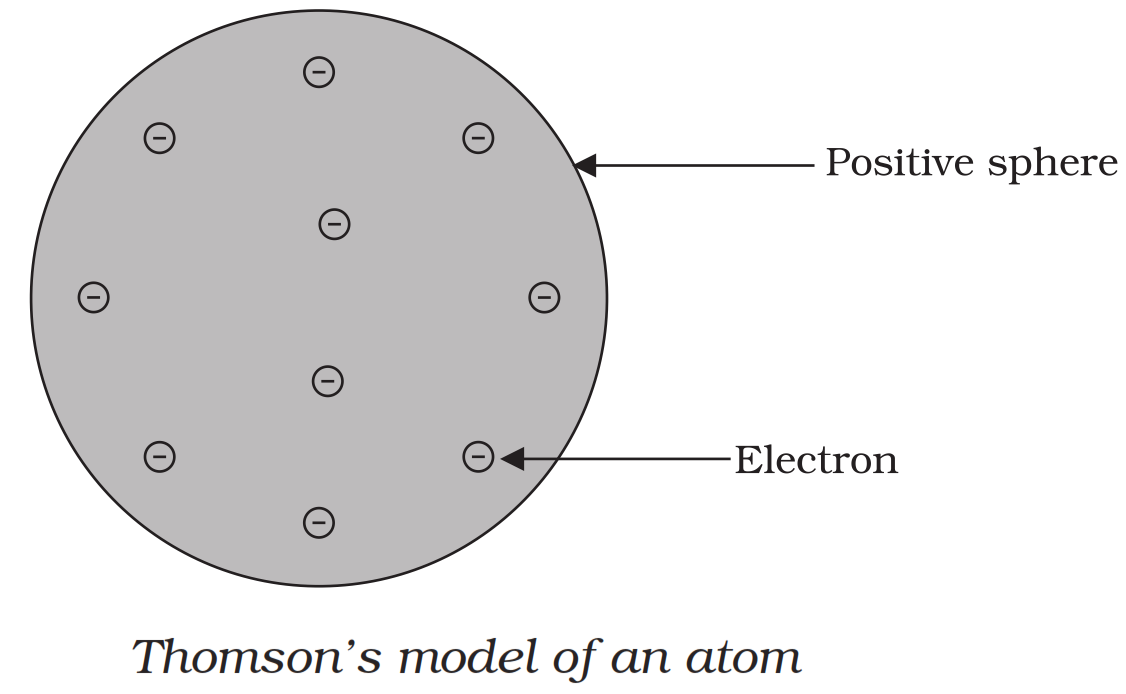
In what way is the Rutherford’s atomic model different from that of Thomson’s atomic model?

Answer
Rutherford had proposed a model in which the electrons revolved around the nucleus in well-defined orbits. There is a positively charged centre (later called "nucleus") in an atom. He also proposed that the size of the nucleus was very small as compared to the size of the atom and nearly all the mass of an atom is centred in the nucleus. Thomson had proposed the model of an atom to be similar to a christmas pudding. The electrons are studded like currants in a positively charged sphere of pudding and the mass of the atom was supposed to be uniformly distributed.
View full question & answer
Question 65 Marks
How will you find the valency of chlorine, sulphur and magnesium?
Answer
If the number of electrons in the outermost shell of the atom of an element is less than or equal to 4, then the valency of the element is equal to the number of electrons in the outermost shell.

On the other hand, if the number of electrons in the outermost shell of the atom of an element is greater than 4, then the valency of that element is determined by subtracting the number of electrons in the outermost shell from 8.

The distribution of electrons in chlorine, sulphur, and magnesium atoms are 2, 8, 7; 2, 8, 6 and 2, 8, 2 respectively. Therefore, the number of electrons in the outer most shell of chlorine, sulphur, and magnesium atoms are 7, 6, and 2 respectively.

Thus,

The valency of chlorine = 8 −7 = 1

The valency of sulphur = 8 − 6 = 2

The valency of magnesium = 2

View full question & answer
Question 75 Marks
Explain with examples

  1. Atomic number,
  2. Mass number,
  3. Isotopes,
  4. Isobars.

Give any two uses of isotopes.

Answer
  1. Atomic number: The atomic number of an element is the total number of protons present in the atom of that element. For example, nitrogen has 7 protons in its atom. Thus, the atomic number of nitrogen is 7.

  2. Mass number: The mass number of an element is the sum of the number of protons and neutrons present in the atom of that element. For example, the atom of boron has 5 protons and 6 neutrons. So, the mass number of boron is 5 + 6 = 11.

  3. Isotopes: They are atoms of the same element and have same atomic number but different mass number/ atomic mass. For example:

Carbon: 6C, 12 and 6C, 14

Two uses of isotopes are as follows:

  1. An isotope of uranium is used as a fuel in nuclear reactors.
  2. An isotope of cobalt is used in the treatment of cancer.
  1. Isobars: They are atoms of different elements having same mass number but different atomic number. For example calcium, atomic number 20 and argon, atomic number 18 The number of electrons in these atoms is different, but the mass number of both these elements is 40. That is, the total number of neutrons is the same in the atoms of this pair of elements.

View full question & answer
Question 85 Marks
Describe the Rutherford’s model of an atom. State one drawback of Rutherford’s model of the atom.
Answer
Rutherford's model of atom:
  1. An atom consists of positively charged, dense and very small nucleus containing all the protons and neutrons. Almost all the mass of atom is concentrated in the nucleus.
  2. The nucleus is surrounded by negatively charged electrons. The electrons are revolving at very high speed round the nucleus in fixed circular orbits.
  3. The electrostatic attraction between the positively charged nucleus and negatively charged electrons keep the atom held together.
  4. An atom is electrically neutral.
  5. Most of the space in an atom is empty.
The major drawback of Rutherford model of atom is that it does not explain the stability of the atom.
View full question & answer
Question 95 Marks
Describe Bohr’s model of the atom.
Answer
The nucleus of an atom is present in the centre.
Around this nucleus will revolve the negatively charged electrons.
Discrete orbits of electrons are present inside the atom.
While in this orbits, the electrons do not radiate energy.
These discrete orbits are represented as K, L, M, N orbits or denoted with the numbers n = 1, 2, 3, 4


View full question & answer
Question 105 Marks
Describe Bohr’s model of the atom. How did Neils Bohr explain the stability of atom?
Answer
Bohr's model of atom:
  1. An atom is made up of three particles, namely electrons, protons and neutrons.
  2. The protons and neutrons are located in the small nucleus at the center of atom.
  3. Electrons revolve round the nucleus in fixed circular orbits.
  4. Maximum no. of electrons for any given shell is fixed. Any shell cannot exceed that maximum value.
  5. Each given shell is associated with fixed amount of energy.
  6. There is no change in energy of electrons as long as they keep revolving in the same energy level, and the atom remains stable.
View full question & answer
Question 115 Marks
Compare all the proposed models of an atom given in this chapter.
View full question & answer
Question 125 Marks
An atom of element E contains 3 protons, 3 electrons and 4 neutrons:
  1. What is its atomic number?
  2. What is its mass number?
  3. Write the electronic configuration of the element E.
  4. State whether element E is a metal or non-metal. Why?
  5. What type of ion, cation or anion, will be formed by an atom of element E? Why?
  6. Write the symbol of the ion formed by an atom of element E.
  7. What could element X be?
Answer
  1. Its atomic number is 3
  2. Mass no. = 3 + 4 = 7
  3. Electronic configuration is

$\text{K}\ \ \ \ \ \text{L}\\2\ \ \ \ \ \ 1$

  1. Element E is a metal because in order to complete its octet, the element loses 1 electron from its outermost orbit and attains a stable configuration with 2 electrons in its first shell. Elements which lose electrons to attain stability are called metals.
  2. A Cation will be formed by an atom of element A because its outermost single electron can be easily donated.
  3. E+
  4. Element X is lithium.
View full question & answer
Question 135 Marks
An atom of an element X may be written as $^{9}_4\text{X} $
  1. What does the figure 9 indicate?
  2. What does the figure 4 indicate?
  3. What is the number of protons in atom X?
  4. What is the number of neutrons in atom X?
  5. What is the number of electrons in atom X?
  6. How many electrons are there in the outermost shell of an atom of element X?
  7. Write the symbol of ion formed by an element Z is 2, 8, 8.
Answer
  1. Figure 9 indicates the mass number.
  2. Figure 4 indicates the atomic number.
  3. No. of protons in atom X = 4
  4. No. of neutrons in atom X = 9 - 4 = 5
  5. No. of electrons in atom X = 4
  6. Electrons in the outermost shell of an atom of element X = 2
  7. X2+
View full question & answer
Answer the questions.[Che-5M] - Science STD 9 Questions - Vidyadip