Question
Describe briefly about embryonic stages in human being.

Answer

Summary of embryonic development stages in human being :
1 day Fertilization, diameter of fertilized egg is about 0.15 mm.
2 days Two cell stage.
3 days 16 celled stage, Morula.
4 days Entry of blastocyst into uterine lumen.
7-8 days Partial Embedding of Blastocyst into endometrium of uterus implantation.
12 days Implantation completed. Formation of embryonic disc, extraembryonic membrane like Amnion, Chorion and Yolk sac etc.
14 days Formation of primitive streak.
18 days Formation of 3-5 pairs of somites.
19 days Formation of neural groove, neural plate, notochordal plate and 6-8 pairs of somites.
24 days Determination of cephalic and caudal parts, formation of 21-23 pairs of somites and heart.
28 days Imitation of heart beat, complete formation of nasal tube, three pairs of visceral arch, 30-31 pairs of somites as blood islands.
32 days Formation of 30-39 pairs of somites.
7 weeks Jaw, fingers, external ear begin to visible CR Length (crown rump-length) of Embryo becomes 19-20 mm.
8 weeks Embryo or foetus fully surrounded by Amnion. Fingers and toes distinctly visible.
All the organs have been formed and growing. By the end of 8th week Embryo takes shape of human and is now called foetus with CR length 28-30 mm.
5 months Blood formation in bone marrow begins, decidua capsularis fused with parietalis hair begin to grow.
9 months Placenta attains maximum size. Nails grow on fingers and foetus becomes ready to take birth in next 10 days.
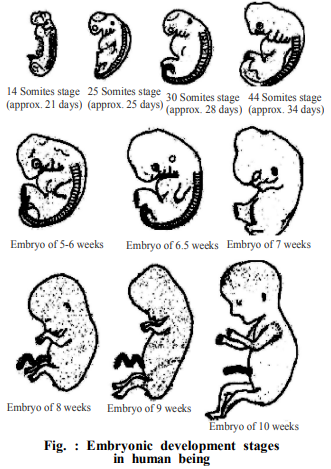
Image
A – 14 somite stage (about 21 days)
B – 25 somite stage (about 25 days)
C – 30 somite stage (about 28 days)
D – 44 somite stage (about 34 days)
E – 5-6 week embryo
F – 6-5 week embryo stage
G – 7 week embryo stage
H – 8 week embryo stage
I – 9 week embryo stage
J – 10 week embryo stage
The above mentioned time period is approximate time period. Sometimes some babies take birth before their gestation time due to some unknown reasons. 

Need a full question paper?

Generate a complete, print-ready paper with questions like this in minutes — across 16+ boards, with answer keys.
Start Generating Free

Similar questions

Answer the following questions:
Explain the role of pituitary and the ovarian hormones in menstrual cycle in human females.
Discuss the following:
Chipko Movement.
Explain the post pollination events up to double fertilisation, that occur in an angiosperm.
  1. Differentiate between: Autogamy, Geitonogamy and Xenogamy.
  2. Explain the events that occur during pollen-pistil interaction.
Answer the following question.
Draw a diagrammatic sectional view of human ovary showing different stages of oogenesis along with corpus luteum.
What is an ecosystem service? List any four important ecosystem services provided by the natural ecosystems. Are you in favour or against levying a charge on the service provided by the ecosystem?
During the course of evolution why DNA was chosen over RNA as genetic material? Give reasons by first discussing the desired criteria in a molecule that can act as genetic material and in the light of biochemical differences between DNA and RNA.
  1. Describe the characteristics a cloning vector must possess.
  2. Why DNA cannot pass through the cell membrane? Explain. How is a bacterial cell made ‘competent’ to take up recombinant DNA from the medium?
  1. Explain the role of regulatory gene, operator, promoter and structural genes in lac operon, when E.coli is growing in a culture medium with the source of energy as lactose.
  2. Mention what would happen, if lactose is withdrawn from the culture medium.
OR
Describe how the lac operon operates both in the presence and absence of an inducer in E.coli.
What is meant by R cells and S cells with which Frederick Griffith carried out this experiments on Streptococcus pneumoniae? What did he prove from these experiments?