Question
Describe detailed information on classification of carbohydrates.

Answer

Carbohydrates are classified on the basis of their behaviour on hydrolysis. They have been broadly divided into following 3 groups
(i) Monosaccharide compounds :
"A carbohydrate that can not be hydrolysed further to give simpler unit of polyhydroxy aldehyde or ketone is called a monosaccharide."
About 20 monosaccharides are known to occur in nature. Some common examples are glucose, fructose, ribose, etc.
(ii) Oligosaccharide compounds :
"Carbohydrates that yield two to ten monosaccharide units, on hydrolysis are called oligosaccharides."
They are further classified as disaccharides, trisaccharides, tetrasaccharides, etc., depending upon the number of monosaccharides they provide on hydrolysis.
Amongst these the most common are disaccharides. The two monosaccharide units obtained on hydrolysis of a disaccharide may be same or different.
For example, one molecule of sucrose on hydrolysis gives one molecule of glucose and one molecule of fructose where as maltose gives two molecules of only glucose.
(iii) Polysaccharide compounds:
"Carbohydrate which yield a large number of monosaccharide units on hydrolysis are called polysaccharides."
Some common examples are starch, cellulose, glycogen, gums etc. Polysaccharides are not sweet in taste. Hence, they are also called non- sugars.
Need a full question paper?

Generate a complete, print-ready paper with questions like this in minutes — across 16+ boards, with answer keys.

Start Generating Free

Similar questions

Read the passage given below and answer the following questions:
(A), (B) and (C) are three non-cyclic functional isomers of a carbonyl compound with molecular formula $C_4H_8O$. Isomers (A) and (C) give positive Tollen's test whereas isomer (B) does not give Tollen's test but gives positive iodoform test. Isomers (A) and (B) on reduction with $\frac{\text{Zn(Hg)}}{\text{conc.}}.$ HCl give the same product (D).
The following questions are multiple choice questions. Choose the most appropriate answer:
  1. Compound A is:
  1. $\text{CH}_3-\text{CH}-\text{CHO}\\\ \ \ \ \ \ \ \ \ \ \ \ \ |\\ \ \ \ \ \ \ \ \ \ \ \ \ \text{CH}_3$
  2. $\text{CH}_3\text{CH}_2\text{CH}_2\text{CHO}$
  3. $\ \ \ \ \ \ \ \ \ \ \ \ \text{O}\\\ \ \ \ \ \ \ \ \ \ \ \ \ ||\\\text{CH}_3-\text{C}-\text{CH}_2-\text{CH}_3$
  4. None of these.
  1. Compound (C) is:
  1. Iso-butyraldehyde
  2. Butyraldehyde
  3. Crotonaldehyde
  4. Acrolein
  1. Compound (B) can be obtained by:
  1. $\text{CH}_3-\text{C}\equiv\text{C}-\text{CH}_2-\text{CH}_3\xrightarrow[333\text{K}]{\text{dil.H}_2\text{SO}_4+\text{HgSO}_4}$
  2. $(\text{CH}_3\text{CH}_2\text{COO})_2\text{Ca}\xrightarrow{\text{Dry distill}}$
  3. $\text{CH}_3-\text{C}\equiv\text{C}-\text{CH}_3\xrightarrow[\frac{\text{H}_2\text{O}_2}{\text{NaOH}}]{\frac{\text{B}_2\text{H}_6}{\text{THF}}}$
  4. $\text{CH}_3-\text{CH}=\text{CH}-\text{CH}_3\xrightarrow[\frac{\text{ZN}}{\text{H}_2\text{O}}]{\text{O}_3}$
  1. Out of (A), (B) and ( C) isomers, which one is least reactive towards addition of HCN?
  1. A
  2. B
  3. C
  4. All are equally reactive.
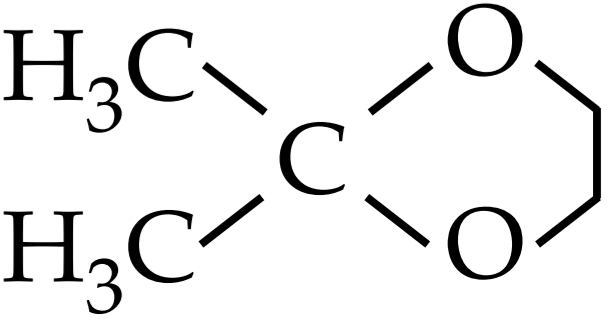
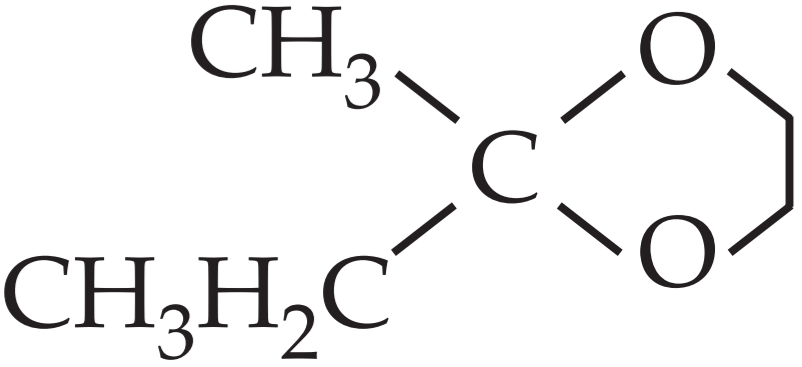
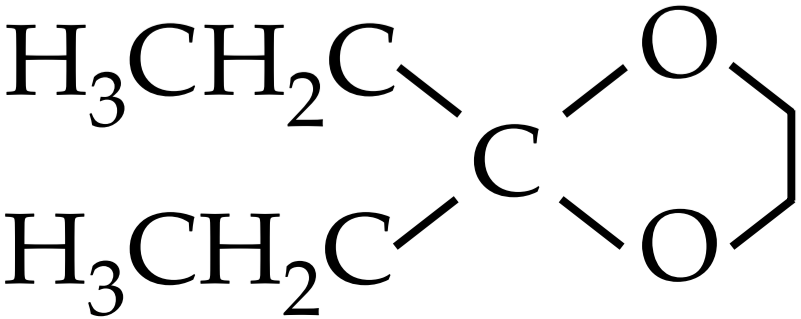
  1. What will be the product when (B) reacts with ethylene glycol in presence of HCl gas?
  1.  
  1.  
  1.  
  1. None of these.
Read the passage given below and answer the following questions: Lucas test is a test to differentiate between primary, secondary and tertiary alcohols. This test consists of treating an alcohol with Lucas' reagent, and turbidity, due to the formation of insoluble alkyl chloride, is observed. Lucas test is based on the difference in reacting of three classes of alcohols with hydrogen chloride via $S_N1$ reaction. The different reactivity reflects the differing ease of formation of the corresponding carbocations. In these questions $(Q.$ No. $i-iv),$ a statement of assertion followed by a statement ofreason is given. Choose the correct answer out of the following choices.
  1. Assertion and reason both are correct statements and reason is correct explanation for assertion.
  2. Assertion and reason both are correct statements but reason is not correct explanation for assertion.
  3. Assertion is correct statement but reason is wrong statement.
  4. Assertion is wrong statement but reason is correct statement.
  1. Assertion: Equimolar mixture of cone. $HCI$ and anhydrous $ZnCl_2$ is called Lucas' reagent.
Reason: Lucas' reagent can be used to distinguish between methanol and ethanol.
  1. Assertion: $2-$Methyl$-2-$butanol gives no turbidity with Lucas' reagent at room temperature.
Reason: It is a $3^\circ$ alcohol.
  1. Assertion: Tertiary alcohols react fastest with Lucas' reagent by $S_N1$ mechanism.
Reason: $3^\circ$ carbocation is most stable.
  1. Assertion: Amongst the compounds, $H2C = CHCH_2OH (I), C_6H_5OH (II), CH_3CH_2CH_2OH (III)$ and $(CH_3)_3COH (IV),$ only $(IV)$ reacts with Lucas' reagent at room temperature.
Reason: Tertiary alcohol gives turbidity immediately with Lucas' reagent.
  1. Assertion: Lucas test can be used to distinguish between $1-$propanol and $2-$propanol.
Reason: Lucas test is based upon the difference in reactivity of primary, secondary and tertiary alcohols with cone. HCI and anhyd. $ZnCl_2.$
Read the passage given below and answer the following questions:
Chlorine is a greenish yellow gas with pungent and suffocating odour. With dry slaked lime, it gives bleaching powder. Bleaching powder is a mixture of calcium hypochlorite and basic calcium chloride:
$[Ca(OCl)_2· CaCl_2· Ca(OH)_2· 2H_2O].$
The amount of chlorine obtained from a sample of bleaching powder by the treatment with excess of dilute acids or $CO_2$ is called available chlorine. Chlorine is a powerful bleaching agent. Bleaching effect of chlorine is permanent.
The following questions are multiple choice questions. Choose the most appropriate answer:
  1. Chlorine gas reacts with _____ to form bleaching powder.
  1. $Ca(OH)_2$
  2. $CaCl_2$
  3. $CaSO_4$
  4. dry $CaO$
  1. Chlorine reacts with cold and dilute alkali to form:
  1. Chloride
  2. Hypochlorite
  3. Chlorate
  4. Both $(a)$ and $(b)$
  1. Which of the following is produced on the reaction of bleaching powder with a few drops of cone. $HCl?$
  1. Hypochlorous acid
  2. Oxygen
  3. Chlorine
  4. Calcium oxide
  1. Chlorine is used as a bleaching agent. The bleaching action is due to.
  1. Oxidation
  2. Chlorination
  3. Hydrogenation
  4. Reduction
  1. Bleaching powder contains a salt of an oxoacid as one of its components. The anhydride of that oxoacid is:
  1. $Cl_2O$
  2. $Cl_2O_7$
  3. $ClO_2$
  4. $Cl_2O_6$
Read the passage given below and answer the following questions:
In an ideal crystal, there must be regular repeating arrangement of the constituting particles and its entropy must be zero at absolute zero temperature. However, it is impossible to obtain an ideal crystal, and it suffers from certain defects called imperfections. In pure crystal, these defects arises either due to disorder or dislocation of the constituting particles from their normal positions or due to the movement of the particles even at absolute zero temperature. Such defects increase with rise in temperature. In addition to this, certain defects arise due to the presence of some impurities. Such defects not only modify the existing properties of the crystalline solids, but also impart certain new characteristics to them.
The following questions are multiple choice questions. Choose the most appropriate answer:
  1. $AgCl$ is crystallized from molten $AgCl$ containing a little $CdCl_2$ The solid obtained will have.
  1. Cationic vacancies equal to number of $Cd^{2+}$ ions incorporated.
  2. Cationic vacancies equal to double the number of $Cd^{2+}$ ions.
  3. Anionic vacancies.
  4. Neither cationic nor anionic vacancies.
  1. Lattice defect per $10^{15}$ $NaCl$ is $1$. What is the number of lattice defects in a mole of $NaCl?$
  1. $6.02 \times 10^{23}$
  2. $6.02 x 10^8$
  3. $10^{14}$
  4. None of these
  1. The ionic substances in which the cation and anion are of almost similar size shows.
  1. Non-stoichiometric defect
  2. Schottky defect
  3. Frenkel defect
  4. All of these.
  1. If $Al^{3+}$ ions replace $Na^+$ ions at the edge centres of $NaCl$ lattice, then the number of vacancies in $1$ mole of $NaCl$ will be.
  1. $3.01 \times 10^{23}$
  2. $6.02 \times 10^{23}$
  3. $9.03 \times 10^{23}$
  4. $12.04 \times 10^{23}$
  1. Which of the following gives both Frenkel and Schottky defect?
  1. $AgCl$
  2. $CsCl$
  3. $KCl$
  4. $AgBr$

Read the passage given below and answer the following questions:
When a solution of an et-amino acid is placed in an electric field depending on the pH of the medium, following three cases may happen.
  1. In alkaline solution, CL-amino acids exist as anion II, and there is a net migration of amino acid towards the anode.
  2. In acidic solution, a-amino acids exist as cation III, and there is a net migration of amino acid towards the cathode.
  3. If II and III are exactly balanced there is no net migration; under such conditions any one molecule exists as a positive ion and as a negative ion for exactly the same amount of time, and any small movement in the direction of one electrode is subsequently cancelled by an equal movement back toward the other electrode. The pH of the solution in which a particular amino acid does not migrate under the influence of an electric field is called the is oelectric point of that amino acid.
The following questions are multiple choice questions. Choose the most appropriate answer:
  1.  

Arrange in order of increasing acid strengths.
  1. X > Z > Y
  2. Z < X < Y
  3. X > Y > Z
  4. Z > X > Y
  1. In aqueous solutions, amino acids mostly exist as:
  1. $NH_2 - CHR - COOH$
  2. $NH_2 - CHR - COO^-$
  3. $\stackrel{+}{\hbox{ N}}\text{H}_3\text{CHRCOOH}$
  4. $\text{H}_3\stackrel{{+}}{\hbox{N}}\text{CHRCOO}^-$
  1. Amino acids are least soluble:
  1. at pH 1
  2. at pH 7
  3. At their isoelectric points.
  4. None of these.
  1. The $\text{pK}_{\text{a}_1}$ and $\text{pK}_{\text{a}_2}$ of an amino acid are 2.3 and 9.7 respectively. The is oelectric point of the amino acid is:
  1. 12.0
  2. 7.4
  3. 6.0
  4. 3.7
  1. A tripeptide (X) on partial hydrolysis gave two dipeptides Cys-Gly and Glu-Cys. Identify the tripeptide.
  1. Glu-Cys-Gly
  2. Gly-Glu-Cys
  3. Cys-Gly-Glu
  4. Cys-Glu-Gly
Read the passage given below and answer the following questions:
Iron forms many complexes in its $+2$ and $+3$ oxidation states such as $[Fe(H_2O)_6]^{2+} (A); [Fe(CN)_6]^{4-} (B); [Fe(H_2O)_6]^{3+} (C); [Fe(CN)_6]^{3-} (D),$ etc., They exhibit, different magnetic properties and undergo different hybridisation of iron.
The following questions are multiple choice questions. Choose the most appropriate answer:
  1. Which of the following statements is correct?
  1. $(B)$ is paramagnetic while $(C)$ is diamagnetic.
  2. Both $(B)$ and $(D)$ are outer orbital complexe.
  3. Both $(A)$ and $(C)$ are paramagnetic.
  4. $(A)$ is outer orbital complex and $(C)$ is inner orbital complex.
  1. The complex having maximum magnetic moment is:
  1. $(A)$
  2. $(B)$
  3. $(C)$
  4. $(D)$
  1. Which of the following does not represent correct configuration of the d-orbitals in the given complexes?
  1. $\text{(A)}:\text{t}^4_{2\text{g}}\text{e}^2_\text{g}$
  2. $\text{(B)}:\text{t}^6_{2\text{g}}\text{e}^0_\text{g}$
  3. $\text{(C)}:\text{t}^4_{2\text{g}}\text{e}^1_\text{g}$
  4. $\text{(D)}:\text{t}^5_{2\text{g}}\text{e}^0_\text{g}$
  1. The spin only magnetic moment of complexes $(A), (B), (C)$ and $(D)$ are respectively $($in $BM).$
  1. $2\sqrt{6},0,\sqrt{35},\sqrt{3}$
  2. $0,2\sqrt{6},\sqrt{35},\sqrt{3}$
  3. $\sqrt{15,}2\sqrt{6},\sqrt{3},0$
  4. $\sqrt{3},\sqrt{8},0,\sqrt{15}$
  1. Which of the given complexes are outer orbital complexes?
  1. $(A)$ and $(B)$ only
  2. $(B)$ and $(C)$ only
  3. $(A)$ and $(C)$ only
  4. $(B)$ and $(D)$ only
Read the passage given below and answer the following questions:
All the elements of group $16$ form hydrides: $H_2O, H_2S, H_2Se, H_2Te$ and $H_2Po.$ All these hydrides have angular structure which involves $sp^3$ hybridisation of the central atom. All hydrides are volatile. The volatility increases from $H_2O$ to $H_2S$ and then decreases. All hydrides are weakly acidic in character. The increase in acidic character from $H_2O$ to $H_2Te$ is a resultof thedecrease in the $1 H-E ($where$ E = O, S, Se, Te, Po)$ bond dissociation enthalpy from $H_2O$ to $H_2Te.$ All the hydrides except water are reducing agents. The reducing property of these hydrides increases from $H_2S$ to $H_2Te.$
In these questions $(Q.No. i - iv),$ a statement of assertion followed by a statement of reason is given. Choose the correct answer out of the following choices.
  1. Assertion and reason both are correct statements and reason is correct explanation for assertion.
  2. Assertion and reason both are correct statements but reason is not correct explanation for assertion.
  3. Assertion is correct statement but reason is wrong statement.
  4. Assertion is wrong statement but reason is correct statement.
  1. Assertion: Water has high boiling point.
Reason: Water molecules are associated with hydrogen bonding.
  1. Assertion: $H_2Te$ has less acidic character than $H_2S.$
Reason: Bond dissociation enthalpy of $H-Te$ is less than $H-S.$
  1. Assertion: Reducing nature of hydrides of group-16 elements increases as the atomic number of central atom increases.
Reason: Due to strong force of attraction of $H-E$ bond.
  1. Assertion: $H_2O$ is the only hydrides of the chakogens which is liquid.
Reason: In ice each $O-$atom is surrounded by $4H-$atoms.
  1. Assertion: The thermal stability of the hydrides decreases as: $H_2O > H_2S > H_2Se > H_2Te.$
Reason: Due to increase in the size of central atom on going down the group.
Read the passage given below and answer the following questions:
Dehydration of alcohols can lead to the formation of either alkenes or ethers. This dehydration can be carried out either with protonic acids such as cone.$H_2SO_4, H_3PO_4$ or catalysts such as anhydrous $ZnCl_2$ or $Al_2O_3$. When primary alcohols are heated with cone. $H_2SO_4$ at $433-44 K$, they undergo intramolecular dehydration to form alkenes. Secondary and tertiary alcohols undergo dehydration under milder conditions. The ease of dehydration of alcohols follows the order: $3^\circ > 2^\circ > 1^\circ$.
The dehydration of alcohols always occurs in accordance with the Saytzeff's rule. Primary alcohols when heated with protic acid at 413K, gives dialkyl ether.
$\text{CH}_3\text{CH}_2\text{OH}\xrightarrow[433.433\text{K}]{\text{conc. H}_2\text{SO}_4}\text{CH}_2=\text{CH}_2+\text{H}_2\text{O}$
$2\text{CH}_3\text{CH}_2\text{OH}\xrightarrow[433\text{K}]{\text{conc. H}_2\text{SO}_4}\text{CH}_3\text{CH}_2-\text{O}-\text{CH}_2\text{CH}_3+\text{H}_2\text{O}$
The following questions are multiple choice questions. Choose the most appropriate answer:
  1. Which one of the following alcohols undergoes acid-catalysed dehydration to alkenes most readily?
  1. $(CH_3)_2CHCH_2OH$
  2. $(CH3)_3COH$
  3. $CH_3CHOHCH_3$
  4. $CH_3CH_2CH_2OH$
  1. Dehydration of alcohol is an example of which type of reaction?
  1. Substitution.
  2. Elimination.
  3. Addition.
  4. Rearrangment.
  1. The alcohol which does not give a stable compound on dehydration is:
  1. Ethyl alcohol.
  2. Methyl alcohol.
  3. N-propyl alcohol.
  4. N-butyl alcohol.
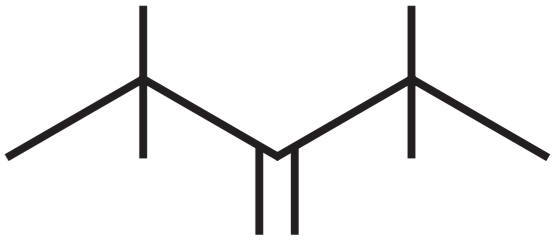
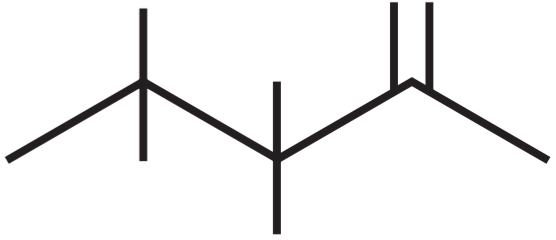
  1. The most stable product (s) is/ are:

  1.  
  1.  
  1. Both (a) and (b)
  2. None of these.
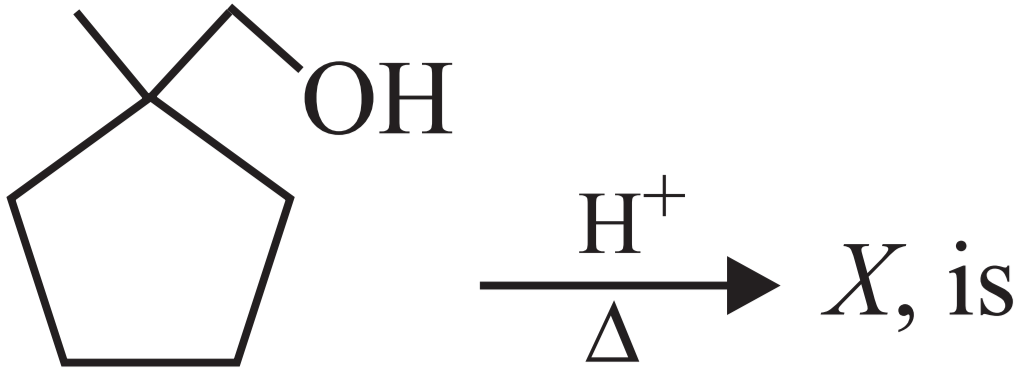
  1. The product of the reaction
Read the passage given below and answer the following questions:
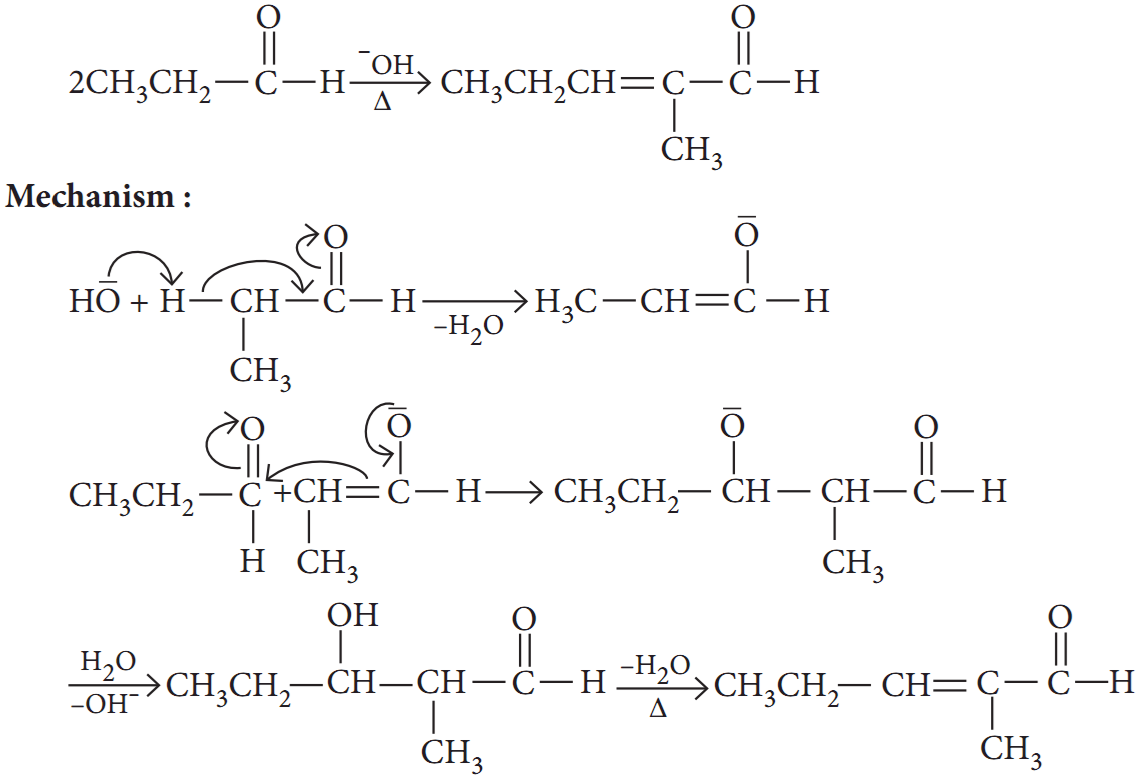
The addition reaction of enol or enolate to the carbonyl functional group of aldehyde or ketone is known as aldol addition. The $\beta-$ hydroxyaldehyde or $\beta-$hydroxyketone so obtained undergo dehydration in second step to produce a conjugated enone. The first part of reaction is an addition reaction and the second part is an elimination reaction. Carbonyl compound having $\propto-$hydrogen undergoes aldol condensation reaction.

The following questions are multiple choice questions. Choose the most appropriate answer:
  1. Condensation reaction is the reverse of which of the following reaction?
  1. Lock and key hypothesis.
  2. Oxidation.
  3. Hydrolysis.
  4. Glycogen formation.
  1. Which of the following compounds would be the main product of an aldol condensation of acetaldehyde and acetone?
  1. $CH_3CH = CHCHO$
  2. $CH_3CH = CHCOCH_3$
  3. $(CH_3)_2C = CHCHO$
  4. $(CH_3)_2C = CHCOCH_3$
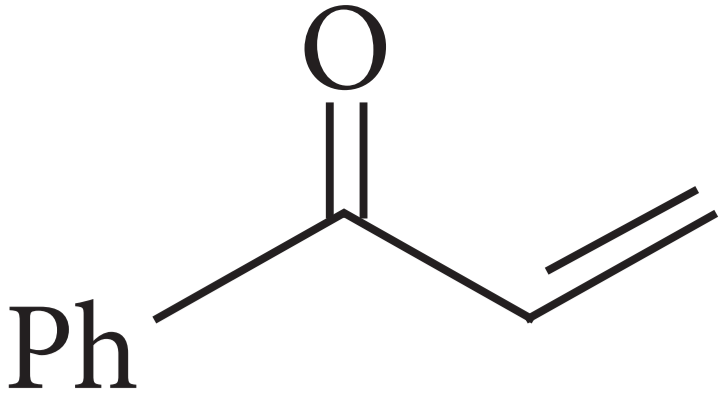
  1. Which combination of carbonyl compounds gives phenyl vinyl ketone by an aldol condensation?
  1. Acetophenone and Formaldehyde.
  2. Acetophenone and acetaldehyde.
  3. Benzaldehyde and acetaldehyde.
  4. Benzaldehyde and acetone.
  1. Which of the following will undergo aldol condensation?
  1. $HCHO$
  2. $CH_3CH_2OH$
  3. $C_6H_5CHO$
  4. $CH_3CH_2CHO$
  1. Which of the following does not undergo aldol condensation?
  1. $CH_3CHO$
  2. $CH_3CH_2CHO$
  3. $CH_3COCH_3$
  4. $C_3H_2CHO$
Read the passage given below and answer the following questions: An organic compound (A) having molecular formula $C_6H_6O$ gives a characteristic colour with aqueous $FeCl_3$ solution. (A) on treatment with $CO_2$ and $NaOH$ at $400K$ under pressure gives (B), which on acidification gives a compound (C). The compound (C) reacts with acetyl chloride to give (D) which is a popular pain killer. The following questions are multiple choice questions. Choose the most appropriate answer:
  1. Compound (A) is:
  1. 2-Hexanol.
  2. Dimethyl ether.
  3. Phenol.
  4. 2-Methyl pentanol.
  1. Compound (C) is:
  1. Salicylic acid.
  2. Salicyladehyde.
  3. Benzoic acid.
  4. Benzaldehyde.
  1. Number of carbon atoms in compound (D) is:
  1. 7
  2. 6
  3. 8
  4. 9
  1. The conversion of compound (A) to (C) is known as:
  1. Reimer-Tiemann reaction.
  2. Kolbe's reaction.
  3. Schimdt reaction.
  4. Swarts reaction.
  1. Compound (A) on heating with compound (C) in presence of $POCl_3$​​​​​​​ gives a compound (D) which is used:
  1. In perfumery as a ftavouring agent
  2. As an antipyretic
  3. As an analgesic
  4. As an intestinal antiseptic.